
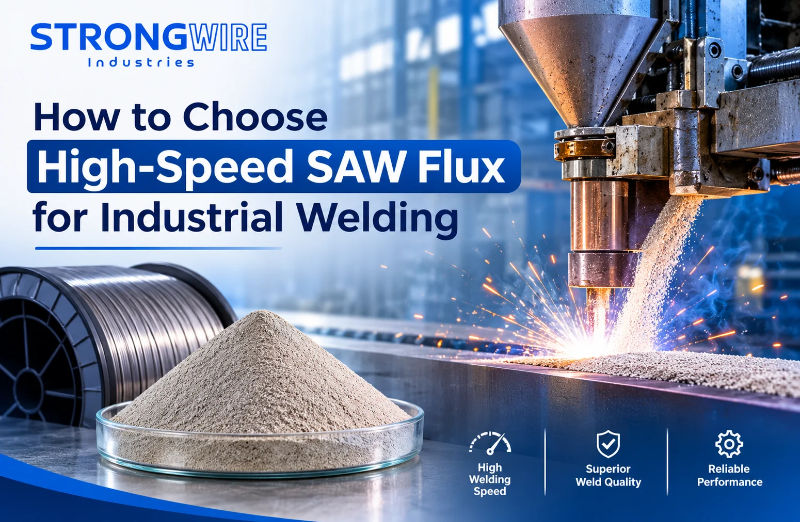
In high-volume steel fabrication, welding productivity depends on more than the speed of the welding machine. The flux, electrode wire, joint design and operating parameters must work together to produce welds that meet quality requirements at the required production rate.
Submerged arc welding (SAW) is widely used for suitable industrial applications because it supports mechanised or automated welding and can deposit substantial quantities of weld metal. When production lines require faster welding, selecting the right high-speed SAW flux becomes an important part of process optimisation.
High-speed SAW flux is selected to support suitable welding conditions at higher travel speeds while maintaining acceptable bead formation, slag removal and weld-metal properties. The correct product depends on the wire, base material, joint configuration, welding parameters and applicable quality requirements.
For fabricators, OEMs, production engineers and procurement teams, this guide explains how to evaluate saw flux, what to verify during trials and how to assess a SAW flux supplier in India.
What Is SAW Flux and Why Does Selection Matter?
SAW flux is a granular consumable used in the submerged arc welding process. During welding, the arc operates beneath a layer of flux, which helps shield the molten weld pool from the atmosphere. The flux also participates in slag formation and can influence weld-metal chemistry and the resulting mechanical properties.
Depending on its formulation, a flux may affect arc behaviour, bead shape, penetration, slag detachability and the ability to achieve required weld-metal properties. These characteristics make flux selection important in industrial fabrication.
A flux suitable for a conventional multi-pass weld may not be the best choice for a production line designed around faster travel speeds and fewer passes.
For example, a pre-engineered building (PEB) manufacturer may prioritise stable welding at production speeds, consistent fillet welds and efficient slag removal. A pressure-vessel fabricator may place greater emphasis on specified impact toughness, weld-metal chemistry and code compliance.
The best choice is therefore the flux that meets the actual production and quality requirements, not simply the product labelled as high-speed.
How Does High-Speed SAW Flux Support Productivity?
Higher welding speed can improve production efficiency when the rest of the welding process is capable of maintaining acceptable results.
The potential benefits of a suitable high-speed saw welding flux include the following.
1. Support for higher travel speeds
A flux formulated for high-speed applications may help maintain a usable weld profile and stable operating conditions within its recommended parameter range.
This can be valuable on repetitive production lines where long welds and consistent joint geometries are common.
However, increasing travel speed without validating current, voltage, wire-feed conditions and joint design can cause incomplete fusion, undercut or an unsuitable bead profile.
2. Consistent weld bead formation
Bead width, reinforcement, toe blending and penetration influence weld quality and downstream finishing.
A suitable flux-wire combination can help produce a consistent bead when used with an appropriate welding procedure. Actual results depend on the joint geometry, material thickness, polarity, electrical parameters and travel speed.
3. Efficient slag removal
After the weld cools sufficiently, the solidified slag must be removed where required for inspection or subsequent welding passes.
Good slag detachability can reduce cleaning effort and improve production flow. However, slag removal depends on the flux formulation, bead geometry, welding conditions and joint configuration.
4. Potential reduction in production bottlenecks
If welding is a bottleneck, a validated increase in travel speed may improve throughput. The actual gain depends on how much of the production cycle is spent welding rather than positioning, handling, inspection or rework.
Manufacturers should measure total cycle time and acceptable weld output rather than relying on nominal travel speed alone.
What Is the Difference Between High-Speed, Active and Neutral SAW Flux?
Flux terminology can be confusing because high-speed performance, chemical activity and basicity describe different characteristics.
| Characteristic | What it means | Why it matters |
| High-speed suitability | Performance under an appropriate higher-travel-speed welding procedure | Helps assess production-line requirements |
| Active flux | Flux that can contribute alloying elements, such as manganese or silicon, to the weld metal | Can be useful in selected single- or two-pass applications but requires parameter control |
| Neutral flux | Flux designed to limit changes in weld-metal composition under specified conditions | Can be useful for applications requiring controlled weld chemistry, including some multi-pass work |
| Flux basicity | A calculated indicator of the chemical balance of flux constituents | Can help inform weld-metal oxygen levels and toughness considerations |
| Slag behaviour | How the flux forms and releases slag | Affects cleaning, interpass work and production flow |
Active fluxes can support fast single- or two-pass welding in suitable applications, while neutral fluxes may be preferable for certain multi-pass procedures. Higher-basicity fluxes can be advantageous when weld-metal toughness is critical, although flux selection must balance several properties. These are general guidelines, not universal rules
A high-speed designation should not be assumed to mean that a flux is active, neutral or high-basicity. Request the manufacturer’s technical data sheet to establish the product’s actual characteristics.
Six Factors to Check Before Selecting High-Speed SAW Flux
1. Base material and required weld-metal properties
Start with the steel grade, material thickness, joint design and applicable welding specification.
The flux and electrode combination must produce weld metal that meets the required strength, ductility and, where specified, impact toughness. Requirements may vary between mild steel, higher-strength structural steel, creep-resistant steel and cryogenic applications.
Do not select a flux solely because it works well on another steel grade.
2. Compatibility with the SAW wire
SAW flux and electrode wire form a consumable system. The flux may influence weld-metal chemistry through reactions during welding, while the wire contributes its own alloying elements.
Confirm the recommended wire classifications and the relevant flux-wire combination. For critical work, verify the classification and mechanical properties of the deposited weld metal under the applicable test conditions.
A wire and flux that are individually suitable are not automatically qualified together for every application.
3. Welding speed and deposition requirements
Determine the production target before choosing a product. Consider the required travel speed, weld size, deposition rate, number of passes and allowable heat input.
High travel speed is useful only when it produces an acceptable weld. Excessive speed or an unsuitable parameter combination can increase the risk of undercut, poor fusion or insufficient weld size.
Conduct controlled trials to establish the usable operating window.
4. Slag detachability and bead profile
Inspect slag removal, weld reinforcement, toe blending and the amount of post-weld cleaning required.
For repetitive fabrication, these characteristics can influence how quickly components move to inspection or the next manufacturing stage.
A flux that supports faster welding but creates frequent cleaning or rework may not deliver a net productivity improvement.
5. Electrical conditions and equipment
Review the welding machine’s output capacity, current and voltage ranges, polarity, electrode configuration and joint accessibility.
The selected flux must perform acceptably with the intended equipment and approved procedure. Confirm whether the manufacturer’s recommendations apply to the planned operating mode.
Avoid copying parameter values from another flux or wire combination without technical validation.
6. Quality requirements and applicable standards
Check whether the application requires a particular AWS classification, mechanical testing, chemical analysis, impact testing, procedure qualification or inspection documentation.
For carbon-steel SAW consumables, AWS A5.17/A5.17M addresses classification requirements for carbon-steel electrodes and fluxes. AWS A5.23/A5.23M covers relevant low-alloy and high-manganese steel electrodes and fluxes. The appropriate standard depends on the consumable and application.
Always verify the applicable edition and project specification before approving the product.
High-Speed SAW Flux for Pre-Engineered Building Manufacturing
Pre-engineered buildings are a particularly relevant application to consider when evaluating high-speed SAW flux.
PEB manufacturing commonly involves repetitive steel components and production processes in which consistent welding output matters. Depending on the component and joint design, manufacturers may need to balance travel speed, weld size, bead appearance, slag removal and inspection requirements.
STRONGWIRE’s company history states that it formulated 12HS SAW FLUX, described as a high-speed SAW welding flux specifically designed for the PEB industry.
This provides a relevant starting point for PEB manufacturers evaluating flux options. Before specifying 12HS or another high-speed flux, request current product documentation and confirm:
- Recommended electrode-wire combinations.
- Applicable steel grades and joint configurations.
- Recommended current, voltage, polarity and travel-speed ranges.
- Weld-metal properties and relevant test results.
- Slag-removal and bead-profile characteristics under representative conditions.
- Any limitations relating to multi-pass welding or project-specific requirements.
Do not assume a particular productivity percentage or performance improvement without verified trial data.
How to Evaluate a SAW Flux Manufacturer or Supplier in India
For industrial procurement, a suitable SAW flux supplier should be able to provide clear product identification, technical guidance and documentation appropriate to the application.
Use this checklist when comparing suppliers.
| Procurement criterion | What to request or verify |
| Product identification | Exact product name and intended application |
| Technical data | Current technical data sheet and recommended operating conditions |
| Wire compatibility | Recommended wire grades and qualified combinations where applicable |
| Weld quality | Relevant deposited weld-metal test data and classification |
| Production suitability | Trial results for the intended joint and travel-speed range |
| Quality documentation | Batch identification, certificates and inspection records required by the project |
| Supply requirements | Packaging, order quantity, lead time and repeat-order availability |
| Technical support | Guidance on process trials, parameter selection and troubleshooting |
When comparing quotations, ensure that the products are being evaluated against the same technical and quality requirements. Price per kilogram alone does not capture flux consumption, wire consumption, cleaning effort, rework or production time.
How to Validate a High-Speed SAW Flux Before Full Production
Before approving a new flux for regular use, conduct a controlled welding trial.
Step 1: Define acceptance criteria. Establish required weld dimensions, visual quality, mechanical properties and inspection requirements before starting the trial.
Step 2: Use representative materials and joints. The test setup should reflect the production steel grade, thickness, joint preparation and welding position.
Step 3: Follow supplier guidance. Establish trial parameters within the recommended operating range for the specific wire and flux combination.
Step 4: Inspect the completed weld. Evaluate bead profile, slag removal and relevant visual or non-destructive examination results. Conduct mechanical tests where required by the procedure or specification.
Step 5: Compare total production performance. Record travel speed, consumable consumption, cleaning time, rework and acceptable weld output.
Step 6: Approve the procedure before rollout. Ensure any required procedure qualification and engineering approval are completed before using the combination on production-critical work.
This approach helps establish whether a high-speed flux provides a measurable benefit without compromising weld quality.
Choosing the Right SAW Flux with STRONGWIRE
STRONGWIRE lists SAW flux categories for mild steel and 490 MPa high-tensile steel, creep-resistant steels, cryogenic applications, 690–900 MPa high-tensile steels and stainless steels. The company also identifies 12HS SAW FLUX as a high-speed product developed for the PEB industry. <Cite refs={[“turn757147search1″,”turn757147search0”]}/>
The appropriate product depends on the steel grade, wire combination, joint configuration, production target and acceptance criteria.
For a product recommendation, provide STRONGWIRE with the base-metal grade, electrode-wire designation, required welding speed, joint details and any applicable mechanical-property or inspection requirements.
Looking for high-speed SAW flux for your industrial welding process? Contact STRONGWIRE to discuss your application, confirm product suitability and request a quote.