
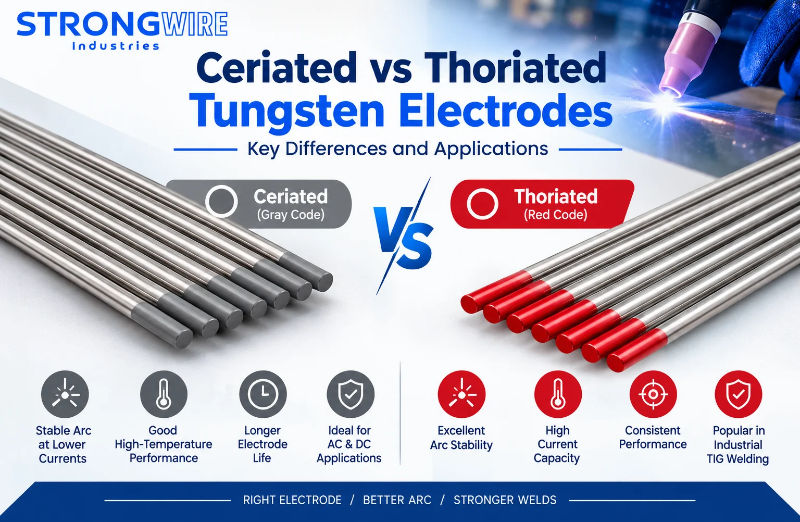
Tungsten electrode selection plays an important role in TIG welding because the electrode directly influences arc starting, stability, current capacity, electrode life, and weld control. Among the commonly used tungsten electrode types, ceriated and thoriated tungsten are frequently considered for industrial welding applications.
Understanding ceriated vs thoriated tungsten is particularly important for engineers, welders, fabrication companies, procurement teams, and industrial buyers selecting electrodes for carbon steel, stainless steel, nickel alloys, titanium, thin sheet, and precision TIG applications.
A 2% ceriated tungsten electrode is known for easy arc starting, particularly at lower current levels, while 2% thoriated tungsten has a long-established history in DC TIG welding because of its arc stability and current-carrying capability. However, thoriated tungsten contains radioactive thorium, which creates additional considerations during grinding and handling.
The right choice depends on the welding current, material, electrode diameter, power source, application requirements, welding procedure, and workplace safety requirements.
What Is Thoriated Tungsten?
Thoriated tungsten is a tungsten electrode alloyed with thorium oxide. A commonly used specification is 2% thoriated tungsten, classified as EWTh-2, which typically contains approximately 2% thorium oxide.
The addition of thorium changes the electron-emission characteristics of tungsten. This can make the arc easier to start and provide stable arc geometry and good current-carrying capability. Thoriated tungsten has therefore been widely used in DC TIG welding for applications requiring predictable arc performance.
STRONGWIRE’s published WT20 specification lists thorium oxide at 1.70–2.20% by mass, with red color coding. The company identifies its thoriated tungsten electrodes for applications including stainless steel, carbon steel, nickel alloys, titanium, aerospace components, pressure vessels, and industrial machinery.
What Is 2% Ceriated Tungsten?
2% ceriated tungsten is a tungsten electrode containing approximately 2% cerium oxide. It is classified as EWCe-2 and is commonly identified by a gray color code.
According to Lincoln Electric, EWCe-2 contains 1.80–2.20% cerium and is particularly effective for low-current welding because of its excellent arc-starting characteristics. It is commonly used for applications such as orbital tube welding and thin sheet-metal work.
Ceriated tungsten is also a non-radioactive electrode option, making it relevant where fabrication operations prefer alternatives to thorium-containing electrodes.
Ceriated vs Thoriated Tungsten: Key Differences
The main difference between ceriated vs thoriated tungsten is the oxide added to the tungsten and the resulting application characteristics.
Ceriated Tungsten
Ceriated tungsten is particularly useful where precise arc starting and lower-current operation are important.
Key characteristics include:
- Excellent arc starting at low amperage
- Good arc stability
- Suitable for low-current TIG applications
- Useful for thin materials
- Suitable for precision welding
- Non-radioactive alloying additive
- Commonly used for carbon steel, stainless steel, nickel alloys, and titanium
Lincoln Electric identifies 2% ceriated tungsten as particularly suitable for low-current DC welding, including orbital tube welding and thin sheet-metal applications.
Thoriated Tungsten
A thoriated tungsten electrode is particularly established in DC TIG welding.
Key characteristics include:
- Good arc starting
- Stable arc performance
- High current-carrying capability
- Good resistance to electrode wear
- Long history of industrial use
- Suitable for demanding DC welding applications
STRONGWIRE specifies its thoriated tungsten electrodes for applications including stainless steel, carbon steel, nickel alloys, titanium, aerospace components, pressure vessels, petrochemical equipment, and industrial machinery.
How Do Ceriated and Thoriated Tungsten Electrodes Improve TIG Performance?
TIG welding uses a non-consumable tungsten electrode to establish an arc between the electrode and workpiece. The arc generates the heat required to melt the base material, while shielding gas protects the weld area from atmospheric contamination.
The electrode composition affects how the tungsten performs under the selected welding conditions.
Arc Starting
Arc starting is one of the most noticeable differences between electrode types.
2% ceriated tungsten is particularly well suited to low-current applications where reliable arc initiation is important. Its electron-emission characteristics make it useful for precision welding and thin materials.
Thoriated tungsten also offers reliable arc starting and is widely recognized for predictable TIG arc behavior.
Arc Stability
A stable arc helps the welder maintain consistent heat input and control.
Thoriated tungsten has a long-established reputation for stable DC arc performance. Ceriated tungsten can also provide good arc stability, particularly in applications within its suitable current range.
Electrode Life
Electrode life depends on several factors, including current, polarity, electrode diameter, tip geometry, cooling, contamination, and welding technique.
Ceriated and thoriated electrodes should therefore be operated within the manufacturer’s recommended parameters rather than assuming that electrode composition alone determines service life.
Welding Precision
For thin sheet, tubing, small components, and other precision applications, controlling arc initiation and heat input can be particularly important.
Ceriated tungsten’s low-current characteristics make it useful for these applications, while thoriated tungsten remains established in applications where stable DC performance and existing welding procedures are important.
Applications Across Industries
Thin Sheet Metal Welding
Thin sheet can be sensitive to excessive heat input. Ceriated tungsten is often considered for lower-current applications because of its strong arc-starting characteristics at low amperages.
Applications may include:
- Thin stainless steel components
- Precision fabrication
- Small assemblies
- Sheet-metal components
- Laboratory and process equipment
Orbital Tube Welding
Orbital TIG welding requires controlled and repeatable arc characteristics. Ceriated tungsten is used in low-current orbital tube welding applications, while thoriated tungsten may remain specified in established procedures.
Stainless Steel Welding
Both ceriated and thoriated tungsten can be used for stainless steel TIG welding, depending on the welding procedure and operating conditions.
ESAB identifies ceriated tungsten as useful for thin materials and identifies thoriated tungsten as a long-established choice for steel and stainless steel welding.
Carbon Steel and Nickel Alloys
Ceriated tungsten is used for carbon steel and nickel alloys, particularly in suitable lower-current applications. Thoriated tungsten is also widely used for these materials in DC TIG welding.
Aerospace and High-Specification Welding
Thoriated tungsten continues to appear in certain high-specification applications because historical welding procedures may have been developed and qualified around it.
ESAB notes that some aerospace and nuclear welding procedures continue to specify thoriated tungsten, meaning substitution should not be made without considering the applicable qualified welding procedure.
How to Choose Between Ceriated and Thoriated Tungsten
There is no single electrode that is appropriate for every TIG application. Selection should begin with the actual welding requirements.
Consider Welding Current
For lower-current precision work, 2% ceriated tungsten can be a suitable option because of its arc-starting characteristics.
For established DC TIG applications requiring higher current capability and stable arc behavior, thoriated tungsten may be specified.
Consider the Base Material
Identify whether the job involves:
- Carbon steel
- Stainless steel
- Nickel alloys
- Titanium
- Aluminum
- Other specialized alloys
The material alone should not determine electrode selection; the welding current, polarity, thickness, machine, and qualified procedure must also be considered.
Consider Electrode Diameter
Electrode diameter should correspond to the welding current and application. An electrode that is too small for the operating conditions can overheat, while an unnecessarily large electrode may make low-current arc control more difficult.
Consider Safety Requirements
Safety is an important distinction between the two electrode types.
Thoriated tungsten contains radioactive thorium. The main occupational concern is associated with grinding and the possibility of inhaling or ingesting thorium-containing dust. Appropriate grinding controls, ventilation, housekeeping, and workplace procedures should therefore be followed.
Ceriated tungsten does not contain thorium and can therefore be considered where a non-radioactive electrode composition is preferred.
Consider Existing Welding Procedures
For qualified industrial welding, procurement teams should not replace a specified tungsten electrode solely because another type appears technically similar.
The applicable WPS, customer specification, welding code, equipment manufacturer’s recommendations, and qualification requirements should be reviewed before changing electrode type.
Common Mistakes to Avoid
Choosing Only by Color
Color bands are useful for identification, but buyers should verify the electrode classification and product specification.
For example, EWCe-2 is commonly gray and EWTh-2 is commonly red.
Using Ceriated Tungsten Outside Its Suitable Range
Ceriated tungsten is particularly associated with low-current applications. For higher-current applications, another electrode type may be more appropriate depending on the welding procedure.
Ignoring Thorium Handling Requirements
If thoriated tungsten is used, grinding practices should account for the radioactive nature of thorium-containing dust.
Selecting Electrodes Without Checking the Machine
AC and DC TIG equipment can have different electrode requirements. Modern inverter machines also provide different arc-control capabilities than older transformer-based equipment.
Changing a Qualified Procedure Without Review
A different tungsten composition can affect the welding process. Any substitution in a qualified industrial procedure should be evaluated according to the applicable requirements.
Why Industries Use Ceriated and Thoriated Tungsten
Both electrode types continue to have a place in TIG welding because their characteristics suit different operating conditions.
Ceriated tungsten is particularly relevant for:
- Low-current TIG welding
- Thin sheet
- Small components
- Precision applications
- Orbital tube welding
- Applications where a non-radioactive electrode is preferred
Thoriated tungsten remains relevant for:
- DC TIG welding
- High-current applications
- Stainless steel
- Carbon steel
- Nickel alloys
- Titanium
- Existing qualified welding procedures
- Applications requiring established thoriated electrode characteristics
The appropriate selection should be based on the welding procedure rather than simply choosing one composition as universally superior.
Why Choose STRONGWIRE?
STRONGWIRE manufactures and supplies a range of welding consumables and tungsten electrodes for industrial applications. The company’s published product range includes thoriated, ceriated, lanthanated, zirconiated, and multi-compound rare-earth tungsten electrodes.
STRONGWIRE operates a vertically integrated manufacturing facility in Bhilad, Gujarat, covering approximately 80,000 square feet, with production infrastructure for welding consumables serving domestic and international markets.
For industrial buyers, relevant considerations include:
- Industry expertise: Experience across welding consumables and related products.
- Product quality: Controlled manufacturing and product specifications.
- Manufacturing capabilities: Integrated production infrastructure.
- Technical support: Product guidance for different welding requirements.
- Reliable supply: Domestic and international supply capabilities.
- Consistent performance: Focus on controlled product manufacturing.
- Customer-focused approach: Product solutions for industrial and fabrication requirements.
When comparing a ceriated tungsten electrode with a thoriated tungsten electrode, procurement teams can evaluate electrode composition, size, current range, application requirements, and supply specifications with STRONGWIRE.
Conclusion
Understanding ceriated vs thoriated tungsten helps welding professionals select an electrode according to the actual requirements of the TIG process.
2% ceriated tungsten is particularly useful for low-current welding because of its excellent arc-starting characteristics and suitability for precision applications. 2% thoriated tungsten has a long-established role in DC TIG welding because of its stable arc characteristics and current-carrying capability.
The presence of radioactive thorium is an important consideration when selecting a thoriated tungsten electrode, particularly during grinding and electrode preparation. Ceriated tungsten provides a non-radioactive alternative for suitable applications.
Before selecting between the two, evaluate welding current, polarity, material, electrode diameter, machine type, tip preparation, applicable welding procedure, safety requirements, and expected operating conditions.
For industrial procurement, selecting the correct tungsten electrode types should be based on documented technical requirements rather than electrode composition alone.