
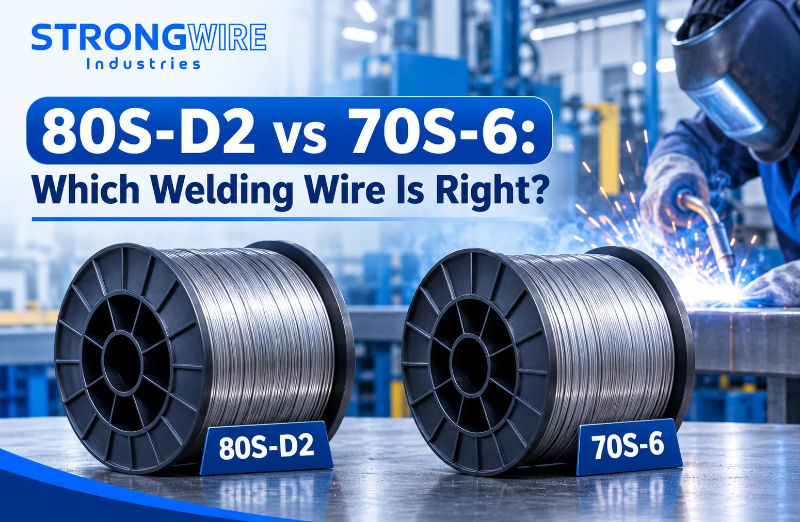
Choosing between 80S-D2 and 70S-6 welding wire depends on the steel being welded, the required weld-metal properties and the approved welding procedure. Although both are solid wires used in gas-shielded arc welding, they belong to different classification families and are not automatic substitutes.
ER70S-6 is commonly selected for compatible carbon-steel fabrication, while ER80S-D2 is considered when a suitable low-alloy wire with a higher weld-metal strength classification is required. The correct choice must be confirmed against the base-metal specification, project requirements and applicable welding procedure—not strength designation alone.
For fabricators, OEMs, welding engineers and procurement teams, understanding the differences helps prevent unsuitable consumable substitutions and supports more reliable purchasing decisions.
80S-D2 vs 70S-6: What Is the Main Difference?
The primary difference is the type of weld-metal classification and the applications for which each wire is designed.
| Comparison factor | ER80S-D2 | ER70S-6 |
| Classification family | Low-alloy steel solid wire | Carbon-steel solid wire |
| Relevant AWS specification | AWS A5.28/A5.28M | AWS A5.18/A5.18M |
| Strength designation | 80-class | 70-class |
| Typical selection context | Compatible low-alloy or higher-strength applications requiring the specified weld-metal properties | General carbon-steel and mild-steel fabrication |
| Alloying approach | Controlled low-alloy chemistry, including molybdenum in the D2 classification | Carbon-steel chemistry with manganese and silicon deoxidizers |
| Common process context | Gas-shielded arc welding, subject to product requirements | Gas metal arc welding (GMAW/MIG-MAG) |
| Key selection priority | Base-metal compatibility, alloy system and required weld properties | Base-metal compatibility, general fabrication needs and required weld properties |
The table provides a general comparison, not a substitute for a specific manufacturer’s technical data sheet. Exact composition limits, test requirements, operating parameters and mechanical properties must be checked against the relevant classification and product documentation.
What Is 80S-D2 Welding Wire?
The designation commonly written as 80S-D2 generally refers to ER80S-D2, a solid low-alloy steel welding wire classified under AWS A5.28/A5.28M.
The “ER” prefix identifies a filler metal classified for electrode or rod use. The “80” indicates the nominal tensile-strength class under the AWS classification system, while “S” denotes a solid electrode or rod. “D2” identifies the specific low-alloy classification.
ER80S-D2 is associated with a controlled low-alloy composition that includes molybdenum. It may be considered for compatible steel grades where the required weld-metal strength and chemistry call for this classification.
When should you consider 80S-D2?
Evaluate ER80S-D2 when:
- The approved welding procedure specifies this classification.
- The base material requires a compatible low-alloy weld deposit.
- The required weld-metal strength and other mechanical properties align with the product’s documented performance.
- The project specification calls for the relevant alloy composition or service-related properties.
- The welding engineer has confirmed the consumable, shielding gas and procedure requirements.
Do not choose ER80S-D2 simply because the number 80 is higher than 70. A higher-strength wire is not automatically more suitable for a joint designed around a different weld-metal chemistry or mechanical-property balance.
What Is 70S-6 Welding Wire?
ER70S-6 is a solid carbon-steel welding wire commonly used for gas metal arc welding (GMAW), also known as MIG/MAG welding.
Under the AWS A5.18/A5.18M classification system, “70” represents the nominal tensile-strength class, “S” identifies a solid electrode or rod, and “6” identifies the applicable composition classification.
ER70S-6 contains manganese and silicon that contribute to its deoxidizing characteristics. It is widely used for suitable carbon-steel and mild-steel fabrication where the required weld-metal properties and procedure permit its use.
Where is 70S-6 commonly considered?
Potential applications include:
- General steel fabrication
- Machine frames and equipment supports
- Automotive and agricultural components made from compatible steels
- Fabricated brackets, frames and enclosures
- Production welding of suitable carbon-steel assemblies
The final application must still meet the project specification. ER70S-6 should not be assumed suitable for every steel grade, structural code or service condition simply because it is widely used.
Four Practical Scenarios: Which Wire Should You Choose?
Rather than comparing the two wires by name alone, start with the job requirements.
Scenario 1: General mild-steel fabrication
A fabrication workshop is joining compatible carbon-steel components for equipment frames and general assemblies. The approved procedure calls for a carbon-steel solid wire, and the required weld-metal properties are consistent with ER70S-6.
In this situation, ER70S-6 may be the appropriate option. Selecting ER80S-D2 without a technical reason could add cost or introduce an unnecessary change to the specified weld-metal chemistry.
Decision: Consider ER70S-6 when it meets the base-metal, design and procedure requirements.
Scenario 2: A specified low-alloy steel joint
A manufacturer is welding a low-alloy steel component, and the engineering specification requires a particular low-alloy filler-metal classification.
ER70S-6 should not be substituted merely because it can be used for some carbon-steel applications. The welding engineer must confirm whether its chemistry and mechanical properties are acceptable for the specified joint.
Decision: Consider ER80S-D2 only when the base material and approved procedure call for or permit the classification and its documented properties meet the requirements.
Scenario 3: A higher tensile-strength target
A purchasing team sees the 80-class designation and assumes it must provide a better weld than a 70-class wire.
This is an incomplete selection method. The weld must meet all applicable requirements, which may include yield strength, tensile strength, elongation, impact toughness, hardness, chemistry and service conditions. The suitability of an overmatching or undermatching weld deposit depends on the engineering design.
Decision: Compare the complete property requirements rather than selecting on tensile-strength designation alone.
Scenario 4: A proposed substitute to control cost
A supplier offers a different wire classification at a lower price. The team wants to substitute it for the wire named in an existing welding procedure.
Before accepting the change, confirm the base material, weld-metal requirements, applicable construction code and procedure qualification rules. A change in filler-metal classification may require technical review and, depending on the code and qualification rules, additional qualification.
Decision: Do not approve substitutions based solely on price, availability or a similar-looking classification.
How Do Alloy Composition and Weld Properties Affect the Choice?
The chemical composition of a welding wire influences the weld-metal composition and the properties that can be achieved under specified test conditions.
ER70S-6 is a carbon-steel classification with manganese and silicon deoxidizing constituents. ER80S-D2 belongs to a low-alloy classification with a different alloying approach, including molybdenum.
These differences matter because weld-metal properties are affected by more than the wire’s nominal strength class. Base-metal dilution, shielding gas, heat input, cooling conditions, joint design and any required post-weld heat treatment can also influence the final result.
For this reason, engineers should review the applicable classification, current product data sheet and procedure qualification records. Do not infer exact impact toughness, service-temperature limits or heat-treatment suitability from a commercial name alone.
What About Shielding Gas, Wire Diameter and Welding Parameters?
Both wire types are used in gas-shielded welding applications, but their recommended operating conditions should be confirmed individually.
Before production, verify:
- Shielding gas: Use the gas or mixture specified by the wire manufacturer and approved procedure.
- Wire diameter: Match the diameter to material thickness, joint geometry, welding position and equipment.
- Polarity and current range: Follow the product documentation and qualified procedure.
- Voltage and wire-feed speed: Establish settings appropriate to the selected wire, transfer mode and application.
- Preheat and interpass temperature: Follow the requirements for the base material, thickness, restraint and applicable code.
- Hydrogen control and heat treatment: Apply the controls required by the material specification and welding procedure.
Do not transfer a parameter sheet from ER70S-6 to ER80S-D2 or the other way around, without confirming that the settings are appropriate for the selected product and process.
What Should Buyers Check Before Ordering?
Whether you are evaluating an 80S-D2 manufacturer, an 80S-D2 supplier or a 70S-6 wire manufacturer, procurement should begin with a clear technical requirement.
Ask for:
- The full classification and applicable standard.
- The current technical data sheet.
- Relevant chemical composition and mechanical-property information.
- Recommended shielding gas and operating parameters.
- Available wire diameters and packaging formats.
- Batch identification and traceability documentation, where required.
- Certificates and inspection records required by the purchase specification.
- Confirmation of product availability and expected supply quantities.
Compare quotations on a like-for-like basis. A low price per kilogram does not necessarily mean a lower total welding cost if the wire is unsuitable for the application or creates additional procedure, inspection or production requirements.
How Does STRONGWIRE Fit into the Selection Process?
STRONGWIRE lists solid welding wires in its 70, 80, 90 and 100 series and provides information about its welding consumable product range. The company’s website also describes its development of low-alloy steel wire grades in the 80, 90 and 100 series.
For buyers considering either classification, the appropriate next step is to share the base-metal grade, required classification, welding process, wire diameter, applicable specification and order quantity. Ask STRONGWIRE to confirm the exact product availability and provide the current technical documentation before placing an order.
Explore the STRONGWIRE welding wire product range or read the existing 80S-D2 welding wire selection guide for further information.
Conclusion: Choose by Specification, Not by Number
ER80S-D2 and ER70S-6 serve different consumable-selection needs. ER70S-6 is a common option for compatible carbon-steel fabrication, while ER80S-D2 is considered when the required low-alloy classification and weld-metal properties call for it.
The right choice depends on the base material, required weld-metal chemistry and mechanical properties, welding procedure, shielding conditions and applicable code. Neither wire is universally better, and one should not replace the other without a technical review.
If you are comparing welding wires for production or industrial procurement, provide your material grade, approved classification, process, wire diameter and project requirements to STRONGWIRE.
Request a Quote to discuss your welding wire requirements and confirm product availability and technical documentation.