
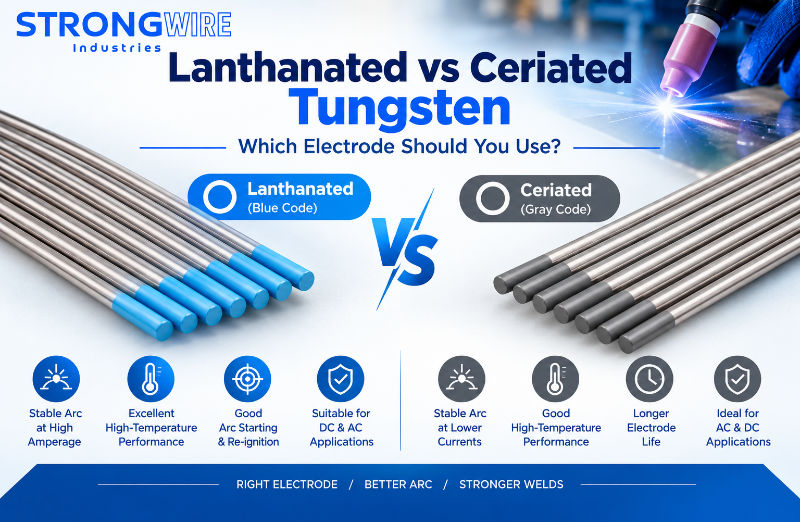
Choosing the right tungsten electrode can directly affect arc starting, arc stability, electrode life, and overall TIG welding performance. Among the available tungsten electrode types, ceriated and lanthanated tungsten are widely used because they provide reliable arc characteristics across a range of TIG applications.
But which one should you use?
The answer depends on factors such as welding current, material, AC or DC operation, equipment type, electrode size, and the required arc characteristics. A ceriated tungsten electrode is particularly useful for low- to medium-current applications and easy arc starting, while a lanthanated tungsten electrode is a versatile choice for stable operation across a broader range of currents and AC/DC applications.
This guide explains the differences between ceriated and lanthanated tungsten electrodes and how to select the appropriate option for industrial TIG welding.
What Are Tungsten Electrode Types?
Tungsten electrode types are non-consumable electrodes used in Gas Tungsten Arc Welding (GTAW), commonly called TIG welding. They are manufactured from tungsten, sometimes with small quantities of oxide additives such as cerium oxide or lanthanum oxide.
According to AWS A5.12M/A5.12:2024, tungsten and oxide-dispersed tungsten electrodes are classified according to their chemical composition, with requirements covering electrode classification, dimensions, finish, identification, color coding, and chemical composition.
Common tungsten electrode types include:
- Pure tungsten
- Thoriated tungsten
- Ceriated tungsten
- Lanthanated tungsten
- Zirconiated tungsten
- Other rare-earth tungsten electrodes
Ceriated and lanthanated electrodes are both oxide-dispersed tungsten electrodes and are commonly selected for modern TIG welding equipment.
How Do Ceriated and Lanthanated Tungsten Electrodes Work?
A tungsten electrode does not normally melt into the weld as a filler metal would. Instead, it maintains the electrical arc between the electrode and workpiece.
Small additions of cerium oxide or lanthanum oxide modify the electrode’s arc-starting and operating characteristics.
Ceriated Tungsten Electrode
A ceriated tungsten electrode contains cerium oxide and is commonly identified as 2% ceriated tungsten, or EWCe-2. Gray is the commonly used color identification for 2% ceriated tungsten.
Ceriated tungsten is known for:
- Good arc starting
- Strong low-current performance
- Good arc stability
- Useful AC performance
- Suitability for precision TIG applications
Miller’s TIG guidance identifies 2% ceriated tungsten as a versatile option, particularly for low- and medium-current welding.
This makes ceriated tungsten useful when the welding process requires controlled starts and relatively low heat input.
Lanthanated Tungsten Electrode
A lanthanated tungsten electrode contains lanthanum oxide. A commonly used grade is 2% lanthanated tungsten, classified as EWLa-2 and commonly identified with a blue color band.
Lanthanated tungsten is valued for:
- Reliable arc starting
- Stable arc performance
- Good re-ignition characteristics
- Lower tendency toward tip erosion
- Performance across AC and DC applications
Miller identifies 2% lanthanated tungsten as an option that provides excellent arc starting and stability and can be used in both AC and DC welding.
Ceriated vs Lanthanated Tungsten: Key Differences
The main difference is the oxide added to the tungsten matrix and the resulting operating characteristics.
1. Arc Starting
Ceriated tungsten has a strong reputation for easy arc starting, particularly at low current settings.
This makes a ceriated tungsten electrode useful for:
- Thin materials
- Precision welding
- Low-amperage TIG
- Frequent arc starts and restarts
Lanthanated tungsten also provides strong arc-starting characteristics and is widely used where stable starts and re-ignition are important.
2. Low-Current Welding
Ceriated tungsten is particularly useful when the application operates at low or medium current.
For example, applications involving thin stainless steel components or precision fabrication may benefit from the starting characteristics of ceriated electrodes.
If low-current control is the primary consideration, ceriated tungsten deserves close consideration.
3. AC and DC Applications
Both electrode types can be used across a variety of AC and DC TIG applications when correctly selected for the equipment and welding procedure.
Modern inverter TIG machines have expanded the practical use of alloyed tungsten electrodes. Miller notes that modern inverter technology has made rare-earth tungsten electrodes such as ceriated and lanthanated tungsten practical choices for AC TIG applications.
However, the electrode should always be selected according to the welding machine manufacturer’s recommendations and the applicable welding procedure.
4. Arc Stability
Both ceriated and lanthanated tungsten can provide stable TIG arcs.
Lanthanated tungsten is often selected when a consistent arc is required across a wider range of operating conditions. Ceriated tungsten is especially useful when easy starting and low-current stability are important.
The quality of the electrode also matters. Consistent oxide distribution, dimensional accuracy, straightness, density, and hardness can influence electrode performance.
Benefits of Ceriated Tungsten Electrodes
A ceriated tungsten electrode can be a practical choice when the welding application prioritizes low-current performance and easy starting.
Key benefits include:
- Easy arc initiation
- Good low-current characteristics
- Stable TIG arc
- Suitable for precision welding
- Useful for thin materials
- Applicable to AC and DC TIG depending on the welding setup
Where Are Ceriated Tungsten Electrodes Used?
Typical applications can include:
- Precision fabrication
- Thin stainless steel welding
- Sheet-metal fabrication
- Small components
- Instrumentation-related fabrication
- Low-current TIG welding
- Maintenance and repair applications
Ceriated tungsten should not be selected solely because it is suitable for low-current work. Electrode diameter, current range, polarity, shielding gas, joint design, and machine characteristics also need to be considered.
Benefits of Lanthanated Tungsten Electrodes
Lanthanated tungsten electrodes are popular because of their versatility.
Important benefits include:
- Excellent arc starting
- Good arc stability
- Reliable re-ignition
- Useful AC and DC performance
- Good resistance to tip erosion
- Suitable for a broad range of TIG applications
One of the important lanthanated tungsten uses is as an alternative to traditional thoriated tungsten in applications where manufacturers or welding procedures specify a non-radioactive rare-earth electrode. Miller specifically identifies 2% lanthanated tungsten as a substitute for 2% thoriated tungsten in appropriate applications.
Common Lanthanated Tungsten Uses
Lanthanated electrodes can be used for applications involving:
- Carbon steel
- Stainless steel
- Aluminum
- Nickel alloys
- Precision TIG welding
- General fabrication
- Industrial maintenance
- Automated or production welding
The exact electrode grade and diameter should be matched to the welding current, material, power source, and procedure.
Which Electrode Should You Use?
There is no universal answer because electrode selection depends on the application.
Consider a ceriated tungsten electrode when:
- You frequently weld at low or medium current.
- Easy arc starting is a priority.
- You work with thin materials.
- Precision welding is important.
- Your TIG procedure calls for ceriated tungsten.
Consider a lanthanated tungsten electrode when:
- You need a versatile electrode for different applications.
- Your operation includes AC and DC TIG.
- Arc stability and reliable starting are important.
- You want an alternative to thoriated tungsten where appropriate.
- You require consistent performance across a broader operating range.
The choice should ultimately be based on the welding procedure, machine manufacturer’s recommendations, electrode specification, and actual operating conditions.
How to Choose the Right Tungsten Electrode
When selecting from different tungsten electrode types, don’t focus only on the alloy designation.
Evaluate the complete welding application.
1. Identify the Base Material
Determine whether you are welding:
- Carbon steel
- Stainless steel
- Aluminum
- Copper alloys
- Nickel alloys
- Other engineering materials
Material type affects current selection, polarity, heat input, and electrode requirements.
2. Check AC or DC Operation
Determine whether your TIG machine operates with:
- DCEN
- AC
- Advanced AC/inverter TIG
Modern inverter equipment provides more flexibility than traditional transformer-based TIG machines, but electrode selection should still follow the equipment and welding procedure recommendations.
3. Select the Correct Diameter
Electrode diameter influences current capacity and arc characteristics.
Common diameters include:
- 1.0 mm
- 1.6 mm
- 2.4 mm
- 3.2 mm
- 4.0 mm
The appropriate diameter depends on welding current, material thickness, electrode type, and torch configuration.
4. Consider Arc Starting Requirements
For automated equipment, repeated starts, thin materials, or precision applications, arc-starting behavior becomes particularly important.
Ceriated and lanthanated electrodes can both provide useful starting characteristics, but the final selection should be based on the specific welding process.
5. Consider Electrode Quality
For industrial procurement, alloy designation alone is not enough.
Buyers should consider:
- Chemical composition
- Oxide distribution
- Diameter tolerance
- Straightness
- Surface finish
- Length consistency
- Packaging
- Traceability
- Applicable specifications
AWS A5.12M/A5.12 provides the relevant framework for classification and requirements of tungsten and oxide-dispersed tungsten electrodes.
Why Industries Prefer High-Quality Tungsten Electrodes
Industrial TIG welding often involves repeatable production conditions. Small variations in electrode geometry or material composition can affect arc behavior and electrode consumption.
For manufacturers and procurement teams, consistent electrodes can support:
- Repeatable welding procedures
- Stable arc performance
- Reduced electrode replacement
- Consistent electrode preparation
- Better process control
- Easier inventory management
For this reason, industrial buyers should evaluate not only the tungsten type but also the manufacturer’s quality-control process and ability to maintain consistent specifications across production batches.
Why Choose STRONGWIRE?
For industrial welding applications, electrode selection should be supported by reliable product specifications and technical understanding.
STRONGWIRE focuses on welding consumables and industrial welding solutions, with attention to product consistency and application requirements.
When sourcing tungsten electrodes, buyers can evaluate STRONGWIRE based on factors such as:
- Industry expertise: Understanding of welding consumables and industrial applications.
- Product quality: Focus on consistent electrode composition, dimensions, and finish.
- Custom manufacturing capabilities: Product configurations can be evaluated according to customer and application requirements.
- Technical support: Assistance with product selection based on welding conditions and specifications.
- Reliable supply: Suitable supply planning for industrial and recurring requirements.
- Consistent performance: Emphasis on repeatable product characteristics.
- Customer-focused approach: Product discussions centered on application requirements rather than one-size-fits-all recommendations.
For engineering and procurement teams, the appropriate tungsten electrode should always be confirmed against the applicable specification and welding procedure.
Final Takeaway
Both ceriated and lanthanated electrodes are important options among modern tungsten electrode types.
A ceriated tungsten electrode can be a strong choice for low- and medium-current TIG applications where easy arc starting and controlled operation are important. Lanthanated tungsten electrodes provide versatile performance and are commonly selected for applications requiring reliable arc starting, stability, and AC/DC capability.
For industrial buyers, the correct choice should be based on the complete welding setup, not simply the electrode color. Consider the base material, current type, amperage, electrode diameter, equipment, welding procedure, and applicable specification before purchasing.
For consistent industrial welding performance, selecting the correct tungsten classification and sourcing electrodes with controlled material and dimensional quality are equally important.