
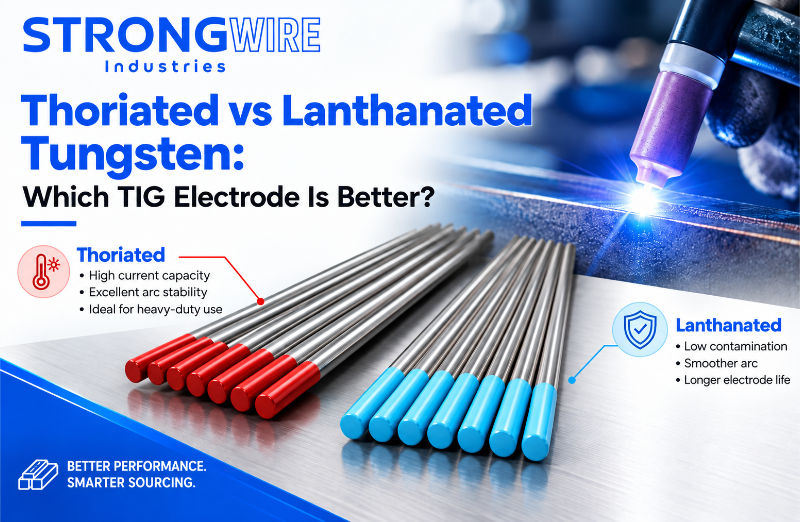
Choosing the right tungsten electrode can directly affect TIG welding arc stability, starting performance, electrode life, and weld consistency. Two widely discussed options are 2% thoriated tungsten and lanthanated tungsten. Both are used for demanding TIG applications, but their characteristics, handling considerations, and suitability can differ depending on the welding current, material, amperage, and equipment.
For welders, fabrication companies, procurement teams, and industrial buyers comparing lanthanated vs thoriated tungsten, the key is not simply choosing one electrode over the other. The better choice depends on the specific welding application and operating conditions.
What Is Lanthanated vs Thoriated Tungsten?
Lanthanated vs thoriated tungsten refers to tungsten electrodes containing different oxide additives that modify the electrode’s electron-emission and arc characteristics.
A thoriated tungsten electrode contains thorium oxide, commonly around 2% in EWTh-2 grades. It has traditionally been used for DC TIG welding because of its stable arc, good arc-starting characteristics, and current-carrying capability. However, thorium is radioactive, so grinding and handling practices require appropriate controls.
A lanthanated tungsten electrode contains lanthanum oxide. Depending on the specification, lanthanated electrodes are available in different lanthanum concentrations. 1.5% lanthanated tungsten is commonly identified as EWLa-1, while 2% lanthanated products are also available commercially. Lanthanated tungsten is widely used as a non-radioactive alternative to thoriated tungsten and can provide good arc starting and stability across a broad operating range.
Quick Answer: Which One Should You Choose?
For applications where a non-radioactive tungsten electrode is preferred, lanthanated tungsten is an important option. For established DC TIG procedures that specifically call for thoriated tungsten, 2% thoriated tungsten remains a technically established choice.
The final selection should consider the welding procedure, power source, material, amperage, electrode diameter, tip preparation, and applicable welding specifications.
Key Features and Benefits
2% Thoriated Tungsten
A 2% thoriated tungsten electrode, commonly identified as EWTh-2, contains approximately 2% thorium oxide. STRONGWIRE’s thoriated tungsten product information specifies thorium oxide in the 1.70–2.20% range and identifies the electrode with the red color code.
Key characteristics include:
- Good arc-starting performance
- Stable DC TIG arc
- High current-carrying capability
- Good resistance to electrode wear
- Consistent arc behavior
- Suitability for demanding industrial welding
Thoriated tungsten has a long history in TIG welding, particularly for steels, nickel alloys, and other materials commonly welded using DC. Its predictable arc characteristics have made it an established option for demanding welding applications.
However, its radioactive thorium content is an important consideration. Grinding can create airborne particulate, so workplaces should follow appropriate occupational safety procedures.
2% Lanthanated Tungsten
2% lanthanated tungsten contains lanthanum oxide as the alloying additive rather than thorium oxide. Lanthanated electrodes are valued for arc starting, stability, and versatility.
Important characteristics include:
- Good arc ignition
- Stable arc performance
- Low electrode burn-off
- Good re-ignition characteristics
- Useful performance across different amperage ranges
- Non-radioactive alloying additive
Lanthanated tungsten is commonly considered a versatile AC/DC electrode and a non-radioactive alternative to thoriated tungsten for many TIG welding applications.
How Electrode Selection Improves Industrial Performance
The choice between a thoriated tungsten electrode and a lanthanated tungsten electrode can influence several aspects of TIG welding.
Arc Starting
Tungsten additives reduce the energy required for electron emission, helping the electrode initiate and maintain an arc. Both thoriated and lanthanated electrodes can provide reliable starting characteristics when correctly selected and prepared.
Arc Stability
Stable arc behavior is particularly important for precision TIG welding. An appropriately selected tungsten can help maintain consistent arc concentration during the welding operation.
Electrode Life
Electrode diameter, amperage, polarity, tip preparation, cooling, and welding technique all influence tungsten life. Operating an electrode above its recommended current range can increase overheating and may contribute to tungsten transfer into the weld pool.
Welding Productivity
For industrial users, electrode selection is also a productivity consideration. Consistent arc starting and reduced electrode consumption can reduce interruptions for electrode replacement and regrinding.
However, electrode selection should always be evaluated together with the complete welding procedure rather than treated as an isolated productivity measure.
Applications Across Industries
Tungsten electrode selection varies according to material and welding process.
Stainless Steel and Carbon Steel
Thoriated and lanthanated tungsten electrodes are commonly considered for DC TIG welding of steel and stainless steel.
Typical applications include:
- Stainless steel fabrication
- Carbon steel components
- Industrial machinery
- Structural fabrication
- Pressure equipment
- General engineering
Nickel Alloys
TIG welding of nickel alloys requires controlled arc characteristics and suitable electrode selection. Thoriated tungsten has historically been used for nickel-alloy applications, while lanthanated tungsten can be considered where a non-radioactive electrode is preferred.
Aerospace and Critical Fabrication
TIG welding is used in aerospace and other applications where precise heat and arc control are important. Electrode selection should follow the applicable welding procedure, qualification requirements, and customer specifications.
Tungsten Electrode for Aluminum
A tungsten electrode for aluminum requires additional consideration because aluminum is commonly welded using AC TIG.
Modern AC/DC inverter machines can use several tungsten types depending on machine settings, electrode geometry, current, and application. Lanthanated tungsten can be suitable for AC/DC use, while electrode selection for aluminum can also include other compositions such as pure, ceriated, or zirconiated tungsten depending on the equipment and application.
Therefore, buyers should not select a tungsten electrode solely because it is labeled for aluminum. The power source and welding procedure should also be considered.
Factors to Consider Before Selection
Before purchasing a lanthanated tungsten electrode or thoriated tungsten electrode, industrial buyers should evaluate:
1. Welding Current
Determine whether the process uses AC or DC and identify the expected operating amperage.
2. Base Material
Steel, stainless steel, nickel alloys, aluminum, titanium, and other materials can require different electrode selections and preparation.
3. Electrode Diameter
Diameter should correspond to the welding current and application. Using an electrode that is too small for the operating current can increase overheating and wear.
4. Tip Geometry
The electrode grind angle and tip geometry influence arc concentration and stability. TIG procedures should specify appropriate preparation for the application.
5. Safety Requirements
If using thoriated tungsten, the presence of thorium requires attention to workplace handling and grinding controls. This is one reason some fabrication operations choose non-radioactive alternatives.
6. Welding Procedure Requirements
For qualified welding procedures, the specified electrode classification should be followed unless the procedure is appropriately reviewed or requalified according to the applicable code or standard.
7. Supply Consistency
For industrial procurement, consistency between batches, correct classification, dimensional accuracy, packaging, traceability, and reliable supply can be just as important as the nominal electrode composition.
Common Mistakes to Avoid
Choosing Only by Color
Color coding can help identify tungsten types, but buyers should verify the actual classification and product specification rather than relying only on color.
For example, 2% thoriated tungsten is commonly red, while lanthanated tungsten can have different color codes depending on the lanthanum content and applicable classification.
Using the Wrong Electrode Diameter
An unsuitable diameter can affect current capacity, electrode heating, arc behavior, and tungsten life.
Ignoring the Power Source
AC and DC welding impose different requirements. The electrode should be selected with the TIG machine’s capabilities and settings in mind.
Overlooking Grinding Practices
A contaminated or incorrectly prepared tungsten can negatively affect arc stability and weld quality.
Treating One Electrode as Universal
There is no single tungsten electrode specification that automatically suits every TIG application. Material, current, amperage, machine type, electrode size, and procedure all matter.
Why Industries Compare Lanthanated and Thoriated Tungsten
The comparison between lanthanated vs thoriated tungsten is particularly relevant when industrial users need reliable TIG arc performance while balancing application requirements and workplace considerations.
Thoriated tungsten has a long-established history and offers useful characteristics for DC TIG welding. Lanthanated tungsten provides comparable application potential in many situations while avoiding the radioactive thorium additive.
For many modern fabrication environments, the choice therefore involves more than arc performance alone. Safety procedures, welding specifications, machine compatibility, procurement requirements, and availability can all influence the final decision.
The right approach is to select the electrode classification that matches the qualified welding procedure and operating conditions.
Why Choose STRONGWIRE?
STRONGWIRE provides a range of tungsten electrodes, including thoriated, lanthanated, ceriated, zirconiated, and multi-compound rare-earth tungsten products.
Its tungsten electrode range is supported by broader experience in welding consumables and industrial manufacturing. STRONGWIRE states that it has operated in the welding industry since the 1980s and introduced tungsten electrodes as part of its product expansion in 2022.
For industrial buyers, relevant considerations include:
- Industry expertise: Decades of experience in welding consumables.
- Product range: Multiple tungsten electrode types for different TIG requirements.
- Manufacturing capabilities: Integrated manufacturing infrastructure and production systems.
- Quality control: Chemical and mechanical testing facilities for raw materials, in-process products, and finished products.
- Technical support: Product and application guidance for industrial requirements.
- Reliable supply: Domestic and export-oriented supply capabilities.
- Customer-focused approach: Support for industrial, OEM, distributor, and fabrication requirements.
For buyers comparing a lanthanated tungsten electrode with a thoriated tungsten electrode, STRONGWIRE’s range allows procurement teams to evaluate different tungsten compositions according to their specific welding requirements.
Conclusion
The choice between lanthanated vs thoriated tungsten depends on the welding application rather than a universal ranking of one electrode over the other.
2% thoriated tungsten is an established option for DC TIG welding and is recognized for arc stability, current-carrying capability, and long-standing industrial use. 2% lanthanated tungsten offers strong arc-starting and stability characteristics and provides a non-radioactive alternative to thorium-containing electrodes.
Before selecting a tungsten electrode, evaluate the welding current, base material, electrode diameter, tip geometry, power source, applicable welding procedure, safety requirements, and supply consistency.
For industrial applications, working with an experienced tungsten electrode supplier such as STRONGWIRE can help procurement and welding teams identify the appropriate product specification for their operating requirements.