
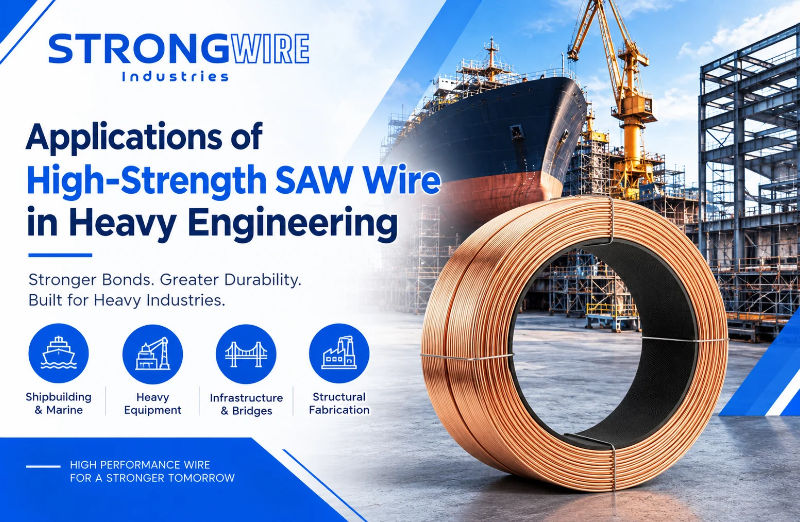
Heavy engineering projects depend on welded joints that can withstand demanding mechanical loads, operating conditions, and service requirements. From pressure vessels and industrial machinery to structural steel assemblies and power-generation equipment, the choice of welding consumables directly affects weld-metal properties, fabrication efficiency, and long-term reliability.
High-strength SAW welding wire is used in heavy engineering to produce welds with specified strength, toughness, and other mechanical properties when paired with a suitable flux and applied through a qualified welding procedure. Submerged Arc Welding (SAW) is particularly useful for long, continuous welds on suitable components because it supports mechanised or automated welding and high deposition rates.
However, selecting a wire based on tensile strength alone is not enough. Engineers must also consider the parent material, weld-metal toughness, operating temperature, joint design, heat input, and applicable fabrication standards.
For industrial buyers and fabrication teams, understanding these factors helps identify an appropriate combination of SAW wire and Submerged Arc Welding flux for the intended application.
What Makes SAW Welding Wire Suitable for Heavy Engineering?
Submerged Arc Welding is an arc welding process in which an electric arc forms between a continuously fed electrode wire and the workpiece beneath a layer of granular flux. The flux shields the welding zone and contributes to the characteristics of the resulting weld metal.
The process is well suited to many heavy fabrication operations because it can deliver high deposition rates, consistent weld profiles, and repeatable results when the equipment, joint preparation, consumables, and parameters are properly controlled.
High-strength applications may require solid SAW wires with specific alloying characteristics. The appropriate wire and flux combination depends on the base-metal grade and the mechanical properties required in the completed joint.
Key considerations include:
- Tensile strength: The weld metal must satisfy the applicable design and welding procedure requirements.
- Toughness: The joint may need to resist brittle fracture under specified temperatures and loading conditions.
- Chemical compatibility: Wire composition and flux selection influence weld-metal chemistry and final properties.
- Weldability: Wire feeding, arc behaviour, slag removal, and bead formation affect fabrication consistency.
- Service conditions: Elevated temperatures, cyclic loads, and other operating conditions may require specialised consumables.
No single SAW wire is suitable for every heavy engineering application. Selection should be based on the qualified welding procedure and the requirements of the component.
Major Applications of High-Strength SAW Wire
1. Pressure Vessels and Boiler Manufacturing
Pressure vessels and boilers contain fluids or gases under specified pressure and temperature conditions. Their welded joints must meet demanding requirements for structural integrity, inspection, and service reliability.
SAW is used in suitable pressure-vessel fabrication operations, including longitudinal and circumferential seams in shell sections and other compatible joints. Its mechanised operation can support consistent production across repetitive welding work.
Wire selection depends on the vessel material, design conditions, applicable construction code, and required weld-metal properties. Carbon steel and low-alloy steel vessels may require different consumable combinations, particularly when elevated-temperature service is involved.
For these applications, fabricators should verify:
- Compatibility with the specified base-metal grade.
- Required tensile and impact properties of the deposited weld metal.
- Compliance with the approved welding procedure specification.
- Heat-input limits, preheat, and post-weld heat treatment requirements where applicable.
- Inspection and traceability requirements.
A wire intended for general structural fabrication should not automatically be assumed suitable for pressure-retaining components.
2. Heavy Structural Steel Fabrication
Industrial buildings, bridges, support frames, large columns, and load-bearing assemblies can contain thick steel sections and long welded joints. SAW is useful for suitable structural components where repeatable welding and production efficiency are important.
High-strength structural steels require particular attention to matching the weld-metal strength and toughness to the design requirements. Excessively high weld-metal strength is not necessarily an advantage if it compromises toughness, ductility, or the intended joint performance.
Fabricators should consider plate thickness, joint geometry, restraint, welding position, and the consequences of residual stresses. Appropriate consumables must also work within the qualified procedure’s heat-input and cooling-rate limits.
3. Heavy Machinery and Construction Equipment
Large machinery, industrial presses, lifting equipment, material-handling systems, and construction equipment often incorporate welded frames, support structures, and fabricated steel components.
The welding requirements depend on how each component carries load. A frame subjected to repeated loading, for example, may need careful control of weld geometry and fatigue-sensitive details in addition to adequate weld-metal strength.
High-strength SAW consumables can be considered for compatible joints in mechanised fabrication. Nevertheless, the consumable should be selected according to the parent steel and the component’s design requirements rather than the machine’s overall size.
Quality planning should include joint preparation, control of welding parameters, inspection of critical welds, and verification that the procedure is appropriate for the intended loading conditions.
4. Shipbuilding and Offshore Fabrication
Shipbuilding involves extensive welding of plates, stiffeners, structural sections, and other fabricated assemblies. SAW can be applied to suitable long seams and repetitive joints where the workpiece geometry and welding position permit the process.
Offshore structures may face additional demands from cyclic loading, low service temperatures, or specified fracture-toughness requirements. These factors can make weld-metal toughness and procedural control particularly important.
A high-strength wire should therefore be evaluated against the applicable material specification, design requirements, and any relevant classification or project approval requirements. A product’s general suitability for shipbuilding does not establish automatic approval for every marine or offshore application.
5. Steel Pipes, Storage Tanks, and Large Cylindrical Structures
SAW is commonly used for suitable longitudinal and circumferential seams in pipe production, storage tanks, and large cylindrical fabrications.
In pipe manufacturing, consumable selection depends on the pipe material, manufacturing process, wall thickness, required weld properties, and applicable product specification. Some production lines use internal and external SAW arrangements to achieve the required joint quality and production rate.
For tanks and cylindrical shells, long seams can benefit from mechanised welding when joint access and positioning are appropriate.
Procurement teams should confirm the exact wire classification, compatible flux, intended application, and documentation required for the project. Requirements for a general storage tank may differ considerably from those for a pipeline or a pressure-retaining system.
6. Power Plants, Refineries, and High-Temperature Equipment
Power-generation equipment and process plants may contain components exposed to elevated temperatures, pressure, or prolonged service. Certain applications use creep-resistant low-alloy steels whose performance depends on carefully controlled alloy composition and heat treatment.
For these materials, a conventional carbon-steel SAW wire is not an interchangeable substitute for a consumable designed for the specified alloy system.
The consumable must be compatible with the base material and the required weld-metal chemistry. Preheat, interpass temperature, post-weld heat treatment, and other procedure controls must follow the approved engineering requirements.
STRONGWIRE lists specialised SAW wires for creep-resistant steels, including STRONG EA3, and publishes product information for this category. The correct grade must still be confirmed against the particular material specification and service conditions.
How to Select the Right SAW Wire and Flux Combination
The wire and flux work together to determine the deposited weld metal’s properties. Choosing them independently can lead to a combination that does not meet the required mechanical or chemical requirements.
A practical selection process should address the following factors.
1. Identify the parent material. Confirm the material grade, strength level, thickness, and any alloying or service-related requirements.
2. Define the required weld-metal properties. Establish the specified tensile strength, yield strength, elongation, impact toughness, and chemical composition where applicable.
3. Verify the consumable classification. Check the applicable AWS classification or other project-specified standard. Classification alone does not establish suitability for every application.
4. Select a compatible flux. Review the manufacturer’s recommended wire-flux combinations, intended application, and relevant qualification data.
5. Confirm process parameters. Wire diameter, current, voltage, travel speed, heat input, joint preparation, and welding sequence should remain within the qualified procedure.
6. Check handling and storage. Follow the manufacturer’s instructions for flux storage, recovery, reuse, and reconditioning. Moisture control and contamination prevention are important where required by the consumable specification and welding procedure.
7. Validate the completed procedure. Confirm the necessary procedure qualification, testing, inspection, and documentation before production welding.
The AWS A5.17/A5.17M specification covers carbon-steel electrodes and fluxes for SAW, while AWS A5.23/A5.23M addresses low-alloy and high-manganese steel electrodes and fluxes. The applicable edition and project requirements should be checked before specifying consumables.
STRONGWIRE SAW Welding Consumables for Industrial Applications
STRONGWIRE publishes product information for several SAW welding wire and flux categories relevant to industrial fabrication.
- STRONG EM12K: A copper-coated SAW wire classified under AWS SFA 5.17 EM12K, listed for medium- and high-tensile steels, boiler manufacturing, pressure vessels, structural steel, and heavy engineering.
- STRONG EH14: A high-manganese SAW wire classified under AWS SFA 5.17 EH14, listed for high-tensile steel applications, shipbuilding, structural fabrication, pipe manufacturing, and pressure vessels.
- STRONG EA3: A low-alloy SAW wire classified under AWS SFA 5.23 EA3 for creep-resistant and high-strength structural steel applications.
- STRONG FLUX 68X: A SAW flux listed for high-strength steel welding applications.
These products represent different consumable requirements rather than interchangeable solutions. Buyers should review the published technical information and confirm the recommended wire-flux combination, required mechanical properties, and suitability for the specific welding procedure before ordering.
Common Mistakes to Avoid in Heavy Engineering Welding
Even a suitable consumable can produce unsatisfactory results when welding controls are inadequate. Common mistakes include:
- Selecting a wire solely because its strength classification appears higher.
- Using a wire and flux combination without checking compatibility.
- Ignoring impact-toughness requirements at the minimum design temperature.
- Changing heat input or interpass temperature outside the qualified procedure.
- Reusing recovered flux without following applicable handling instructions.
- Treating a product’s general application description as proof of project-specific code compliance.
- Failing to maintain batch identification, inspection records, and consumable traceability.
Avoiding these mistakes requires coordination among design engineers, welding engineers, quality teams, procurement specialists, and consumable suppliers.
Conclusion
High-strength SAW welding wire supports a wide range of heavy engineering operations, including pressure vessel fabrication, structural steel production, heavy machinery manufacturing, shipbuilding, pipe production, and specialised high-temperature equipment.
The most suitable solution is not necessarily the wire with the highest nominal strength. It is the wire-and-flux combination that meets the specified weld-metal properties, suits the parent material, and performs within a qualified welding procedure.
STRONGWIRE offers SAW wires and fluxes for several industrial steel-welding applications. Before placing an order, fabrication teams should confirm the required classification, technical documentation, compatible flux, and project-specific requirements.
Planning a heavy engineering welding project? Contact STRONGWIRE to discuss your SAW welding wire and flux requirements and request the relevant product specifications.
Request a Quote: https://strongwire.in/