
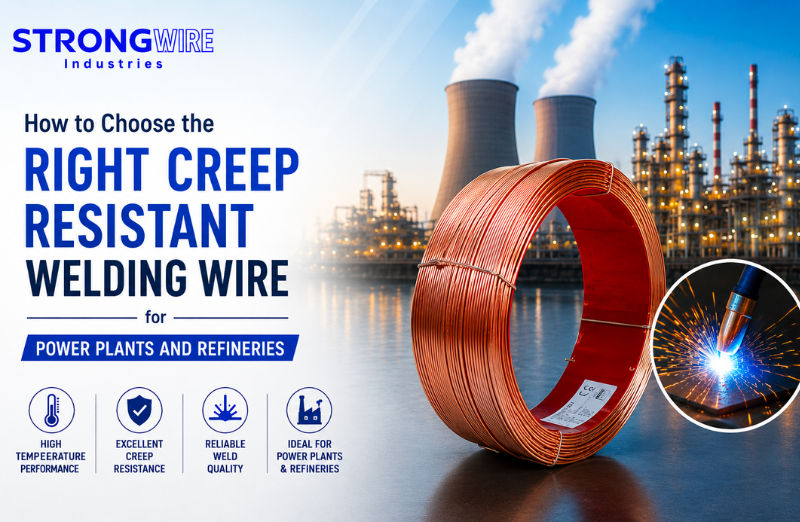
High-temperature industrial environments demand welding materials that can withstand continuous thermal stress without compromising structural integrity. Industries such as power generation, oil & gas, petrochemicals, and refineries rely on specialized welding consumables designed to perform under extreme operating conditions.
Selecting the right creepresistance saw wire, Creepresistant Steel wire, or Creepresistant Steel saw wire is critical for ensuring long-term reliability, minimizing maintenance costs, and extending the service life of welded components.
This guide explains how creep-resistant welding wire works, its benefits, applications, selection criteria, and why choosing a trusted Creepresistant Steels manufacturer or Creepresistant Steels wire supplier is essential for demanding industrial projects.
What is Creepresistance SAW Wire?
Creepresistance SAW Wire is a submerged arc welding (SAW) consumable specially engineered for welding creep-resistant steels used in high-temperature applications. These welding wires produce weld deposits capable of maintaining mechanical strength even after prolonged exposure to elevated temperatures.
Unlike conventional welding wires, creep-resistant SAW wires are formulated with alloying elements such as:
- Chromium (Cr)
- Molybdenum (Mo)
- Vanadium (V)
- Niobium (Nb)
- Tungsten (W)
These alloying elements improve resistance to deformation, oxidation, thermal fatigue, and long-term creep.
What is Creep Resistant Steel Wire?
Creepresistant Steel wire is a specialized welding wire developed for joining heat-resistant alloy steels that operate under high pressure and elevated temperatures.
These wires are commonly used when welding:
- Boiler components
- Steam pipelines
- Pressure vessels
- Heat exchangers
- Refinery equipment
- Superheater tubes
- Turbine components
The primary objective is to create durable weld joints capable of performing reliably for decades in severe operating environments.
How Does Creepresistant Steel SAW Wire Work?
Creep occurs when metal slowly deforms under constant stress at elevated temperatures over extended periods.
Creepresistant Steel saw wire minimizes this deformation by producing weld deposits with:
- High-temperature strength
- Stable microstructure
- Excellent metallurgical compatibility
- Superior resistance to thermal fatigue
- Enhanced oxidation resistance
During submerged arc welding, the welding wire melts beneath a protective flux layer, producing clean, deep-penetration welds with minimal contamination.
The result is strong weld joints capable of maintaining performance in critical industrial systems.
Key Features and Benefits of Creepresistance SAW Wire
Excellent High-Temperature Strength
The weld metal maintains mechanical properties even after years of service at elevated temperatures.
Outstanding Creep Resistance
Designed specifically to resist deformation caused by prolonged thermal exposure.
Superior Weld Quality
Produces smooth, defect-free welds with consistent penetration.
High Productivity
Suitable for automated submerged arc welding processes, increasing manufacturing efficiency.
Excellent Mechanical Properties
Provides:
- High tensile strength
- Good impact toughness
- Stable hardness
- Excellent ductility
Long Equipment Life
Reduces weld failures, minimizing unexpected shutdowns and maintenance costs.
Benefits of Using Creepresistant Steel Welding Wire
Industrial facilities choose Creepresistant Steels welding wire because it offers several operational advantages.
Improved Reliability
Critical welded components remain stable during continuous operation.
Reduced Downtime
Durable welds lower maintenance frequency.
Enhanced Safety
Reliable weld joints reduce the likelihood of failures in high-pressure systems.
Lower Lifecycle Costs
Although premium welding consumables may have a higher initial cost, their longer service life significantly reduces total ownership costs.
Consistent Weld Integrity
Maintains strength even during repeated thermal cycling.
Applications Across Industries
Power Plants
Thermal and supercritical power plants use creep-resistant welding wires for:
- Boiler headers
- Steam drums
- Superheaters
- Reheaters
- High-pressure steam pipes
Oil & Gas Refineries
Refineries require reliable welds for:
- Reactor vessels
- Pressure piping
- Cracking units
- Heat exchangers
Petrochemical Plants
High-temperature processing equipment depends on creep-resistant welds for long-term operational stability.
Heavy Engineering
Manufacturers producing industrial boilers and pressure vessels rely on these welding wires for code-compliant fabrication.
Fertilizer Plants
High-pressure process equipment benefits from excellent creep resistance and thermal stability.
Why Industries Prefer Creepresistant Steel SAW Wire
Industrial buyers prefer Creepresistant Steel saw wire because it delivers dependable performance where standard welding consumables cannot.
Major reasons include:
- Long service life
- Reliable mechanical properties
- Excellent resistance to thermal fatigue
- Better weld consistency
- Compatibility with alloy steels
- Reduced maintenance
- High welding productivity
- Suitable for critical pressure equipment
These advantages make creep-resistant SAW wire the preferred choice for mission-critical welding applications.
How to Choose the Right Creepresistance SAW Wire
Selecting the proper welding wire involves evaluating multiple technical factors.
Match the Base Material
Always ensure the welding wire matches the chemical composition of the parent metal.
Different grades require different alloy combinations.
Verify Operating Temperature
Consider:
- Maximum service temperature
- Continuous operating conditions
- Thermal cycling frequency
Higher temperatures require higher alloy content.
Review Mechanical Property Requirements
Check specifications for:
- Tensile strength
- Yield strength
- Elongation
- Impact toughness
- Creep rupture strength
Select the Correct Welding Process
Ensure the welding wire is designed specifically for Submerged Arc Welding (SAW).
Proper compatibility improves weld quality and productivity.
Evaluate Industry Standards
Choose products that comply with applicable standards such as:
- AWS
- ASME
- ISO
- EN
Compliance ensures consistent quality and traceability.
Consider Weldability
Good weldability reduces defects including:
- Porosity
- Cracking
- Slag inclusions
- Lack of fusion
Source from an Experienced Manufacturer
Partnering with an established Creepresistant Steels manufacturer provides better quality assurance, technical guidance, and consistent product availability.
Common Mistakes to Avoid
Many welding projects experience premature failures because of incorrect consumable selection.
Avoid these common mistakes:
- Selecting wire based only on price
- Ignoring service temperature
- Mismatching base metal chemistry
- Overlooking welding procedure specifications
- Using non-certified consumables
- Neglecting post-weld heat treatment requirements
- Purchasing from unreliable suppliers
Careful planning helps maximize weld performance and service life.
Industry Example
Consider a thermal power plant replacing high-pressure steam pipelines.
Using conventional welding wire may result in premature creep deformation after prolonged operation.
However, selecting the appropriate Creepresistant Steel wire designed for elevated-temperature service can significantly improve weld durability, reduce maintenance intervals, and support long-term plant reliability when combined with proper welding procedures and post-weld heat treatment.
Why Choose the Right Creepresistant Steels Wire Supplier?
Working with an experienced Creepresistant Steels wire supplier provides advantages beyond product delivery.
Look for suppliers offering:
- Consistent manufacturing quality
- Complete material traceability
- Technical documentation
- Welding procedure support
- Reliable inventory management
- Timely deliveries
- Responsive customer service
Reliable suppliers help ensure project success while minimizing procurement risks.
Why Choose Strong Wire?
Choosing the right welding consumable partner is as important as selecting the correct welding wire.
Strong Wire focuses on delivering dependable welding solutions for demanding industrial applications through:
- Extensive industry expertise
- High-quality manufacturing standards
- Consistent product performance
- Custom manufacturing capabilities
- Reliable supply chain management
- Technical guidance for product selection
- Customer-focused support
- Quality-driven manufacturing processes
By emphasizing quality, consistency, and technical assistance, Strong Wire Industries helps industrial customers select welding consumables suitable for critical fabrication projects.
Conclusion
Choosing the correct creepresistance saw wire, Creepresistant Steel wire, or Creepresistant Steel saw wire directly impacts equipment reliability, safety, and long-term operational efficiency.
For power plants, refineries, petrochemical facilities, and heavy engineering industries, selecting welding consumables based on operating temperature, alloy compatibility, mechanical properties, and supplier expertise ensures durable, high-quality welds.
Working with a trusted Creepresistant Steels manufacturer and reliable Creepresistant Steels wire supplier helps reduce maintenance costs while supporting consistent industrial performance over the equipment’s service life.