
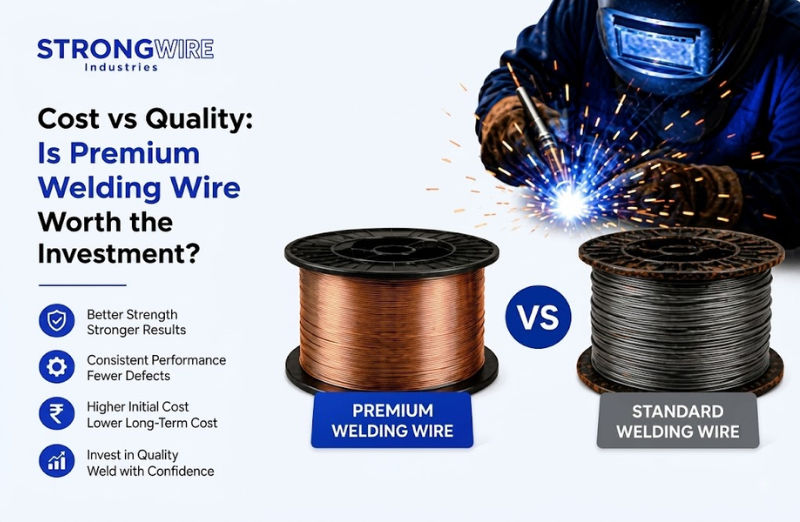
When purchasing welding consumables, price is often one of the first things buyers compare. A lower-cost welding wire may look attractive, especially when large quantities are required for industrial welding. But the initial purchase price does not always represent the actual cost of welding.
Wire quality can influence arc stability, weld consistency, rework, downtime, productivity, and maintenance costs. This raises an important question for fabricators and industrial buyers: Is premium welding wire really worth the investment?
In many welding applications, the answer is yes but the right choice depends on the material, process, operating conditions, and quality requirements.
What Makes Welding Wire “Premium”?
Premium welding wire is not simply wire with a higher price tag. Quality generally comes from consistent raw materials, controlled manufacturing processes, accurate chemical composition, clean wire surfaces, and reliable dimensional consistency.
A quality-focused welding wire manufacturer typically maintains tighter production controls so that the wire performs consistently from one batch to another.
This consistency matters because welding is a process where small variations can affect the final result. Reliable wire can help operators maintain a stable arc and produce more uniform welds.
Low-Cost vs Premium Welding Wire: What Is the Real Difference?
The most obvious difference is the purchase price. However, industrial buyers should consider the total cost of welding, rather than looking only at the price per kilogram.
Lower-cost wire may sometimes lead to:
- Increased spatter
- Less consistent arc performance
- More frequent wire-feeding issues
- Additional grinding and cleaning
- Higher weld rejection or rework
- Greater downtime
- More frequent equipment maintenance
Premium welding wire may have a higher upfront cost but can reduce some of these hidden expenses.
For high-volume production, even a small improvement in process efficiency can make a meaningful difference to overall operating costs.
How Premium Welding Wire Can Reduce Maintenance Costs
Maintenance costs are an important consideration in continuous welding operations. Poorly performing wire can contribute to feeding problems, contact-tip wear, liner contamination, and other equipment-related issues.
Consistent wire diameter and surface quality can support smoother feeding through the welding system. When the wire feeds reliably, operators may spend less time stopping production to troubleshoot feeding or arc problems.
This does not mean premium wire eliminates maintenance. Welding equipment still requires proper cleaning, inspection, and replacement of wear components. However, using dependable welding consumables can help reduce avoidable process interruptions.
Arc Stability Matters More Than You Think
Arc stability directly affects the welding experience and the quality of the finished joint.
A stable arc provides more predictable heat transfer and helps the welder maintain a consistent welding technique. In automated or semi-automated industrial welding, this consistency becomes even more important because the process may run for long periods with limited operator intervention.
A quality welding wire can contribute to stable arc characteristics when it is correctly matched with the welding process, shielding gas, equipment settings, and base material.
For manufacturers handling large production volumes, improved arc stability can translate into better process control and fewer interruptions.
The Importance of Material Compatibility
One of the biggest mistakes when selecting welding wire is choosing based only on price.
Material compatibility should come first.
Different base materials require different welding wire characteristics. Carbon steel, stainless steel, aluminium, and other alloys have different chemical and mechanical requirements.
Before selecting a wire, buyers should consider:
- Base material composition
- Required weld strength
- Welding position
- Welding process
- Shielding gas
- Operating temperature
- Surface condition
- Applicable industry standards
Understanding these factors helps determine whether a particular wire is suitable for the intended welding applications.
When Is Premium Welding Wire Worth the Cost?
Premium wire is particularly valuable when welding quality, productivity, and consistency are critical.
1. High-volume manufacturing
When welding takes place continuously, even minor process problems can accumulate into significant production losses. Consistent wire can help support uninterrupted operation.
2. Critical fabrication
Industries producing pressure equipment, heavy machinery, structural components, automotive parts, or other critical assemblies may have strict quality requirements. In these environments, weld consistency is often more important than saving a small amount on consumables.
3. Automated welding
Robotic and automated welding systems require predictable wire feeding and arc performance. Inconsistent consumables can affect process stability and increase production interruptions.
4. Expensive rework
If a defective weld requires cutting, grinding, rewelding, inspection, or replacement of a component, the cost can quickly exceed the original savings from cheaper wire.
5. Skilled labour efficiency
Experienced welders are valuable resources. Spending their time correcting inconsistent welds instead of producing quality work can increase overall production costs.
How to Choose Welding Wire Without Overpaying
Choosing premium wire does not mean automatically buying the most expensive product available.
The better approach is to evaluate performance against application requirements.
Ask your welding wire supplier for technical information covering chemical composition, mechanical properties, applicable standards, recommended welding parameters, and compatible shielding gases.
It is also useful to compare suppliers based on:
- Product consistency
- Technical support
- Quality-control practices
- Certifications and standards
- Batch traceability
- Product availability
- Packaging quality
- Industry experience
A reliable welding wire supplier should be able to explain why a particular wire is suitable for your process rather than simply recommending the highest-priced option.
What Should Industrial Buyers Compare?
Before making a purchasing decision, compare the total cost of ownership, not just the purchase price.
A simple evaluation can include:
Wire cost + labour + rework + downtime + maintenance + inspection + productivity
For example, saving a small amount per kilogram may not be worthwhile if the wire creates additional spatter, increases cleanup time, or causes more rejected welds.
On the other hand, if two products deliver virtually identical results in a non-critical application, the less expensive option may be perfectly reasonable.
The objective is not to buy the most expensive welding consumable. It is to buy the most cost-effective consumable for the application.
Why the Right Welding Wire Manufacturer Matters
The manufacturer behind the product can have a significant impact on consistency and reliability.
Established welding wire manufacturers generally invest in production controls, testing, raw-material management, and quality assurance. These factors can help maintain consistent product performance across different batches.
For industrial users, working with an experienced welding wire manufacturer can also provide access to technical guidance when selecting consumables for specific materials and processes.
This becomes especially valuable when a company is standardising welding consumables across multiple production lines.
Premium Welding Wire: A Cost or an Investment?
The answer depends on how you measure cost.
If you only compare the price printed on the purchase order, premium welding wire may appear more expensive. But if you consider productivity, weld quality, downtime, rework, maintenance costs, and labour, the calculation can change significantly.
For demanding industrial welding operations, a reliable premium-grade wire can be an investment in process consistency rather than simply an additional expense.
For less demanding applications, a standard-quality product that meets the required specifications may provide better overall value.
Final Verdict
Premium welding wire is worth the investment when its improved consistency, arc stability, productivity, and reliability reduce the total cost of welding.
The key is not to choose welding wire based solely on price. Instead, evaluate the complete application including base material, welding process, production volume, quality requirements, and expected maintenance.
A trusted welding wire manufacturer or supplier can help you select the right consumable for your specific requirements.
In short, the cheapest welding wire is not always the lowest-cost option, and the most expensive wire is not automatically the best. The right wire is the one that delivers reliable performance at the lowest practical total cost.