
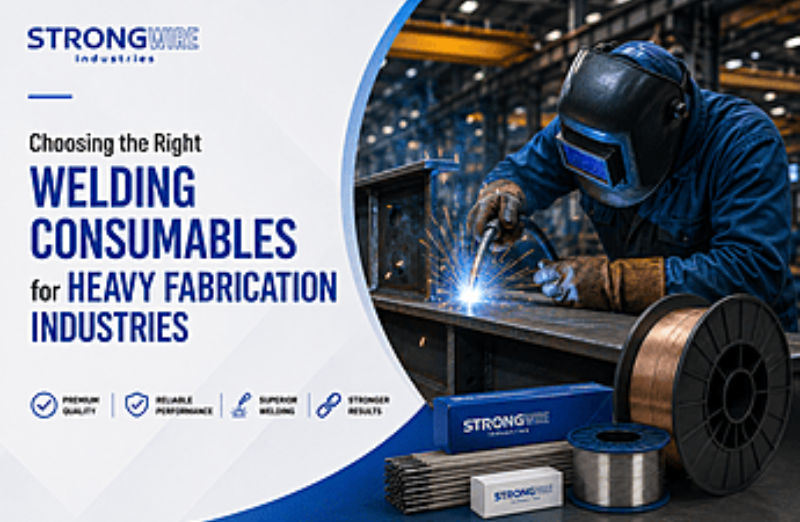
Heavy fabrication is not a job where you can afford to compromise on welding quality. Large steel structures, industrial equipment, pressure-related components, machinery frames, storage systems, and infrastructure projects depend on welds that can withstand demanding service conditions.
One of the most important decisions in the welding process is selecting the right welding consumables.
The consumable affects much more than the appearance of a weld. It can influence arc stability, penetration, deposition rate, weld strength, hydrogen levels, productivity, and the risk of defects.
But with so many options available, how do you choose welding electrodes or other consumables for a particular fabrication job?
The answer depends on several factors, including the base metal, thickness, welding process, welding position, joint design, required mechanical properties, working environment, and project specifications.
This guide explains the major types of welding consumables, how to select them, and what heavy fabrication companies should consider before starting a project.
What Are Welding Consumables?
Welding consumables are materials that are consumed during the welding process and become part of, or directly support, the weld.
Common examples include:
- Welding electrodes
- Solid MIG welding wire
- Flux cored welding wire
- Submerged arc welding wire
- Welding flux
- TIG filler rods
The appropriate consumable depends on the welding process and application.
For heavy fabrication, selecting the consumable based only on price or availability can create problems later. A technically suitable consumable should match the welding procedure and the properties required from the finished joint.
Why Welding Consumable Selection Matters in Heavy Fabrication
In heavy fabrication welding, welds may need to withstand significant loads, vibration, impact, temperature changes, and long-term service conditions.
The wrong consumable can contribute to problems such as:
- Porosity
- Cracking
- Lack of fusion
- Excessive spatter
- Poor penetration
- Slag inclusions
- Unstable arc performance
- Increased rework
- Reduced productivity
The right selection, on the other hand, can support consistent weld quality and improve production efficiency.
That is why welding electrode selection should be treated as a technical decision rather than simply a purchasing decision.
Types of Welding Consumables Used in Heavy Fabrication
Different fabrication applications require different consumables. Understanding the main options makes the selection process easier.
1. Welding Electrodes
Welding electrodes are widely used with the Shielded Metal Arc Welding (SMAW) process.
They are available in different classifications and are designed for different base materials, positions, and mechanical requirements.
Electrodes are commonly selected based on:
- Tensile strength
- Yield strength
- Welding position
- Coating type
- Polarity
- Hydrogen requirements
- Base-metal compatibility
SMAW electrodes are particularly useful for maintenance, construction, field fabrication, and applications where portability is important.
2. Low Hydrogen Welding Electrodes
Low hydrogen welding electrodes are widely used when hydrogen control and crack resistance are important considerations.
Hydrogen can become a concern when welding susceptible steels, particularly in situations involving high restraint, thicker sections, or specific structural requirements.
Low-hydrogen electrodes are designed to minimize the amount of diffusible hydrogen introduced into the weld when they are properly stored, handled, and used.
However, simply purchasing a low-hydrogen electrode is not enough. Storage and handling are equally important.
Electrodes should be protected from moisture according to the manufacturer’s recommendations, and required baking or holding procedures should be followed where applicable.
3. MIG Welding Wire
MIG welding uses a continuously fed wire electrode and shielding gas.
MIG welding wire is commonly used in fabrication shops because continuous feeding can provide good productivity and reduce the interruptions associated with changing stick electrodes.
However, MIG welding wire selection should consider:
- Base-metal grade
- Material thickness
- Wire classification
- Wire diameter
- Shielding gas
- Welding position
- Required deposition rate
- Welding parameters
For example, a wire suitable for general carbon-steel fabrication may not be appropriate for a higher-strength alloy steel application.
4. Flux Cored Welding Wire
Flux cored welding wire contains a flux-filled core and is available in different classifications for different applications.
Flux-cored welding can be particularly useful in heavy fabrication because it can provide high deposition rates and good productivity.
Depending on the wire type, FCAW can be gas-shielded or self-shielded.
Self-shielded flux-cored welding can be useful in outdoor fabrication and construction environments where maintaining external shielding gas can be difficult.
Gas-shielded FCAW is commonly used in controlled fabrication environments where productivity and weld quality need to be balanced.
The correct wire should always be selected according to its classification and the approved welding procedure.
How to Choose Welding Electrodes for Heavy Fabrication
When deciding how to choose welding electrodes, start with the application rather than the product name.
Step 1: Identify the Base Metal
First determine exactly what material is being welded.
Is it:
- Mild steel?
- Carbon steel?
- Low-alloy steel?
- High-strength structural steel?
- Stainless steel?
- Another specialized alloy?
The electrode or wire must provide properties compatible with the base material and project requirements.
Step 2: Check Material Thickness
Thickness affects heat input, current requirements, preheat requirements, and electrode or wire diameter.
Thin materials may require different parameters and consumables compared with thick plates or heavy sections.
For thick structural components, the welding procedure may specify preheating and interpass temperature control.
Step 3: Consider Welding Position
Not every consumable performs the same way in every position.
Typical welding positions include:
- Flat
- Horizontal
- Vertical
- Overhead
If a fabrication project involves significant vertical or overhead welding, the consumable should be approved for the required positions.
Step 4: Check Mechanical Requirements
This is one of the most important steps.
The consumable should provide the required:
- Tensile strength
- Yield strength
- Elongation
- Impact toughness
- Weld-metal properties
For critical applications, the required classification should be confirmed against the applicable code, specification, and qualified welding procedure.
Step 5: Consider the Welding Environment
The working environment can influence consumable selection.
A controlled fabrication shop provides different conditions from an outdoor construction site.
Wind, moisture, temperature, accessibility, and equipment limitations can all affect the practical choice.
For example, self-shielded flux-cored wire may be considered for certain outdoor applications where external shielding gas is difficult to maintain.
How to Select MIG Welding Wire
MIG welding wire selection should follow a systematic process.
Start by identifying the base material and its thickness. Then determine the required wire classification, diameter, shielding gas, polarity, and welding parameters.
The wire diameter should be appropriate for the equipment and application. Larger diameters can support higher deposition rates in suitable applications, while smaller diameters can offer better control on thinner sections.
Shielding gas also matters. An incorrect gas combination or poor gas flow can contribute to porosity, spatter, and inconsistent arc performance.
In short, don’t select MIG wire in isolation. The wire, gas, machine settings, base metal, and welding technique work together.
Types of Welding Electrodes: What Should You Consider?
There are several types of welding electrodes, and each has a specific purpose.
Some common categories include:
Cellulosic Electrodes
These electrodes are known for strong arc characteristics and penetration and are commonly associated with certain pipe welding applications.
Rutile Electrodes
Rutile-coated electrodes generally offer easy arc starting and smooth welding characteristics, making them suitable for a range of general fabrication applications.
Basic or Low-Hydrogen Electrodes
These electrodes are selected when hydrogen control and mechanical performance are important considerations.
Iron Powder Electrodes
These can provide high deposition efficiency and are used in suitable fabrication applications where productivity is important.
The correct choice depends on the application and electrode classification rather than coating type alone.
Common Mistakes in Welding Consumable Selection
Even experienced fabrication teams can run into problems when consumable selection is treated casually.
Choosing Based Only on Price
A cheaper consumable may appear attractive initially, but increased spatter, rework, lower productivity, or inconsistent weld quality can increase the overall cost.
Ignoring Storage Requirements
Moisture can affect consumables, particularly electrodes where hydrogen control is important.
Using the Same Consumable for Every Application
Different materials, thicknesses, welding positions, and service conditions may require different consumables.
Ignoring the Welding Procedure
The approved WPS should always guide consumable selection for applications where a qualified procedure is required.
Failing to Match Shielding Gas
Using an unsuitable shielding gas with a MIG or gas-shielded flux-cored wire can affect weld quality and arc behavior.
How Proper Consumables Improve Fabrication Productivity
The right welding consumable can contribute to productivity in several ways.
Higher deposition: Suitable wires and electrodes can help increase the amount of weld metal deposited in a given period.
Reduced rework: Consistent consumables and correct parameters can help minimize welding defects.
Better arc stability: Stable welding characteristics make it easier for operators to maintain consistent welds.
Less cleanup: Lower spatter and predictable slag characteristics can reduce finishing work.
Better consistency: Standardized consumables make repeat fabrication easier across multiple components.
For heavy fabrication companies, these benefits can have a significant impact when multiplied across large production volumes.
Best Practices for Welding Consumable Storage
Proper storage should be part of every consumable-management system.
Follow these basic practices:
- Keep consumables in their original packaging until required.
- Store them in clean and dry conditions.
- Protect electrodes and wires from moisture.
- Follow manufacturer-recommended storage temperatures.
- Use designated holding ovens where required.
- Avoid contamination from oil, grease, dust, and chemicals.
- Follow the manufacturer’s instructions for opened packages.
- Use older suitable stock according to your inventory-control procedure.
For low-hydrogen electrodes, storage and handling are especially important because moisture pickup can undermine the purpose of using a low-hydrogen consumable.
A Practical Welding Consumable Selection Checklist
Before purchasing or issuing a consumable, fabrication teams should confirm:
- Base-metal grade
- Material thickness
- Welding process
- Welding position
- Consumable classification
- Required mechanical properties
- Wire or electrode diameter
- Shielding gas requirements
- Preheat requirements
- Interpass temperature
- Storage requirements
- Applicable welding code or project specification
- WPS/PQR requirements where applicable
- Manufacturer recommendations
This simple checklist can prevent many avoidable welding problems.
Conclusion
Choosing the right welding consumables is one of the foundations of reliable heavy fabrication welding.
Whether the application requires welding electrodes, low-hydrogen electrodes, MIG welding wire, or flux cored welding wire, the selection should always begin with the material and welding requirements.
A good consumable selection strategy considers the base metal, thickness, welding position, process, mechanical requirements, shielding conditions, storage, and applicable welding procedure.
For heavy fabrication companies, this approach can help improve weld consistency, reduce defects, control rework, and support better overall productivity.
The goal should not simply be to find a welding consumable that works. The goal is to select a consumable that is technically suitable, consistently available, properly stored, and matched to the complete welding application.
That is what turns welding consumables from a basic shop purchase into an important part of fabrication quality and production performance.