
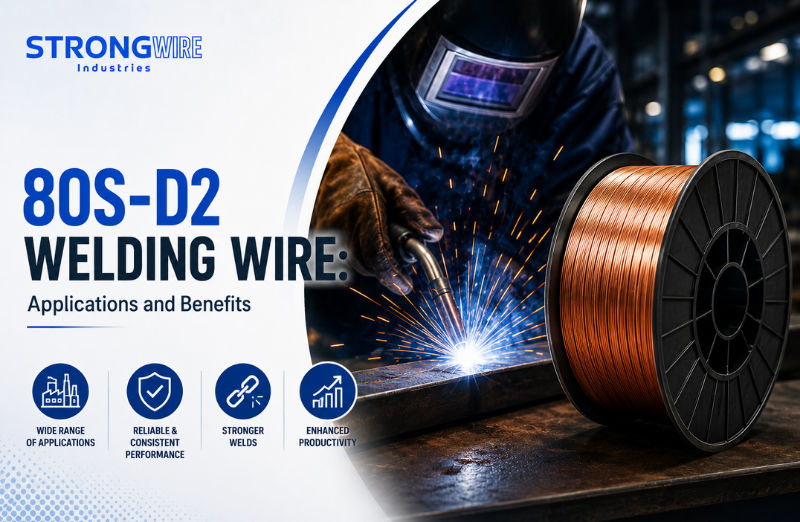
80S-D2 welding wire is a copper-coated, solid low-alloy steel wire designed for welding applications where higher strength, improved toughness, and resistance to atmospheric conditions are important. It is commonly used with the MIG/GMAW welding process and is selected for fabricating and repairing carbon and low-alloy steel components.
For manufacturers, fabricators, maintenance teams, and B2B buyers, choosing the correct MIG welding wire is important because the wire influences weld strength, deposition performance, arc stability, productivity, and the overall quality of the finished fabrication.
This guide explains what 80S-D2 welding wire is, where it is used, its key benefits, how it compares with conventional welding wire, and what buyers should check before purchasing.
What Is 80S-D2 Welding Wire?
80S-D2 is a solid low-alloy welding wire classified under AWS A5.28 for gas-shielded arc welding of carbon and low-alloy steels.
The “80” in the designation generally relates to a minimum tensile-strength level of approximately 80 ksi (550 MPa) for the deposited weld metal under the applicable classification conditions. The “D2” designation identifies the alloying system, which includes elements such as manganese, silicon, molybdenum, and other controlled alloying constituents.
The exact chemical composition and mechanical properties can vary according to the applicable standard and manufacturer specification. Therefore, B2B buyers should always verify the manufacturer’s technical data sheet and applicable AWS classification before final procurement.
80S-D2 is typically supplied as a solid welding wire and used with a suitable shielding gas. Its alloy composition makes it particularly useful when a conventional mild-steel wire does not provide the required weld-metal strength or service performance.
Why Choose 80S-D2 Instead of Standard MIG Welding Wire?
Standard carbon-steel MIG wires such as ER70S-series wires are suitable for many general fabrication applications. However, some components require higher-strength weld metal or improved performance under demanding service conditions.
This is where 80S-D2 can provide an advantage.
Key reasons for selecting 80S-D2 include:
- Higher-strength weld-metal capability
- Suitable for carbon and low-alloy steel fabrication
- Good arc characteristics when correctly matched with equipment and shielding gas
- Consistent deposition in mechanized and semi-automatic welding
- Suitable for structural and heavy-duty fabrication
- Useful for repair and maintenance applications
- Appropriate for components exposed to demanding mechanical service
- Can support higher productivity compared with manual electrode welding in suitable applications
The correct wire should always be selected based on the parent material, joint design, required mechanical properties, welding position, shielding gas, preheat/interpass requirements, and applicable welding procedure.
Chemical Composition and Metallurgical Characteristics
80S-D2 belongs to the low-alloy welding-wire family. Its alloying elements are controlled to achieve the desired combination of strength, toughness, weldability, and service performance.
Typical elements associated with an 80S-D2 classification include:
| Element | Purpose in Welding Wire |
| Carbon | Contributes to strength and hardness |
| Manganese | Supports strength and deoxidation |
| Silicon | Acts as a deoxidizer and influences weld cleanliness |
| Molybdenum | Helps improve strength, particularly at elevated temperatures |
| Copper | May be present depending on the product specification and coating system |
Exact limits should not be assumed from a generic description. Buyers should compare the mill test certificate, chemical composition, AWS classification, and manufacturer’s technical data sheet with their welding procedure requirements.
Main Applications of 80S-D2 Welding Wire
80S-D2 welding wire is primarily selected for applications where stronger weld deposits are required than those normally associated with standard mild-steel MIG wires.
1. Heavy Equipment Manufacturing
Manufacturers of construction and industrial equipment may use low-alloy welding wires for components subjected to substantial mechanical loads.
Typical applications can include:
- Equipment frames
- Heavy-duty structural components
- Machinery assemblies
- Support structures
- Load-bearing fabricated components
The welding procedure should be qualified for the specific base material and service requirements.
2. Structural Steel Fabrication
80S-D2 can be considered for structural fabrication involving suitable carbon or low-alloy steels where the specified weld-metal strength requires a low-alloy consumable.
For structural projects, buyers should ensure that the selected wire complies with the project specification and applicable structural welding code.
3. Pressure and Process Equipment
Certain pressure and process-equipment applications use low-alloy steels because of their strength and temperature-service requirements. Where specified by the applicable welding procedure, a suitable 80S-D2-class wire can be used for joining compatible materials.
For pressure-retaining components, the consumable should never be selected solely from a product name. The approved WPS/PQR, base-metal grade, design code, heat treatment, and service conditions must determine the final consumable selection.
4. Automotive and Transportation Components
Heavy-duty vehicle and transportation-equipment manufacturers may require welding consumables capable of producing strong and reliable joints.
Potential applications include:
- Chassis-related fabrication
- Heavy vehicle components
- Trailer structures
- Frames and brackets
- Industrial transport equipment
Actual suitability depends on the base material and manufacturer’s welding procedure.
5. Machinery and Industrial Fabrication
Industrial machinery often contains fabricated components that experience vibration, impact, mechanical loading, or repeated service cycles.
80S-D2 may be suitable where the welding specification calls for a low-alloy solid wire with the required strength characteristics.
6. Repair and Maintenance Welding
Maintenance teams may use low-alloy MIG welding wires for repairing suitable carbon and low-alloy steel components.
Before repair welding, it is important to identify the base material and understand its previous heat treatment and service history. Some steels require controlled preheating, interpass temperature management, or post-weld heat treatment.
Key Benefits of 80S-D2 Welding Wire
Higher Weld Strength
One of the primary reasons to select 80S-D2 is its higher-strength weld-metal capability compared with many general-purpose mild-steel welding wires.
This can make it appropriate for demanding fabricated structures when specified by the welding procedure.
Good Deposition Productivity
As a solid MIG welding wire, 80S-D2 can provide continuous wire feeding. This can reduce the interruptions associated with changing stick electrodes and may improve welding productivity in suitable applications.
Consistent Welding
Quality solid wire manufactured to controlled chemical and dimensional specifications can provide consistent feeding and deposition. Consistency is particularly important for automated and semi-automated welding operations.
Suitable for Mechanized Welding
Where the welding procedure permits it, continuous wire feeding makes the product suitable for mechanized or automated welding systems.
This can be valuable for manufacturers producing repeated assemblies in larger quantities.
Low-Alloy Weld Metal
The controlled alloying system provides characteristics that make 80S-D2 different from ordinary carbon-steel MIG wires. This is especially useful when weld-metal strength and service requirements demand a low-alloy consumable.
80S-D2 vs 70S-6 Welding Wire
One of the most important purchasing decisions is understanding whether a standard ER70S-6 wire or an 80S-D2-class wire is appropriate.
| Feature | 80S-D2 | ER70S-6 |
| Wire type | Solid low-alloy wire | Solid carbon-steel wire |
| Typical strength class | Higher strength | General-purpose strength |
| Alloy system | Low-alloy | Carbon/manganese/silicon steel |
| Typical use | Higher-strength applications | General fabrication |
| MIG/GMAW use | Yes, with suitable gas/procedure | Yes |
| Application selection | Based on WPS and material | Broad general fabrication use |
The higher strength of 80S-D2 does not automatically make it the better choice for every application. Using a higher-strength wire when it is not specified can affect weld-metal properties, cost, procedure qualification, and overall fabrication requirements.
The correct welding wire is the one that matches the engineering specification.
Choosing the Right Shielding Gas
Shielding gas selection has a direct effect on arc stability, penetration, spatter, weld profile, and weld-metal chemistry.
Depending on the specific 80S-D2 product and welding procedure, shielding gases may include argon-based mixtures or other gases permitted by the applicable classification and manufacturer recommendations.
Buyers should confirm:
- Recommended shielding gas
- Gas flow rate
- Welding current range
- Voltage range
- Wire-feed speed
- Contact-tip-to-work distance
- Welding position
- Preheat and interpass requirements
Do not copy settings from a different wire simply because both products are used for MIG welding.
Welding Parameters Matter
The performance of 80S-D2 depends on more than the wire itself.
Important process variables include:
- Wire diameter
- Welding current
- Arc voltage
- Wire-feed speed
- Travel speed
- Shielding gas
- Gas flow
- Polarity
- Joint preparation
- Base-metal thickness
- Preheat temperature
- Interpass temperature
- Welding position
Manufacturers should establish and follow a qualified welding procedure wherever the application or applicable code requires one.
Available Wire Diameters
80S-D2 welding wire is generally available in different diameters to suit welding current, material thickness, equipment configuration, and production requirements.
Common MIG wire diameters in industrial welding can include approximately:
- 0.8 mm
- 1.0 mm
- 1.2 mm
- 1.6 mm
Availability varies by manufacturer and market.
For B2B purchasing, selecting diameter based on the actual welding process is more important than simply choosing the most commonly available size.
How to Store 80S-D2 Welding Wire
Correct storage protects the wire from contamination and moisture-related problems.
Recommended practices include:
- Store unopened packages in a clean and dry environment.
- Keep wire away from water, condensation, and excessive humidity.
- Do not place wire directly on the floor.
- Keep packages sealed until required for production.
- Protect opened spools from dust and contaminants.
- Follow the manufacturer’s storage recommendations.
- Check the wire surface before installation.
- Avoid using wire with visible rust, contamination, or surface damage.
Poor storage can contribute to feeding problems, porosity, inconsistent arc performance, and weld defects.
Common Welding Problems and Their Causes
Even high-quality welding wire cannot compensate for poor process control.
Porosity
Possible causes include:
- Insufficient shielding gas
- Gas leaks
- Excessive wind or air movement
- Contaminated base metal
- Moisture
- Incorrect torch positioning
Excessive Spatter
Possible causes can include:
- Incorrect voltage
- Incorrect wire-feed speed
- Poor shielding-gas selection
- Incorrect contact-tip-to-work distance
- Unstable arc conditions
Poor Wire Feeding
Possible causes include:
- Damaged spool
- Incorrect drive-roll selection
- Dirty liner
- Incorrect drive-roll pressure
- Excessive cable bends
- Contaminated wire
A systematic process check should be performed before assuming that the consumable itself is defective.
What B2B Buyers Should Check Before Purchasing
For industrial procurement, price should not be the only purchasing factor. A small difference in wire price can become insignificant if poor-quality consumables increase rework, downtime, or rejected welds.
Before placing a bulk order, buyers should evaluate:
1. AWS Classification
Confirm that the product classification matches the welding procedure and application.
2. Chemical Composition
Request the manufacturer’s technical data and, where required, a mill test certificate or certificate of conformity.
3. Wire Diameter Tolerance
Consistent diameter supports reliable feeding, especially in automated welding.
4. Surface and Copper Coating Quality
The wire surface should be clean and suitable for consistent feeding and electrical contact.
5. Spool and Packaging Quality
Industrial packaging should protect the wire from moisture, contamination, deformation, and handling damage.
6. Batch Traceability
For industrial applications, batch or lot traceability can help manufacturers maintain quality records and investigate production issues.
7. Technical Support
A reliable welding wire supplier should be able to provide technical documentation and product guidance rather than competing only on price.
8. Supply Capacity
Large fabrication companies should evaluate monthly production capacity, stock availability, lead times, export capability, and consistency between batches.
How to Select Welding Wire Manufacturers in India
When evaluating welding wire manufacturers in India, B2B buyers should look beyond catalogue availability.
Consider:
- Manufacturing capabilities
- Quality-control systems
- Applicable welding standards
- Raw-material control
- Batch consistency
- Testing facilities
- Product documentation
- Packaging standards
- Production capacity
- Domestic and export supply capability
- Technical support
- Delivery reliability
For large-volume users, it is also useful to conduct sample trials before approving a consumable for regular production.
Why Product Trials Are Important
A wire that performs well in one workshop may require different settings in another facility because welding machines, base materials, joint designs, shielding gases, and operators can vary.
Before committing to a large order, manufacturers can conduct a controlled trial covering:
- Arc stability
- Wire feeding
- Weld appearance
- Penetration
- Spatter level
- Deposition rate
- Mechanical properties where required
- Radiographic or ultrasonic testing where applicable
- Consumable consumption
- Overall welding cost
This provides more meaningful purchasing information than comparing the price per kilogram alone.
Understanding the Total Cost of Welding
The cheapest welding wire is not necessarily the lowest-cost welding solution.
A practical cost evaluation should consider:
Total welding cost = Consumable cost + shielding gas + labour + electricity + equipment time + rework + inspection + downtime
A wire that costs slightly more per kilogram may reduce rework or increase productivity, potentially lowering the total cost per finished component.
For B2B buyers, this total-cost approach is particularly important in high-volume fabrication.
80S-D2 Welding Wire: Buyer Checklist
Before purchasing, confirm:
- Required AWS classification
- Base-metal grade
- Required weld-metal strength
- Welding process
- Recommended shielding gas
- Wire diameter
- Welding position
- Required mechanical properties
- WPS/PQR requirements
- Preheat and interpass requirements
- Heat-treatment requirements, if applicable
- Packaging and spool size
- Batch traceability
- Certificate requirements
- Required monthly quantity
- Delivery schedule
- Supplier technical support
Conclusion
80S-D2 welding wire is a specialized solid low-alloy MIG welding wire designed for applications that require stronger weld-metal performance than many general-purpose carbon-steel wires. Its suitability for heavy fabrication, machinery, structural components, transportation equipment, and specified repair applications makes it an important option within the broader range of welding wire types.
For manufacturers and B2B buyers, the best purchasing decision goes beyond wire price. Classification, base-metal compatibility, welding procedure, shielding gas, wire diameter, batch consistency, packaging, certification, and supplier reliability should all be evaluated before procurement.
When comparing welding wire suppliers or welding wire manufacturers in India, buyers should prioritize documented quality, consistent production, technical support, and dependable supply. A properly selected 80S-D2 wire can help manufacturers achieve reliable weld quality, productivity, and performance across demanding industrial applications.
For reliable 80S-D2 welding wire and expert product support, contact STRONGWIRE today to discuss your industrial welding requirements.