
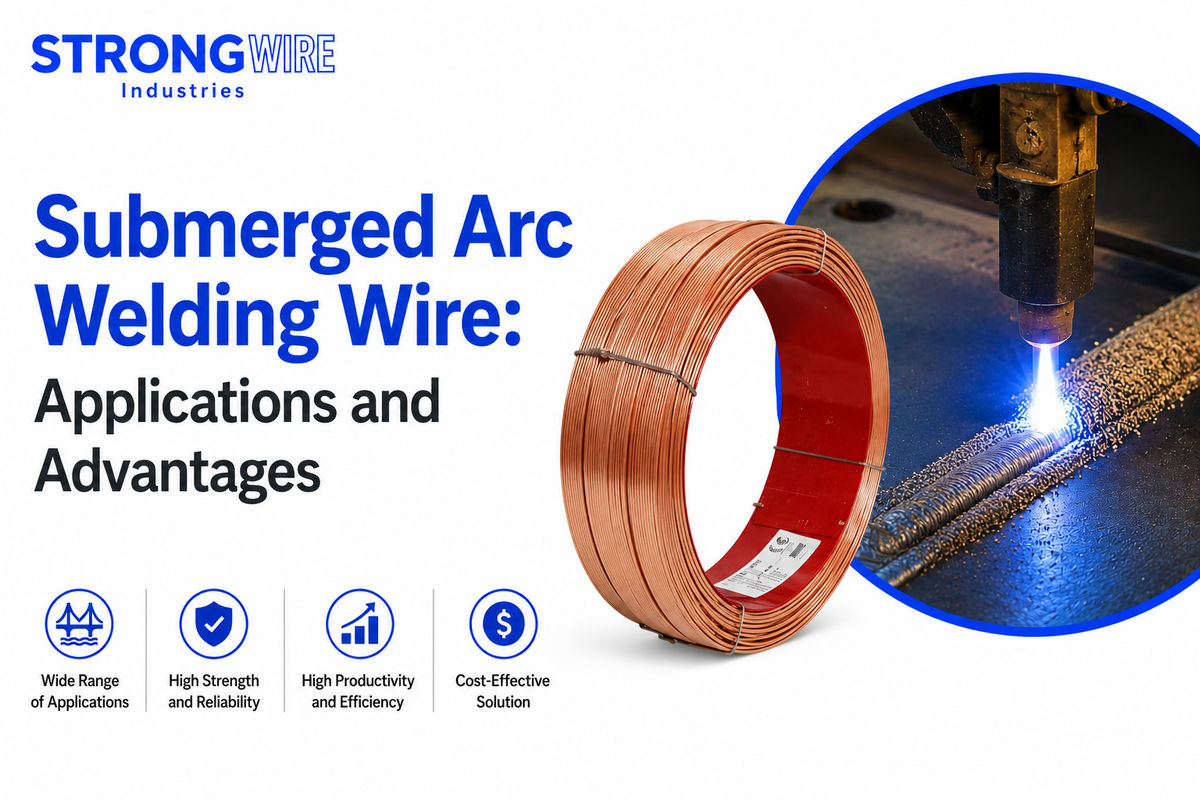
In heavy engineering, infrastructure development, shipbuilding, pressure vessel manufacturing, and structural steel fabrication, welding quality and productivity are critical factors that directly impact project success. As industries increasingly seek efficient welding solutions for large-scale fabrication, the demand for reliable submerged arc welding wire continues to grow.
The submerged arc welding process (SAW) is widely recognized for its ability to produce high-quality welds with excellent penetration, minimal spatter, and superior productivity. When combined with the right industrial welding wire, SAW becomes one of the most efficient welding methods for high-volume manufacturing and heavy fabrication applications.
This guide explores the applications, advantages, and selection criteria of submerged arc welding wire, helping engineers, procurement managers, plant managers, and industrial buyers make informed decisions.
What is Submerged Arc Welding Wire?
Definition Snippet
Submerged arc welding wire is a continuous electrode wire used in the submerged arc welding process, where the welding arc operates beneath a layer of granular flux. The flux protects the weld pool from atmospheric contamination and contributes to improved weld quality.
Unlike conventional welding methods, the arc remains completely submerged under the flux blanket, resulting in cleaner and more efficient welding operations.
Submerged arc welding wire is commonly used for:
- Structural steel fabrication
- Heavy equipment manufacturing
- Pressure vessels
- Shipbuilding
- Industrial construction
- Pipeline fabrication
How Does the Submerged Arc Welding Process Work?
The submerged arc welding process uses a continuously fed electrode wire along with a layer of welding flux.
The process follows these steps:
- Welding wire is fed automatically into the weld joint.
- Granular flux covers the welding area.
- An electric arc forms beneath the flux layer.
- The arc melts both the wire and base material.
- Flux protects the molten weld pool from contamination.
- Solidified slag is removed after welding.
Because the arc remains covered, the process provides:
- Reduced weld spatter
- Minimal smoke generation
- Deep penetration
- High deposition rates
- Improved weld consistency
Key Types of Submerged Arc Welding Wire
Carbon Steel Welding Wire
Commonly used for general fabrication and structural applications.
Applications include:
- Buildings
- Industrial structures
- Fabrication workshops
- Infrastructure projects
Structural Steel Welding Wire
Structural steel welding wire is designed to meet mechanical property requirements for load-bearing structures.
Benefits include:
- High tensile strength
- Reliable toughness
- Excellent weld integrity
- Consistent performance
Low Alloy Welding Wire
Used where improved mechanical properties are required.
Suitable for:
- Heavy engineering
- Pressure vessels
- Industrial machinery
- Energy projects
Heavy Fabrication Welding Wire
Heavy fabrication welding wire is specifically developed for large-scale industrial fabrication requiring deep penetration and high deposition efficiency.
Key Features and Benefits of Submerged Arc Welding Wire
High Deposition Rates
One of the biggest advantages of SAW is its ability to achieve significantly higher deposition rates than many conventional welding methods.
Benefits include:
- Faster welding speeds
- Increased throughput
- Improved production efficiency
Deep Weld Penetration
Submerged arc welding wire enables strong fusion and excellent penetration.
Benefits include:
- Enhanced weld strength
- Improved structural integrity
- Reliable performance in critical applications
Superior Weld Quality
The flux layer protects the weld pool throughout the process.
Benefits include:
- Reduced contamination
- Lower defect rates
- Improved weld consistency
Minimal Spatter
Because the arc is submerged beneath flux, spatter generation is significantly reduced.
Benefits include:
- Cleaner work environments
- Reduced post-weld cleaning
- Better weld appearance
Automation Compatibility
The submerged arc welding process is highly suitable for automated and mechanized systems.
Benefits include:
- Repeatable results
- Improved productivity
- Lower labor requirements
How Submerged Arc Welding Wire Improves Industrial Performance
Benefit Snippet
Submerged arc welding wire improves industrial performance by delivering high deposition rates, superior weld quality, reduced defects, and support for high-volume manufacturing operations.
Supports High Productivity Welding Process
The SAW process is often considered a high productivity welding process due to its ability to maintain continuous welding operations.
Advantages include:
- Faster project completion
- Higher output
- Reduced production bottlenecks
Enhances Weld Consistency
Consistent wire chemistry and controlled welding parameters contribute to:
- Uniform penetration
- Stable mechanical properties
- Improved quality control
Reduces Rework
Quality industrial welding wire helps minimize:
- Porosity
- Cracking
- Incomplete fusion
- Weld discontinuities
Reducing defects lowers overall production costs.
Applications Across Industries
Structural Steel Fabrication
SAW is widely used for:
- Steel structures
- Bridges
- Industrial buildings
- Infrastructure projects
Shipbuilding Industry
Submerged arc welding wire supports:
- Hull fabrication
- Offshore structures
- Marine equipment manufacturing
Pressure Vessel Manufacturing
Used in:
- Boilers
- Storage tanks
- Pressure vessels
- Process equipment
Heavy Engineering
Applications include:
- Industrial machinery
- Mining equipment
- Material handling systems
- Heavy fabrication projects
Energy and Power Generation
Used for:
- Power plant construction
- Wind energy towers
- Industrial facilities
- Transmission structures
Factors to Consider Before Selection
Base Material Compatibility
Match the wire composition with the base metal.
Common materials include:
- Carbon steel
- Structural steel
- Low alloy steel
- High-strength steel
Mechanical Property Requirements
Evaluate:
- Tensile strength
- Yield strength
- Toughness
- Impact resistance
Flux Compatibility
Submerged arc welding wire should be compatible with the selected welding flux.
Proper wire-flux combinations improve:
- Weld quality
- Mechanical properties
- Productivity
Production Requirements
For high-volume manufacturing, select wire optimized for:
- High deposition rates
- Automation
- Continuous welding operations
Joint Design and Thickness
Material thickness and joint configuration influence wire selection.
Common Mistakes to Avoid
- Choosing welding wire based only on cost can result in poor welding performance and reduced weld quality.
- Ignoring flux compatibility may lead to improper fusion, defects, and reduced weld strength.
- Overlooking required mechanical properties can compromise structural integrity and fail design specifications.
- Using incorrect welding parameters such as current, voltage, and travel speed can reduce efficiency and weld consistency.
- Selecting the wrong wire diameter can negatively affect weld penetration, deposition rate, arc stability, and overall productivity.
Why Industries Prefer Submerged Arc Welding Wire
Industry Use-Case Snippet
Industries prefer submerged arc welding wire because it delivers excellent weld quality, high deposition rates, deep penetration, and supports large-scale fabrication projects.
Key Reasons
- High productivity welding process
- Superior weld quality
- Reduced defects
- Excellent penetration
- Low spatter generation
- Automation compatibility
- Improved efficiency
- Lower rework rates
- Reliable mechanical properties
- Consistent production performance
These advantages make SAW one of the most preferred welding methods for industrial manufacturing and heavy fabrication.
Why Choose STRONGWIRE?
STRONGWIRE supports industrial welding applications with a focus on quality, consistency, and technical reliability.
Industry Expertise
- Experience serving fabrication and engineering industries
- Understanding of industrial welding requirements
- Application-driven solutions
Product Quality
- Strict manufacturing controls
- Consistent product performance
- Reliable welding results
Custom Manufacturing Capabilities
- Solutions tailored to industry needs
- Support for diverse welding applications
Technical Support
- Guidance on wire and flux selection
- Welding parameter recommendations
- Application assistance
Reliable Supply
- Consistent product availability
- Support for uninterrupted production schedules
Consistent Performance
- Stable welding characteristics
- Reliable mechanical properties
- Uniform weld quality
Customer-Focused Approach
- Practical technical assistance
- Long-term customer support
- Focus on operational efficiency
Conclusion
The submerged arc welding process remains one of the most efficient and reliable welding methods for large-scale industrial fabrication. By combining high deposition rates, excellent weld quality, and automation compatibility, submerged arc welding wire helps industries improve productivity while maintaining strict quality standards.
Whether used for structural steel fabrication, pressure vessel manufacturing, shipbuilding, or heavy engineering, selecting the right industrial welding wire and compatible flux system is essential for achieving optimal welding performance.
Partnering with an experienced manufacturer such as STRONGWIRE can help organizations maintain quality, consistency, and efficiency across demanding welding applications.