
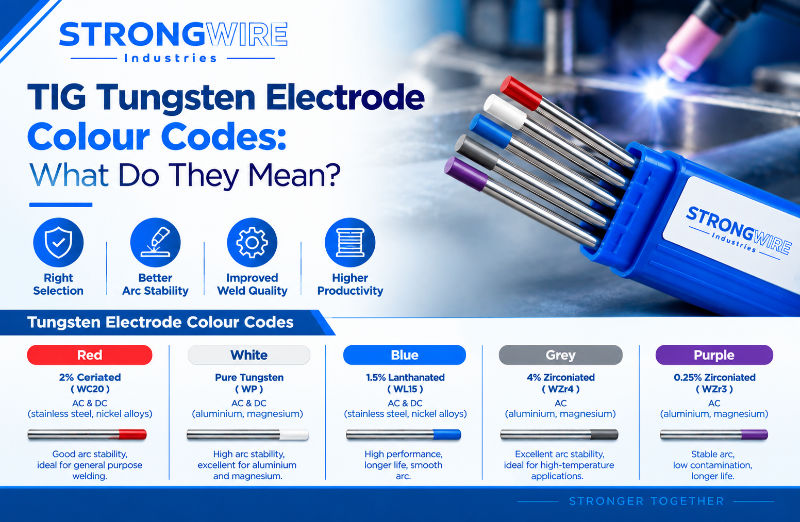
TIG welding depends on precise arc control, and choosing the correct tungsten electrode is an important part of achieving consistent results. One of the quickest ways to identify an electrode is its colour band, which indicates the electrode classification and helps distinguish different oxide compositions.
TIG tungsten electrode colour codes identify the type of tungsten electrode and its alloying additives. Common examples include red for 2% thoriated tungsten, blue for 2% lanthanated tungsten, grey for 2% ceriated tungsten in commonly used identification systems, and white for 0.8% zirconiated tungsten. However, colour conventions can vary between classifications and suppliers, so the printed classification and technical specification should always be checked before use.
For welding professionals, fabrication companies, OEMs and industrial buyers, understanding these codes helps simplify electrode selection, inventory management and technical purchasing.
TIG Tungsten Electrode Colour Codes: Quick Reference Chart
The following table combines common industry colour conventions with the classifications published for relevant STRONGWIRE products. Confirm the applicable standard and product documentation when ordering, especially for electrodes containing multiple rare-earth oxides.
| Tungsten electrode type | Common colour code | Typical classification | Main selection consideration |
| Thoriated, approximately 2% thorium oxide | Red | EWTh-2 / WT20 | Established option for DC TIG welding |
| Lanthanated, approximately 2% lanthanum oxide | Blue | EWLa-2 / WL20 | Versatile AC/DC applications |
| Ceriated, approximately 2% cerium oxide | Grey in common current conventions; orange appears in some older references | EWCe-2 / WC20 | Low-current and precision welding |
| Zirconiated, approximately 0.8% zirconium oxide | White | EWZr-8 / WZ8 | Commonly selected for AC welding, including aluminium |
| Multi-compound rare-earth tungsten | Supplier- and classification-dependent | Check product designation | Confirm the exact oxide blend and specified colour |
AWS A5.12M/A5.12:2024 addresses classification, chemical composition, product identification and colour coding for tungsten and oxide-dispersed tungsten electrodes. Colour alone is not a substitute for checking the classification.
STRONGWIRE’s published product information identifies its WT20 thoriated electrode as red, WL20 lanthanated electrode as blue, and WZ8 zirconiated electrode as white. Its product range also includes ceriated and multi-compound rare-earth tungsten electrodes.
What Do the Different Tungsten Electrode Colours Mean?
1. Red – Thoriated Tungsten Electrodes
Red is the common colour code for 2% thoriated tungsten, classified as EWTh-2 under AWS terminology and WT20 under the corresponding ISO designation.
These electrodes contain thorium oxide, which influences electron emission and arc characteristics. Thoriated tungsten has traditionally been used for DC TIG welding because of its established arc-starting behaviour, stability and current-carrying capability.
Typical applications include:
- Carbon steel and stainless steel fabrication
- Nickel-alloy welding
- Industrial equipment manufacturing
- Applications using an established procedure that specifies thoriated tungsten
Important safety consideration: Thorium is radioactive. Grinding thoriated electrodes can generate dust containing thorium, so appropriate local extraction, dust control, housekeeping and workplace safety procedures are essential. Where an alternative is permitted by the welding procedure, a non-thoriated electrode may be considered.
For product-specific composition and identification, refer to STRONGWIRE Thoriated Tungsten Electrodes.
2. Blue – Lanthanated Tungsten Electrodes
Blue commonly identifies 2% lanthanated tungsten, designated EWLa-2 / WL20. The electrode contains lanthanum oxide rather than thorium oxide.
Lanthanated tungsten is valued for reliable arc starting and stable operation. Depending on electrode diameter, current, preparation and equipment, it can be used across suitable AC and DC TIG applications.
Potential applications include:
- Stainless steel fabrication
- Carbon steel welding
- Aluminium welding with compatible AC TIG equipment
- Nickel-alloy and other precision welding work
For purchasing teams, the lanthanum concentration matters. Different lanthanated grades can use different colour codes, so a blue band should not be assumed to identify every lanthanated electrode.
STRONGWIRE’s WL20 Lanthanated Tungsten Electrode page specifies 1.70–2.20% lanthanum oxide and a blue colour code.
3. Grey – Ceriated Tungsten Electrodes
Ceriated tungsten contains cerium oxide. The commonly used 2% grade is EWCe-2 / WC20 and is frequently identified by a grey colour band in current identification conventions. Some older references and products use orange, so the classification should take priority over colour alone.
Ceriated tungsten is particularly associated with good arc initiation at lower current levels. It can be useful when the welding task requires controlled starts and precise heat input.
Typical applications include:
- Thin sheet-metal fabrication
- Small components and precision assemblies
- Low-current TIG operations
- Certain orbital tube-welding applications
Its suitability depends on the welding procedure and operating range; the colour does not establish a universal current limit or guarantee a particular weld result.
See STRONGWIRE Ceriated Tungsten Electrodes for product-specific details.
4. White – Zirconiated Tungsten Electrodes
White commonly identifies WZ8, a zirconiated tungsten grade containing approximately 0.8% zirconium oxide.
Zirconiated tungsten is commonly used for AC TIG welding, particularly when welding aluminium and magnesium alloys. Under suitable conditions, it can maintain a stable balled tip and help resist tungsten contamination of the weld pool.
Applications may include:
- Aluminium fabrication
- Magnesium-alloy welding
- Automotive and marine components
- Industrial fabrication involving non-ferrous metals
Electrode selection must still account for the AC power source, current, electrode diameter and tip preparation. Not every aluminium welding application requires zirconiated tungsten.
STRONGWIRE’s WZ8 Zirconiated Tungsten Electrode page identifies the oxide range as 0.65–1.10% and the colour code as white.
5. Multi-Compound Rare-Earth Tungsten Electrodes
Multi-compound rare-earth electrodes contain combinations of oxide additives rather than relying on a single principal additive. Their performance depends on the actual composition and the manufacturer’s classification.
These products may be considered when a welding application calls for particular arc-starting or operating characteristics. However, there is no single universal colour code that should be assumed for every proprietary rare-earth blend.
Before placing an order, confirm:
- The exact electrode designation
- The oxide composition stated in the technical documentation
- The manufacturer’s colour-code convention
- The recommended current type and application range
- Compliance with the required welding procedure
STRONGWIRE lists a Multi-Compound Rare-Earth Tungsten Electrode in its published product range. Buyers should use the product documentation to verify its exact classification and colour identification.
Why Are Tungsten Electrodes Alloyed With Different Oxides?
Tungsten is used as a non-consumable electrode in gas tungsten arc welding (GTAW), commonly called TIG welding. The electrode establishes and maintains the arc; filler metal, when required, is supplied separately.
Small additions of oxides such as thorium oxide, lanthanum oxide, cerium oxide or zirconium oxide alter the electrode’s electron-emission and operating characteristics. These differences can influence arc initiation, stability, tip behaviour and electrode wear under particular conditions.
The result is that two electrodes with the same diameter may behave differently in the same welding setup. Neither colour nor oxide composition alone determines the outcome: current, polarity, electrode preparation, shielding gas, base material and power-source characteristics also matter.
For industrial applications, electrode selection should follow the welding procedure and equipment manufacturer’s recommendations rather than a general-purpose colour chart.
How to Choose a TIG Tungsten Electrode
When deciding how to choose a TIG tungsten electrode, use the following checks before selecting a product.
Identify the welding process and current
Determine whether the job uses AC or DC and establish the operating current. Different electrode compositions are suited to different operating conditions, and the appropriate choice depends on the complete setup.
Confirm the base material
Identify whether the work involves carbon steel, stainless steel, aluminium, nickel alloys, titanium or another material. Aluminium is commonly welded using AC TIG, while many steel applications use DC TIG, but the applicable procedure takes precedence.
Select the correct diameter and tip preparation
The electrode diameter must match the intended current range and application. Tip geometry should also be appropriate for the electrode type and welding process. An unsuitable diameter or preparation can compromise arc control and electrode life.
Verify the classification, not just the colour
Check the packaging, grade designation, oxide composition and technical data. This is particularly important for ceriated electrodes, where colour conventions may differ, and for multi-compound rare-earth grades.
Consider safety and procedure requirements
Review workplace controls for grinding and handling, particularly when using thoriated tungsten. For qualified production welding, do not substitute one electrode classification for another without the required technical review and approval.
Common Mistakes When Reading Tungsten Electrode Colour Codes
Assuming every manufacturer uses the same colour convention: Colours can differ across classifications, grades and older references.
Ignoring the electrode designation: A product code and documented composition provide stronger identification than paint alone.
Choosing an electrode based only on the base metal: Current, polarity, electrode diameter, equipment and procedure all affect selection.
Treating all rare-earth electrodes as identical: Multi-compound electrodes can have different compositions and operating characteristics.
Changing an approved welding procedure without review: A substitute electrode should be evaluated against the applicable procedure, code and customer requirements.
Why Industrial Buyers Should Verify Electrode Specifications
For procurement teams, colour-code knowledge is most useful when it supports consistent purchasing and traceability. An order should identify the required grade, diameter, length, quantity, applicable classification and any documentation or inspection requirements.
Where welding work is subject to a qualified welding procedure specification (WPS), purchasing should match that specification. If an alternative electrode is proposed, the welding engineer or responsible technical authority should determine whether a change is acceptable.
STRONGWIRE’s published range includes thoriated, lanthanated, ceriated, zirconiated and multi-compound rare-earth tungsten electrodes. Buyers can review the relevant product pages and confirm grade-specific details before ordering.
Conclusion
TIG tungsten electrode colour codes provide a quick way to distinguish common electrode types, but the colour band is only the starting point. Red commonly identifies thoriated tungsten, blue identifies 2% lanthanated tungsten, grey is commonly used for 2% ceriated tungsten, and white identifies WZ8 zirconiated tungsten. Multi-compound rare-earth grades require particular attention to the manufacturer’s classification.
For reliable selection, verify the electrode designation and composition, then match the product to the current, base material, power source, electrode diameter, safety requirements and approved welding procedure.
STRONGWIRE offers a range of tungsten electrodes for industrial welding requirements. Review the product specifications and contact STRONGWIRE to discuss the required electrode grade, dimensions and supply details.
Request a Quote for your tungsten electrode requirements.