
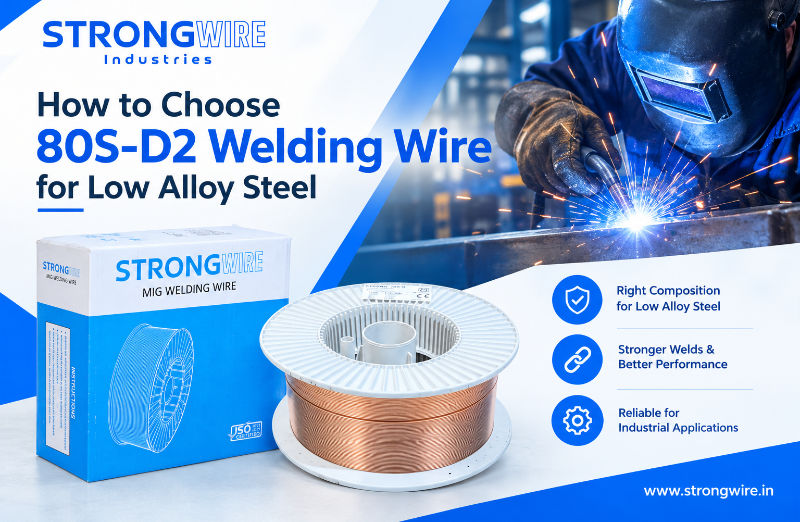
Choosing the right welding wire is critical when joining low alloy steel, especially in applications where strength, toughness, crack resistance, and weld reliability are important. Among the available consumables, 80S-D2 welding wire is commonly considered for welding certain low alloy and higher-strength steels because of its alloying characteristics and mechanical performance.
However, selecting a welding wire should not be based on tensile strength alone. Material grade, welding process, joint design, service conditions, preheating requirements, shielding gas, welding position, and applicable standards all influence the final choice.
This guide explains how to select 80S-D2 welding wire for low alloy steel and what engineers, fabricators, procurement teams, and industrial buyers should evaluate before purchasing.
What Is 80S-D2 Welding Wire?
80S-D2 welding wire is a low-alloy, copper-coated solid welding wire typically associated with the AWS classification ER80S-D2. It is designed for applications where a stronger and more alloyed weld deposit is required than conventional mild-steel welding wires can provide.
The designation provides information about the wire’s expected performance and classification under the relevant welding specification. The “80” indicates a minimum tensile-strength level of approximately 80 ksi for the deposited weld metal under the classification system, while “S” identifies a solid wire.
The D2 classification indicates an alloyed wire chemistry containing elements such as manganese, silicon, molybdenum, and other controlled constituents depending on the applicable specification.
In simple terms: ER80S-D2 is selected when the application requires a low-alloy welding consumable capable of producing a relatively high-strength weld deposit and suitable compatibility with certain low-alloy steel grades.
Why Is 80S-D2 Used for Low Alloy Steel?
Low alloy steels are developed by adding controlled quantities of alloying elements to improve properties such as strength, toughness, hardenability, or resistance to elevated-temperature service.
Using a welding wire with an appropriate alloy composition helps achieve a weld deposit whose properties are compatible with the base material and service requirements.
Common reasons engineers may consider 80S-D2 welding wire include:
- Higher weld-metal strength compared with standard mild-steel wires
- Compatibility with selected low alloy steel applications
- Good weldability when the appropriate procedure is followed
- Suitability for mechanized, automated, or production welding
- Potential use in components exposed to demanding mechanical service
- Consistent wire feeding when manufactured to appropriate dimensional tolerances
The exact suitability depends on the base-metal grade, welding procedure, applicable code, and required mechanical properties.
Understanding Welding Wire Classification
Understanding welding wire classification is an important part of consumable selection.
A classification is not simply a product name. It communicates technical characteristics established by the applicable welding standard. For ER80S-D2, engineers should review the relevant AWS specification and manufacturer’s certificate rather than assuming that every product marketed under a similar commercial description has identical chemistry or performance.
When evaluating a wire, review:
- AWS classification
- Chemical composition
- Tensile and yield strength requirements
- Elongation
- Impact toughness where applicable
- Recommended shielding gas
- Welding current and polarity
- Wire diameter
- Available spool or coil sizes
- Applicable quality certifications
- Batch or heat traceability
This information allows the welding engineer to determine whether the consumable is suitable for the specific welding procedure.
How to Choose 80S-D2 Welding Wire for Low Alloy Steel
Selecting the correct wire involves more than choosing the highest-strength consumable. The following factors should be evaluated.
1. Identify the Base Metal
First, determine the exact grade and specification of the low alloy steel being welded.
Check:
- Material grade
- Chemical composition
- Thickness
- Mechanical properties
- Heat-treatment condition
- Service temperature
- Previous welding history
The welding consumable should provide an appropriate balance between weld-metal strength and compatibility with the base material.
For critical fabrication, do not select ER80S-D2 solely because its strength appears suitable. The complete welding procedure should establish compatibility.
2. Determine the Required Weld Strength
The weld must meet the mechanical requirements of the component and applicable design code.
Consider:
- Minimum tensile strength
- Yield strength
- Elongation
- Impact toughness
- Hardness requirements
- Fatigue or cyclic loading
If the weld metal is significantly different from the base metal, engineers should evaluate whether an overmatching or undermatching approach is appropriate for the application.
3. Select the Appropriate Welding Process
ER80S-D2-type solid wires are commonly associated with gas-shielded arc welding applications, particularly GMAW.
The selected wire diameter should match:
- Material thickness
- Welding position
- Required deposition rate
- Equipment capability
- Joint configuration
- Required heat input
For production welding, a larger wire diameter may support higher deposition rates, while smaller diameters can provide better control for thinner sections and positional welding.
4. Check Shielding Gas Requirements
Shielding gas affects arc characteristics, penetration, spatter, bead profile, and weld-metal properties.
Depending on the manufacturer’s recommendations and qualified welding procedure, shielding gases may include argon-based mixtures or other suitable gas combinations.
Do not substitute shielding gases casually. Changes in gas composition can affect the welding characteristics and may require procedure qualification or requalification.
5. Consider Preheating and Interpass Temperature
Low alloy steels can be sensitive to hydrogen-assisted cracking and thermal effects.
Depending on the steel grade, thickness, carbon equivalent, restraint, and environmental conditions, preheating and controlled interpass temperatures may be necessary.
A suitable welding procedure may specify:
- Minimum preheat temperature
- Maximum interpass temperature
- Heat-input range
- Travel speed
- Post-weld heat treatment
- Hydrogen-control practices
The welding engineer should establish these parameters based on the applicable code, material requirements, and qualified procedure.
6. Evaluate Wire Quality and Manufacturing Consistency
For industrial welding, consumable consistency is extremely important.
An 80S-D2 manufacturer should be able to provide appropriate technical documentation for the supplied wire. Procurement teams should evaluate more than price.
Important considerations include:
- Chemical consistency
- Dimensional consistency
- Surface cleanliness
- Copper-coating quality
- Wire feeding performance
- Packaging integrity
- Batch traceability
- Test certificates
- Quality-control procedures
Consistent wire characteristics help reduce unnecessary variations during production welding.
Where Is 80S-D2 Welding Wire Used?
The specific applications depend on the qualified welding procedure and material combination. Potential industrial applications can include fabrication and repair of components manufactured from suitable low alloy steels.
Typical sectors may include:
- Heavy engineering
- Structural fabrication
- Industrial equipment
- Pressure-related fabrication where approved by the applicable procedure
- Machinery manufacturing
- Transportation equipment
- Energy-sector equipment
- General heavy-duty fabrication
For safety-critical applications, the welding consumable must always be evaluated against the relevant design and welding standards.
Common Mistakes When Selecting Welding Wire
Even experienced procurement teams can encounter problems when consumable selection is based primarily on price or product availability.
Common mistakes include:
- Choosing wire without confirming the base-metal grade
- Treating commercial wire names as equivalent to AWS classifications
- Ignoring shielding-gas recommendations
- Selecting wire diameter without considering joint geometry
- Overlooking preheat requirements
- Failing to verify certificates
- Mixing consumables from different specifications
- Not checking batch traceability
- Assuming every ER80S-D2 product has identical chemistry
A strong welding wire selection guide should therefore consider both technical requirements and supply-chain reliability.
How to Select an 80S-D2 Supplier
Choosing the right 80S-D2 supplier is just as important as choosing the correct classification.
Industrial buyers should ask potential suppliers for relevant technical information, including:
- Product classification
- Chemical composition
- Mechanical-test results
- Product datasheet
- Recommended welding parameters
- Available wire diameters
- Packaging options
- Quality certifications
- Batch traceability
- Inspection documentation
- Technical assistance
For repeat production requirements, supply consistency should also be considered. A supplier capable of maintaining consistent product quality across batches can help reduce variations in welding operations.
Why Choose Strongwire for Welding Wire Requirements?
Strongwire approaches industrial welding consumables with an emphasis on technical suitability, product consistency, and customer requirements.
When evaluating 80S-D2 welding wire, buyers can consider factors such as:
- Industry expertise: Understanding of industrial welding consumables and application requirements.
- Product quality: Focus on controlled manufacturing and consistent product characteristics.
- Custom manufacturing capabilities: Product specifications can be evaluated according to application and customer requirements where technically feasible.
- Technical support: Assistance with product selection and relevant technical information.
- Reliable supply: Attention to consistent production and industrial procurement requirements.
- Consistent performance: Focus on maintaining repeatable product characteristics.
- Customer-focused approach: Support for engineers, fabricators, distributors, and industrial purchasing teams.
For a critical application, customers should provide the base-metal specification, thickness, welding process, applicable standard, and required mechanical properties so that the appropriate consumable can be evaluated.
Final Checklist for Selecting 80S-D2 Welding Wire
- Before purchasing 80S-D2 welding wire, verify the following:
- Is ER80S-D2 the correct classification for the application?
- Is the base metal compatible with the consumable?
- Does the weld deposit meet the required mechanical properties?
- Is the wire diameter suitable for the joint and welding position?
- Is the recommended shielding gas available?
- Are preheat and interpass temperatures defined?
- Does the product meet the applicable welding specification?
- Is batch traceability available?
- Are inspection and test certificates provided where required?
- Can the 80S-D2 manufacturer or 80S-D2 supplier provide technical support?
Conclusion
The correct 80S-D2 welding wire should be selected based on the complete welding application rather than tensile strength or price alone. Base-metal chemistry, mechanical requirements, welding process, shielding gas, joint design, heat control, applicable standards, and consumable quality all need to be considered.
For industrial buyers, working with a technically capable 80S-D2 manufacturer or 80S-D2 supplier can make consumable selection and ongoing procurement more reliable.