
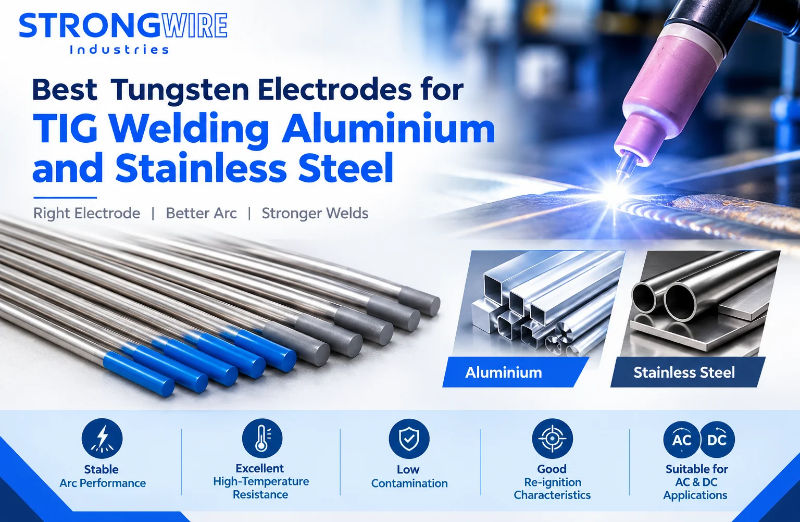
TIG welding is widely used when weld quality, arc control, appearance, and precision are important. However, achieving consistent results depends on more than choosing the right welding machine or filler metal. The tungsten electrode type, diameter, preparation, and welding conditions also have a direct influence on arc behavior.
For aluminium and stainless steel TIG welding, ceriated, lanthanated, zirconiated, and other alloyed tungsten electrodes may be considered depending on the application and power source. Modern inverter TIG machines have expanded the practical use of alloyed tungsten electrodes, particularly for AC welding of aluminium.
For engineers, welding supervisors, procurement teams, and industrial buyers, understanding tungsten electrode types helps improve electrode selection and avoid unnecessary process variation.
This guide explains which tungsten electrodes are commonly considered for aluminium and stainless steel, how tungsten electrode sizes affect performance, and what to evaluate when selecting a Tungsten Electrodes supplier or manufacturer.
What Are Tungsten Electrode Types?
Different TIG welding jobs require different electrode characteristics. Tungsten electrode types are selected according to the material being welded, welding current, machine type, and the level of arc control required.
For example, aluminium TIG welding commonly uses AC, while stainless steel is generally welded using DC. Because these applications place different demands on the tungsten electrode, choosing the appropriate composition and diameter can help maintain a stable arc and consistent welding performance.
Common options include:
- Ceriated tungsten – often selected for good arc starting and low- to medium-current applications.
- Lanthanated tungsten – known for versatile TIG performance across suitable AC and DC applications.
- Zirconiated tungsten – traditionally associated with AC welding of aluminium and magnesium alloys.
- Thoriated tungsten – commonly associated with DC TIG welding, particularly for steels and other suitable applications.
- Pure tungsten – primarily associated with specific AC welding applications and older welding practices.
The right choice should not be based on electrode color alone. Tungsten electrode sizes, welding amperage, AC or DC operation, electrode preparation, base material, and the TIG power source all need to be considered.
For industrial welding operations, selecting the correct tungsten electrode can help establish repeatable welding parameters and support consistent arc performance.
Which Tungsten Is Best for TIG Welding Aluminium?
Aluminium TIG welding commonly uses AC current because the process needs to manage the oxide layer on aluminium.
Modern inverter TIG machines provide greater flexibility in electrode selection than traditional transformer-based equipment. Ceriated and lanthanated tungsten electrodes are among the alloyed options used for AC TIG applications. Zirconiated tungsten is also traditionally associated with aluminium and magnesium welding.
Ceriated Tungsten for Aluminium
A 2% ceriated tungsten electrode is commonly identified by a gray color band.
It can provide:
- Good arc starting
- Good arc stability
- Useful low- and medium-current performance
- AC and DC TIG capability depending on the welding setup
- Suitability for a range of metals
For aluminium fabrication involving relatively controlled current levels, ceriated tungsten can be a practical option.
The electrode should still be selected according to the welding machine manufacturer’s recommendations and the applicable welding procedure.
Lanthanated Tungsten for Aluminium
Lanthanated tungsten is another alloyed electrode option for aluminium TIG welding, particularly with modern inverter equipment.
Its characteristics can make it useful where the welding operation requires:
- Stable arc behavior
- Reliable arc starting
- Consistent electrode performance
- AC/DC flexibility where supported
- Precision TIG operation
The exact electrode grade and diameter should be selected according to the welding current and equipment.
Zirconiated Tungsten for Aluminium
Zirconiated tungsten has traditionally been associated with AC welding of aluminium and magnesium alloys. It can provide good current-carrying capability and arc characteristics for these applications.
However, modern inverter machines have changed the range of practical tungsten options available to welders. Therefore, selection should be based on the complete welding setup rather than assuming that one electrode type is universally required for aluminium.
Which Tungsten Is Best for TIG Welding Stainless Steel?
Stainless steel TIG welding is generally performed using DC, commonly DC electrode negative (DCEN), although the exact process depends on the application and equipment.
Ceriated and lanthanated tungsten electrodes are commonly considered for stainless steel TIG applications because they can provide good arc-starting and stability characteristics.
Ceriated Tungsten for Stainless Steel
A ceriated tungsten electrode can be useful for stainless steel applications where:
- Low- to medium-current welding is required
- Easy arc starting is important
- Thin stainless steel components are being welded
- Precision and arc control are priorities
Miller identifies 2% ceriated tungsten as a versatile option for AC and DC TIG welding on steel, stainless steel, and aluminium.
Lanthanated Tungsten for Stainless Steel
Lanthanated tungsten is another commonly selected option for stainless steel TIG.
It may be suitable for:
- Fabrication work
- Production welding
- Precision stainless steel welding
- General industrial TIG applications
- Applications requiring stable arc characteristics
For procurement teams, the important point is that electrode selection should be tied to the actual welding procedure rather than simply choosing an electrode based on color.
Ceriated vs Lanthanated Tungsten: Which Should You Use?
There is no single tungsten electrode that is correct for every TIG application.
Ceriated tungsten can be particularly useful where good arc starting and low- to medium-current performance are important.
Lanthanated tungsten is often selected when a versatile alloyed electrode is required across a range of TIG applications.
When comparing these two tungsten electrode types, consider:
- AC or DC operation
- Welding current
- Material thickness
- Base-metal type
- TIG machine technology
- Electrode diameter
- Tip preparation
- Welding procedure
- Required arc stability
Modern inverter TIG machines have made alloyed tungsten electrodes increasingly useful for AC TIG applications.
Understanding Tungsten Electrode Sizes
Choosing the correct tungsten electrode sizes is just as important as selecting the electrode composition.
Common industrial diameters include:
- 1.0 mm
- 1.6 mm
- 2.0 mm
- 2.4 mm
- 3.2 mm
- 4.0 mm
The appropriate diameter depends on factors such as:
- Welding amperage
- Material thickness
- Current type
- Electrode composition
- AC waveform
- Torch configuration
- Joint design
- Welding procedure
A tungsten that is too small for the application can experience excessive heating or degradation. An unnecessarily large electrode may make arc starting and control more difficult at lower currents.
Miller also notes that tungsten diameter affects arc starting and current capacity, making size selection an important part of TIG setup.
Why Tungsten Preparation Matters
Even when the correct tungsten electrode type and size are selected, preparation can affect welding performance.
For DC TIG welding, electrodes are commonly prepared with a longitudinal grind and an appropriate point geometry.
For AC TIG welding, electrode preparation depends on the machine, waveform, current balance, electrode type, and welding procedure. Modern inverter machines may allow operators to use more pointed electrode preparations than traditional AC systems.
For aluminium, the electrode should also be monitored during welding. Excessive electrode contamination, overheating, or an unsuitable preparation can affect arc behavior.
The goal is to establish a repeatable preparation method that matches the welding procedure.
How to Choose Tungsten Electrodes for Aluminium and Stainless Steel
Before purchasing tungsten electrodes, welding engineers and procurement managers should evaluate several factors.
1. Identify the Base Material
Start with the material being welded.
For example:
- Aluminium → normally AC TIG
- Stainless steel → commonly DC TIG
- Thin sheet → lower current and greater arc-control requirements
- Heavy sections → higher current and potentially larger electrode diameter
This helps narrow the appropriate electrode and size.
2. Check the TIG Power Source
Determine whether the machine is:
- AC TIG
- DC TIG
- AC/DC TIG
- Transformer-based
- Inverter-based
Machine technology can influence the practical choice of tungsten electrode.
3. Determine the Welding Current
Current is one of the most important factors in selecting tungsten electrode sizes.
Higher welding currents generally require an electrode diameter and preparation appropriate for the thermal load.
Always follow the equipment manufacturer’s recommendations and the applicable welding procedure.
4. Consider Electrode Quality
For industrial purchasing, the tungsten classification is only one part of the specification.
A buyer should also consider:
- Chemical composition
- Oxide distribution
- Diameter tolerance
- Length consistency
- Straightness
- Surface condition
- Tip condition
- Packaging
- Identification and traceability
- Applicable standards
AWS A5.12M/A5.12 specifies requirements related to chemical composition, standard sizes, finish, lengths, product identification, and color coding.
Choosing a Tungsten Electrodes Supplier
Selecting a reliable Tungsten Electrodes supplier is important for manufacturers that depend on repeatable TIG welding.
Industrial buyers should evaluate whether a supplier can provide:
- Consistent electrode specifications
- Appropriate tungsten grades
- Multiple electrode sizes
- Controlled manufacturing processes
- Reliable packaging
- Product identification
- Technical information
- Repeatable supply
- Application support
For larger manufacturing operations, consistency between batches can be particularly important because changes in electrode characteristics may require adjustments to welding parameters.
Why Choose STRONGWIRE?
STRONGWIRE provides welding consumables and tungsten electrode solutions for industrial welding applications.
When evaluating STRONGWIRE as a potential tungsten electrode source, buyers can consider:
- Industry expertise: Knowledge of welding consumables and industrial welding requirements.
- Product quality: Focus on controlled composition, dimensions, and product consistency.
- Custom manufacturing capabilities: Options can be evaluated according to specific application and customer requirements.
- Technical support: Assistance with selecting suitable electrode types and sizes based on welding conditions.
- Reliable supply: Support for recurring industrial procurement requirements.
- Consistent performance: Emphasis on repeatable electrode characteristics.
- Customer-focused approach: Product recommendations based on application requirements rather than a one-size-fits-all approach.
For buyers looking for a Tungsten Electrodes manufacturer in India, STRONGWIRE can be evaluated based on product specifications, quality requirements, manufacturing capabilities, and supply needs.
Applications of Tungsten Electrodes
Tungsten electrodes are used across many TIG welding environments, including:
- Stainless steel fabrication
- Aluminium fabrication
- Automotive components
- Aerospace-related fabrication
- Chemical equipment
- Food and pharmaceutical equipment
- Pressure equipment
- Precision engineering
- General industrial manufacturing
- Repair and maintenance
The specific tungsten electrode type should always be matched to the welding process and material.
Final Takeaway
Choosing the right tungsten electrode types for aluminium and stainless steel requires more than selecting a color-coded electrode.
For aluminium, AC TIG capability, electrode composition, diameter, preparation, and modern inverter technology should be considered. For stainless steel, DC TIG requirements, current level, electrode diameter, and arc stability are important factors.
Ceriated and lanthanated tungsten electrodes can both provide useful performance across industrial TIG applications, but the correct choice depends on the welding procedure and equipment.
For procurement teams searching for a Tungsten Electrodes manufacturer in India or a dependable Tungsten Electrodes supplier, product consistency, specification control, technical support, and reliable supply should be evaluated alongside price.
STRONGWIRE focuses on these factors to support industrial users seeking dependable welding consumables for demanding fabrication and manufacturing environments