
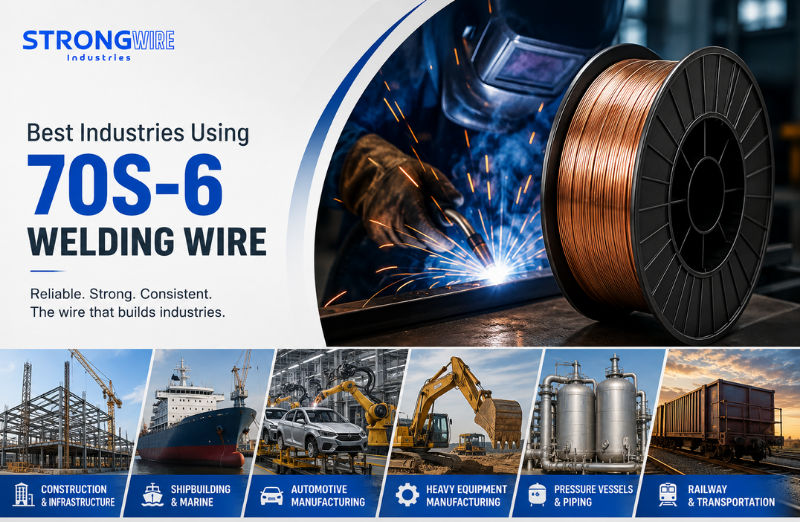
Choosing the right welding wire is an important decision for manufacturers, fabricators, contractors, and industrial procurement teams. The consumable affects weld quality, productivity, deposition performance, operating cost, and the overall reliability of fabricated components.
Among commonly used solid wires for gas metal arc welding, ER70S-6 welding wire is a popular choice for welding carbon and mild steel applications. It is particularly useful where the base material may contain a moderate amount of surface scale or where additional deoxidizing capability is beneficial.
Because of its versatility, 70S-6 welding wire is used across several industries, including automotive components, structural fabrication, machinery manufacturing, agricultural equipment, general engineering, and metal fabrication.
This guide explains where ER70S-6 welding wire is commonly used, why industries select it, what buyers should consider, and how to choose a suitable MIG welding wire supplier.
What Is ER70S-6 Welding Wire?
ER70S-6 welding wire is a solid carbon-steel welding electrode commonly used with the GMAW/MIG welding process.
The “ER” designation identifies the product as an electrode or rod, while “70” indicates a nominal minimum tensile strength of 70 ksi under the applicable classification system. “S” indicates a solid electrode, and “-6” identifies the specific chemical composition classification.
ER70S-6 is commonly selected for welding carbon and mild steels because its formulation contains relatively higher levels of deoxidizing elements such as manganese and silicon compared with some other ER70S classifications.
This makes it a practical option for many fabrication environments.
Important: Actual mechanical properties, chemical composition, shielding gas requirements, current range, and dimensional availability should always be confirmed against the applicable product standard and manufacturer’s technical data sheet.
Why Is 70S-6 Welding Wire So Widely Used?
The popularity of 70S-6 comes from its combination of versatility, availability, and suitability for common steel fabrication applications.
Key reasons include:
- Suitable for many carbon-steel applications
- Good arc characteristics when properly applied
- Compatible with common MIG/MAG welding equipment
- Available in multiple wire diameters
- Suitable for automated and semi-automated welding
- Useful for general fabrication and repair work
- Good productivity potential compared with many manual welding processes
- Widely available from industrial welding consumable suppliers
However, selecting 70S-6 should not be based simply on popularity. The welding procedure, base material, joint design, required mechanical properties, shielding gas, welding position, and applicable code or specification should all be considered.
1. Automotive and Auto Component Industry
The automotive industry is one of the important application areas for solid MIG welding wire.
Manufacturers and component suppliers use MIG welding for fabricating and assembling various carbon-steel components, brackets, frames, supports, and fabricated assemblies.
ER70S-6 can be considered for suitable mild-steel applications where its classification and mechanical properties meet the requirements of the welding procedure.
Common applications include:
- Automotive brackets
- Chassis-related fabricated components
- Supports and frames
- Exhaust-related fabrication where appropriate
- Trailer components
- Vehicle body and structural fabrication
- General automotive assemblies
For automotive suppliers, consistency is particularly important because production may involve thousands of repeated welds.
Buyers should therefore evaluate wire consistency, spool winding, feeding performance, surface cleanliness, batch traceability, and supplier quality systems rather than focusing only on purchase price.
2. Structural Steel and Fabrication
Structural fabrication involves welding beams, frames, supports, platforms, and other steel structures.
MIG/MAG welding is commonly used in fabrication workshops where productivity and repeatability are important.
Suitable ER70S-6 products may be used for:
- Steel frames
- Fabricated supports
- Platforms
- Structural assemblies
- Brackets
- Steel furniture structures
- General carbon-steel fabrication
For structural applications, however, buyers must verify the applicable project specification and welding procedure before selecting a consumable.
The cheapest wire is not necessarily the most economical choice if inconsistent feeding, spatter, downtime, or rejected welds increase production costs.
3. General Engineering and Machinery Manufacturing
Machinery manufacturers frequently fabricate components from mild and carbon steel.
ER70S-6 welding wire can be suitable for many general engineering applications involving compatible base materials.
Examples include:
- Machine frames
- Equipment supports
- Fabricated housings
- Steel guards
- Industrial stands
- Machine bases
- Material-handling equipment
- General engineering assemblies
For machinery manufacturers, the ability to use consistent wire across repeat production runs can simplify inventory planning and welding parameter control.
4. Agricultural Equipment Manufacturing
Agricultural machinery operates in demanding environments, making strong and reliable fabrication important.
Depending on the base material and design requirements, MIG welding with ER70S-6 may be used for fabrication of:
- Agricultural implements
- Equipment frames
- Brackets
- Trailer components
- Machine supports
- Cultivation equipment
- General farm machinery components
Manufacturers should select the welding consumable according to the actual steel grade and design requirements rather than assuming that ER70S-6 is appropriate for every agricultural component.
5. Construction Equipment Manufacturing
Construction equipment manufacturers produce heavy-duty machinery and fabricated assemblies.
MIG/MAG welding can be used in suitable carbon-steel fabrication processes for components such as:
- Equipment frames
- Structural supports
- Guards
- Brackets
- Fabricated attachments
- Platforms
- Non-critical structural assemblies
Heavy equipment applications can have demanding engineering requirements. Buyers should verify the consumable classification, base material compatibility, welding procedure qualification, and required mechanical properties before production.
6. Trailer and Truck Body Manufacturing
Trailer and truck-body manufacturers rely heavily on efficient steel fabrication.
ER70S-6 may be used for suitable mild-steel fabrication applications involving:
- Trailer frames
- Side supports
- Cross members
- Brackets
- Mounting structures
- General fabricated assemblies
MIG welding is particularly attractive for production environments because it allows continuous wire feeding and can provide high productivity when parameters and shielding conditions are correctly controlled.
7. Industrial Fabrication Workshops
General fabrication companies are among the most frequent users of versatile MIG welding consumables.
A fabrication workshop may work on different customer projects every week. Because of this, a flexible welding wire such as ER70S-6 can be useful for compatible carbon-steel applications.
Typical work may include:
- Gates and frames
- Steel structures
- Machinery components
- Industrial racks
- Pipe supports
- Platforms
- Brackets
- Custom steel fabrication
For these businesses, availability is often an important purchasing consideration.
A reliable MIG welding wire supplier should be able to provide consistent product availability across the wire diameters required by the workshop.
8. Metal Furniture Manufacturing
Metal furniture manufacturers use welding to create frames and structural components.
Suitable ER70S-6 MIG welding wire can be used for certain mild-steel furniture applications, including:
- Chair frames
- Table frames
- Storage racks
- Shelving
- Metal cabinets
- Office furniture frames
- Industrial furniture
In visible-finish applications, surface appearance and spatter control can be particularly important because additional grinding and finishing increase labor costs.
9. HVAC and Sheet Metal Fabrication
HVAC equipment and sheet-metal fabrication often involve relatively thin carbon-steel components.
MIG welding can be used where the material thickness, joint design, and equipment are appropriate.
Applications may include:
- Equipment frames
- Supports
- Ducting-related components
- HVAC cabinets
- Steel brackets
- Fabricated enclosures
For thin material, selecting the correct MIG welding wire diameter and welding parameters is especially important to reduce the risk of burn-through and excessive heat input.
10. Infrastructure and Industrial Projects
Infrastructure projects often involve large quantities of fabricated steel components.
Depending on engineering specifications, suitable ER70S-6 wire can be used in applications involving carbon-steel fabrication.
Potential areas include:
- Steel supports
- Fabricated frames
- Industrial structures
- Equipment supports
- Construction components
- General steel assemblies
For major infrastructure projects, purchasing decisions should be based on approved specifications and qualified welding procedures rather than general product popularity.
ER70S-6 vs Other Welding Wires
One common mistake among buyers is assuming that all solid MIG wires are interchangeable.
They are not.
Different classifications can have different chemical compositions, deoxidizing characteristics, mechanical properties, and recommended applications.
For example, ER70S-6 is commonly chosen where additional deoxidizing capability is useful for welding certain carbon-steel surfaces.
However, ER70S-6 is not automatically the correct choice for stainless steel, aluminum, high-strength low-alloy steel, or every structural application.
Always match the wire classification with:
Base material + welding process + shielding gas + joint design + welding position + required mechanical properties + applicable specification
What Wire Size Should Buyers Choose?
The appropriate wire diameter depends on material thickness, welding current, welding position, equipment, joint design, and production requirements.
Commonly available solid MIG wire diameters may include sizes around:
- 0.8 mm
- 0.9 mm
- 1.0 mm
- 1.2 mm
- 1.6 mm
Availability varies by manufacturer and market.
For example, thinner materials often require smaller wire diameters and lower welding parameters, while heavier fabrication may use larger diameters.
B2B buyers should avoid choosing wire size solely according to price or stock availability. The welding procedure should determine the required diameter.
What Should B2B Buyers Check Before Purchasing ER70S-6?
For industrial procurement teams, buying welding wire is more than comparing prices per kilogram.
Consider the following factors.
1. Product Classification
Confirm that the wire classification matches the required welding procedure and application.
2. Chemical Composition
Review the manufacturer’s technical data and applicable standard requirements.
3. Mechanical Properties
Check tensile strength, yield strength, elongation, and other specified properties where relevant.
4. Wire Diameter
Make sure the supplier can provide the required diameter consistently.
5. Surface Quality
The wire should be properly manufactured and packaged to minimize contamination and feeding issues.
6. Spool and Packaging Quality
Damaged or poorly wound spools can create feeding problems and production interruptions.
7. Batch Traceability
For industrial production, batch information can be valuable for quality control and troubleshooting.
8. Consistency Between Batches
Consistent chemistry, dimensions, surface condition, and winding are important for repeat manufacturing.
9. Technical Documentation
Ask for relevant product data sheets, certificates, and compliance documentation when required by the project.
10. Supply Capacity
A supplier should be able to support your regular consumption rather than only one small shipment.
How to Select MIG Welding Wire Manufacturers
When comparing MIG welding wire manufacturers, industrial buyers should evaluate the complete supply package.
Look at:
- Manufacturing capability
- Quality control procedures
- Product range
- Wire diameter availability
- Packaging options
- Batch traceability
- Testing facilities
- Production capacity
- Technical support
- Export experience
- Delivery reliability
For Indian buyers, working with established welding wire manufacturers in India can also provide advantages in terms of local availability, technical communication, logistics, and ongoing supply support.
What Makes a Good MIG Welding Wire Supplier?
A good MIG welding wire supplier should do more than deliver material.
For B2B customers, useful supplier support includes:
Product Selection: Helping buyers identify suitable classifications and diameters.
Documentation: Providing technical specifications and relevant quality documents.
Consistency: Maintaining reliable product quality across batches.
Supply Planning: Supporting recurring orders and production schedules.
Technical Support: Helping customers understand product application and welding parameters within the manufacturer’s recommendations.
Traceability: Maintaining batch and production information where required.
For large manufacturers, these factors can have a greater financial impact than a small difference in price per kilogram.
Cost Considerations: Price Per Kg Isn’t the Whole Story
For procurement managers, welding wire cost should be evaluated as part of the total welding cost.
A low-cost wire may not necessarily produce the lowest manufacturing cost if it causes:
- More spatter
- Increased grinding
- Wire feeding problems
- Production downtime
- Higher rejection rates
- More frequent spool changes
- Inconsistent weld quality
A useful purchasing approach is to evaluate:
Total welding cost = Consumable cost + Labor + Gas + Electricity + Rework + Downtime + Finishing
This gives manufacturers a more realistic picture of the financial impact of consumable selection.
Storage Also Matters After Purchase
Even high-quality ER70S-6 welding wire can be affected by poor storage.
After receiving material from MIG welding wire manufacturers in India or suppliers, buyers should:
- Store wire in a clean and dry area.
- Protect it from moisture and condensation.
- Keep packages away from chemicals and oil.
- Avoid damaging spools during handling.
- Follow manufacturer storage recommendations.
- Use proper stock rotation.
- Inspect wire before production.
- Maintain batch traceability.
Good storage practices help preserve the condition of the consumable between delivery and actual use.
Conclusion
ER70S-6 welding wire is a versatile solid wire used across many carbon-steel fabrication applications. Its combination of practical welding characteristics, availability, and suitability for a broad range of fabrication work makes it an important consumable for industries ranging from automotive and machinery manufacturing to agricultural equipment, trailers, structural fabrication, and general engineering.
For B2B buyers, however, choosing the right MIG welding wire is about more than selecting a popular classification. Wire diameter, base material, welding procedure, shielding gas, application requirements, quality consistency, packaging, documentation, and supply reliability should all be evaluated.
Whether you are a manufacturer purchasing in bulk, a fabrication workshop managing regular production, or an industrial procurement team comparing MIG welding wire manufacturers, selecting a reliable supplier can help maintain consistent welding performance and control overall production costs.
When sourcing from welding wire manufacturers in India, prioritize proven quality, technical documentation, consistent supply, and application support not simply the lowest price per kilogram.
Looking for consistent ER70S-6 welding wire for your industrial application? Contact STRONGWIRE to discuss your required wire size, specifications, packaging, and supply requirements.