
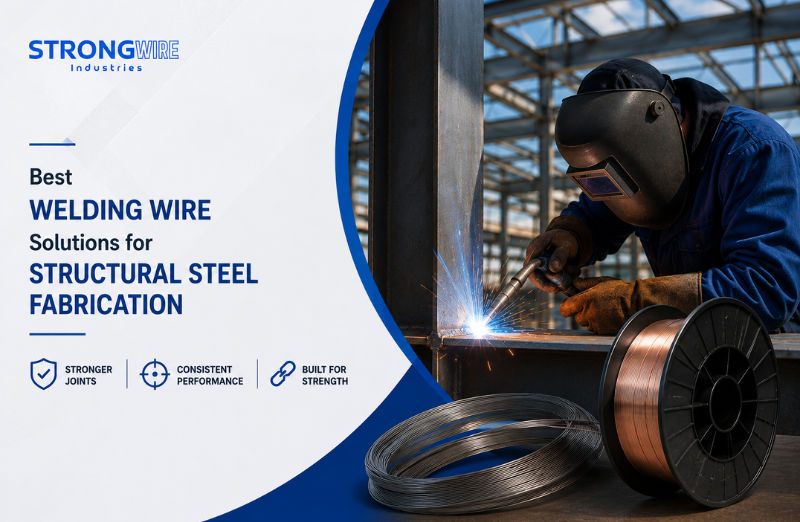
Structural steel fabrication requires more than simply joining two pieces of metal. The welding wire used in the process directly affects weld strength, appearance, consistency, productivity, and the long-term performance of the fabricated structure.
From buildings and bridges to industrial equipment, frames, beams, and heavy machinery, fabricators need welding consumables that match the steel grade, welding process, joint design, and required mechanical properties.
For many mild and carbon steel applications, carbon steel welding wire, MIG wire for mild steel, and ER70S-6 welding wire are commonly considered because they provide reliable arc performance and consistent weld quality when selected and used correctly.
What Is Structural Steel Fabrication?
Structural steel fabrication is the process of cutting, forming, assembling, and welding steel components to create structures or structural parts.
Common applications include:
- Steel buildings and warehouses
- Bridges and infrastructure
- Industrial frames
- Beams and columns
- Storage systems
- Heavy equipment
- Construction machinery
- Platforms and structural supports
Because these applications can involve significant loads and demanding service conditions, weld quality is an important part of the overall fabrication process.
Why Welding Wire Selection Matters
The welding wire acts as the filler material that forms the weld joint. Choosing an unsuitable wire can lead to poor fusion, excessive spatter, inconsistent bead appearance, or weld defects.
The right welding wire should be selected based on factors such as:
- Base metal composition
- Steel thickness
- Welding process
- Joint configuration
- Required tensile strength
- Welding position
- Shielding gas
- Welding parameters
- Fabrication environment
For general structural steel fabrication, selecting a compatible steel welding wire helps fabricators maintain consistent weld quality while improving productivity.
Best Welding Wire Solutions for Structural Steel
There is no single welding wire that is suitable for every structural steel application. However, several wire options are widely used for carbon and mild steel fabrication.
1. Carbon Steel Welding Wire
Carbon steel welding wire is designed for joining carbon and low-alloy steel materials in a range of fabrication applications.
It is commonly used where fabricators need:
- Reliable weld strength
- Stable arc performance
- Consistent deposition
- Good weld appearance
- Efficient welding
- Compatibility with common carbon steel grades
The exact wire classification should always be matched with the base material and project welding specification.
2. MIG Wire for Mild Steel
MIG wire for mild steel is widely used in fabrication shops because MIG welding can provide high productivity and relatively easy operation.
MIG welding is particularly useful for structural components where long, continuous welds are required. With appropriate shielding gas and correctly selected parameters, it can provide smooth and consistent welds.
When choosing MIG wire for mild steel, consider:
- Wire diameter
- Base metal thickness
- Shielding gas
- Welding current
- Welding position
- Required deposition rate
Proper wire selection combined with suitable machine settings can help reduce spatter and improve weld consistency.
3. Mild Steel Welding Wire
Mild steel welding wire is commonly selected for fabrication involving low-carbon steel components.
It is suitable for applications such as:
- Structural frames
- General fabrication
- Construction equipment
- Steel furniture
- Machinery components
- Industrial assemblies
The correct wire classification depends on the mechanical and metallurgical requirements of the application. Fabricators should always refer to the applicable welding procedure and material specifications before selecting a consumable.
4. ER70S-6 Welding Wire
ER70S-6 welding wire is a popular solid wire classification used for welding carbon steel.
It contains higher levels of deoxidizing elements than some other commonly used solid wires, which can help the welding process handle certain levels of surface contamination more effectively.
ER70S-6 is commonly considered for:
- Mild steel fabrication
- Structural components
- Automotive fabrication
- General machinery
- Industrial fabrication
- Sheet and plate welding
However, the presence of deoxidizers does not eliminate the need for proper surface preparation. Clean base metal, suitable shielding gas, and correct welding parameters remain essential.
How to Choose the Right Steel Welding Wire
Selecting the appropriate steel welding wire should begin with the base material rather than simply choosing a wire based on availability.
Check the Base Metal
Identify the grade and thickness of the steel being welded. Carbon steel, mild steel, stainless steel, and alloy steel can require different consumables.
Consider the Welding Process
For MIG/GMAW applications, solid welding wire is commonly used. Other fabrication requirements may call for flux-cored wire, submerged arc welding wire, or another consumable.
Match Mechanical Requirements
The welding consumable should provide mechanical properties compatible with the project specification.
For structural applications, factors such as tensile strength, yield strength, elongation, and impact requirements may need to be considered.
Select the Correct Wire Diameter
Wire diameter affects deposition rate, current requirements, penetration, and overall welding productivity.
Common diameters vary according to material thickness and welding application, so the selection should follow the welding procedure and equipment capabilities.
Consider Shielding Gas
Shielding gas protects the molten weld pool from atmospheric contamination.
For MIG welding, the gas mixture should be compatible with the selected wire and application. Incorrect gas selection can affect arc stability, penetration, spatter, and weld appearance.
What About Welding Flux for Stainless Steel Fabrication?
Welding flux for stainless steel fabrication is a different consideration from solid MIG wire used for mild or carbon steel.
Stainless steel fabrication may involve processes such as:
- TIG welding
- MIG welding
- Submerged arc welding
- Flux-cored arc welding
- Specialized welding processes
The appropriate flux or filler metal depends on the stainless steel grade, welding process, joint design, and required corrosion and mechanical properties.
It is important not to assume that a carbon steel welding wire or flux is suitable for stainless steel. Stainless steel applications require consumables specifically matched to the material and applicable welding standard.
Common Welding Problems in Structural Steel Fabrication
Even with a suitable welding wire, poor welding practices can cause defects.
Porosity
Porosity occurs when gas becomes trapped in the solidifying weld metal. Common causes include:
- Contaminated surfaces
- Moisture
- Inadequate shielding gas
- Incorrect gas flow
- Poor equipment setup
Keeping the workpiece clean and maintaining appropriate shielding gas coverage can help reduce the risk.
Excessive Spatter
Excessive spatter may result from incorrect voltage, wire feed speed, shielding gas, stick-out, or other welding parameters.
Following the manufacturer’s recommended settings can help achieve a more stable arc.
Lack of Fusion
Lack of fusion can occur when the weld metal does not properly fuse with the base metal or previous weld pass.
Appropriate heat input, travel speed, joint preparation, and welding technique are important for achieving proper fusion.
Cracking
Cracking can be associated with material chemistry, joint design, hydrogen, restraint, preheating requirements, or unsuitable welding procedures.
For critical structural applications, welding procedures should be developed and qualified according to the relevant project requirements and standards.
Best Practices for High-Quality Structural Steel Welding
Choosing the right wire is only one part of producing reliable welds.
Fabricators should also:
- Clean the base metal before welding.
- Store welding wire properly to protect it from moisture and contamination.
- Use the recommended shielding gas.
- Set voltage and wire feed speed correctly.
- Maintain appropriate contact-tip-to-work distance.
- Follow qualified welding procedures.
- Inspect welds regularly for visible defects.
- Use consumables appropriate for the steel grade.
- Maintain welding equipment and replace worn components.
- Follow applicable welding codes and project specifications.
These practices help improve consistency and reduce avoidable welding defects.
Why ER70S-6 Is Commonly Used for Mild Steel
ER70S-6 is frequently selected for general carbon and mild steel welding because it offers a useful combination of weldability, deposition performance, and mechanical properties when used within its intended application range.
However, “commonly used” does not mean “universally suitable.” Structural fabrication projects can have specific requirements based on design codes, steel grades, service conditions, and qualification procedures.
Therefore, fabricators should verify the required welding consumable classification before production welding.
Final Thoughts
The right carbon steel welding wire, MIG wire for mild steel, or ER70S-6 welding wire can contribute significantly to consistent and efficient structural steel fabrication. But wire selection should always be considered alongside the base metal, welding process, shielding gas, joint design, and project specifications.
For fabricators, the goal is not simply to choose a welding wire that produces a weld it is to select a compatible consumable that supports strength, consistency, productivity, and reliable weld performance throughout the fabrication process.
Working with an experienced welding wire manufacturer can also help fabricators identify suitable consumables for specific materials, welding processes, and production requirements.