
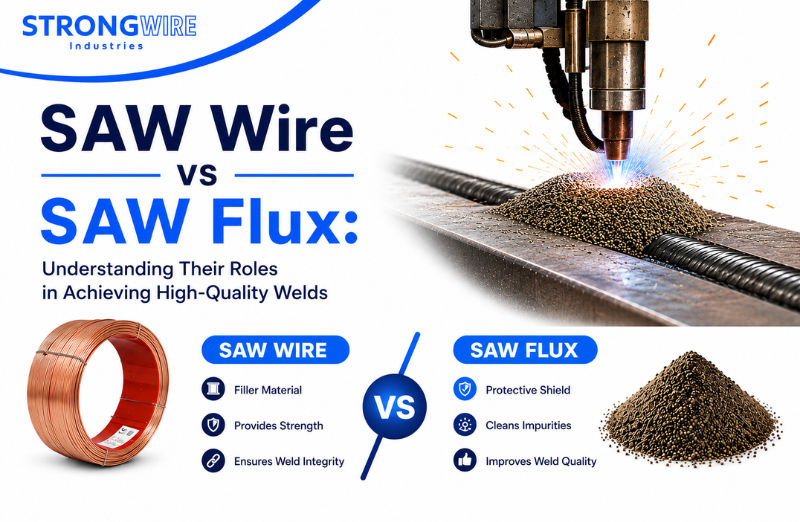
In Submerged Arc Welding (SAW), producing a strong and defect-free weld depends on more than advanced equipment and skilled operators. Two essential consumables SAW Wire and SAW Flux work together throughout the welding process, yet each performs a completely different function. Understanding these roles is crucial for achieving consistent weld quality, mechanical performance, and production efficiency.
Many engineers, fabricators, and industrial buyers assume that SAW Welding Wire and SAW Welding Flux serve the same purpose or that one can compensate for the other. In reality, the wire provides the filler metal that becomes part of the weld, while the Flux for SAW protects the weld pool, stabilises the arc, and influences the metallurgical properties of the finished joint.
Industries such as shipbuilding, structural steel fabrication, pressure vessel manufacturing, oil & gas, pipeline construction, power generation, heavy engineering, and wind energy rely on both consumables to achieve high-quality welds. Understanding how each component contributes to the welding process helps manufacturers optimise productivity, improve weld reliability, and minimise defects.
This guide explains the difference between SAW Wire and SAW Flux, their individual functions, how they work together, and why selecting compatible consumables is essential for industrial welding applications.
Understanding the Submerged Arc Welding Process
Before comparing SAW Wire and SAW Flux, it is important to understand how the Submerged Arc Welding process works.
Submerged Arc Welding is an automated or semi-automated welding process in which the welding arc is completely covered by a layer of granular SAW Flux. During welding, a continuously fed Submerged Arc Welding Wire melts into the joint, while the flux forms a protective barrier over the molten weld pool.
Unlike open-arc welding processes, the arc is hidden beneath the flux layer, which helps reduce atmospheric contamination, minimise spatter, and improve welding efficiency. This process is particularly suitable for welding thick steel sections and long continuous joints where high productivity and consistent weld quality are required.
What is SAW Wire?
SAW Wire, also known as Submerged Arc Welding Wire, is a continuously fed consumable electrode used to provide filler metal during the Submerged Arc Welding process.
As the wire passes through the welding gun, it melts under the heat of the electric arc and combines with the parent metal to create the weld joint. The chemical composition of the wire directly influences the strength, ductility, toughness, and overall mechanical properties of the completed weld.
Different grades and diameters of SAW Welding Wire are available to suit various steel grades, joint configurations, and industrial applications.
Definition
SAW Wire is a continuously fed electrode that melts during Submerged Arc Welding to provide filler metal and produce strong, high-quality weld joints.
Primary Functions of SAW Wire
- Supplies filler metal for the weld
- Carries welding current
- Determines deposition rate
- Influences weld strength
- Contributes to weld chemistry
- Supports high-speed automated welding
- Provides consistent weld penetration
Without SAW Wire, no weld metal would be deposited, making it one of the primary consumables in the welding process.
What is SAW Flux?
SAW Flux is a specially formulated granular material that covers the welding arc throughout the Submerged Arc Welding process.
As welding begins, the flux melts to create a protective slag that shields the molten weld pool from oxygen, nitrogen, and other atmospheric contaminants. It also stabilises the welding arc, supports alloy transfer, controls bead appearance, and contributes to the final mechanical properties of the weld.
Unlike SAW Wire, the primary role of SAW Welding Flux is not to supply filler metal but to create the ideal welding environment.
Definition
SAW Flux is a granular consumable used during Submerged Arc Welding to protect the weld pool, stabilise the arc, refine weld metallurgy, and improve weld quality.
Primary Functions of SAW Flux
- Shields the molten weld pool
- Prevents atmospheric contamination
- Stabilises the welding arc
- Forms protective slag
- Improves bead appearance
- Controls weld chemistry
- Enhances impact toughness
- Simplifies slag removal
Because different flux formulations provide different metallurgical characteristics, selecting the appropriate Flux for SAW is essential for achieving the desired weld properties.
SAW Wire vs SAW Flux: What’s the Difference?
Although SAW Wire and SAW Flux are always used together in Submerged Arc Welding, they perform entirely different functions.
The wire becomes part of the finished weld, while the flux protects and enhances the welding process.
| Feature | SAW Wire | SAW Flux |
| Purpose | Provides filler metal | Protects the weld pool |
| Physical Form | Solid wire | Granular material |
| Conducts Current | Yes | No |
| Melts During Welding | Yes | Yes |
| Becomes Part of the Weld | Yes | Mostly forms slag |
| Controls Arc Stability | Partially | Primarily |
| Influences Weld Chemistry | Yes | Yes |
| Protects Against Contamination | No | Yes |
| Produces Slag | No | Yes |
| Primary Role | Metal deposition | Weld protection |
Understanding these differences helps welding professionals appreciate why both consumables are equally important for achieving reliable welding performance.
The Role of SAW Wire in Weld Quality
The performance of the finished weld begins with the SAW Welding Wire.
Since the wire melts and becomes part of the welded joint, it directly influences the weld’s mechanical properties. Selecting the correct wire ensures that the finished weld can withstand the intended service conditions, whether it involves pressure, heavy loading, vibration, or extreme temperatures.
SAW Wire Contributes To:
- Tensile strength
- Yield strength
- Weld penetration
- Deposition efficiency
- Chemical composition
- Productivity
- Joint integrity
For applications such as pressure vessels, offshore structures, and pipelines, the quality and composition of the Submerged Arc Welding Wire are critical to long-term structural performance.
The Role of SAW Flux in Weld Quality
While the wire creates the weld, SAW Flux creates the environment necessary for producing a sound weld.
During welding, the molten metal is highly susceptible to contamination from oxygen, nitrogen, and moisture. The flux acts as a protective barrier that prevents these contaminants from entering the weld pool.
In addition, the flux influences several aspects of weld quality that are not immediately visible but are essential for long-term performance.
SAW Flux Helps:
- Maintain arc stability
- Reduce porosity
- Improve slag detachability
- Control bead shape
- Refine weld metallurgy
- Reduce hydrogen content
- Improve impact toughness
- Enhance surface finish
Without a properly selected SAW Welding Flux, even high-quality wire may fail to produce satisfactory welds.
How SAW Wire and SAW Flux Work Together
Although their functions differ, SAW Wire and SAW Flux operate as a coordinated system during welding.
The process begins when the SAW Welding Wire feeds continuously into the welding joint. At the same time, a blanket of SAW Flux completely covers the arc. As welding progresses, the wire melts to provide filler metal, while the flux melts to form a protective slag that shields the molten weld pool from atmospheric contamination.
During this process:
- The wire supplies filler metal.
- The flux protects the weld pool.
- The arc remains stable beneath the flux layer.
- Alloying elements influence the weld chemistry.
- The slag solidifies and is removed after cooling.
- A smooth, high-quality weld bead is produced.
This coordinated interaction is why manufacturers qualify specific combinations of SAW Welding Wire and SAW Welding Flux rather than treating them as independent consumables.
Why Compatibility Between SAW Wire and SAW Flux Matters
Although SAW Wire and SAW Flux perform different functions, they are designed to work as a compatible system. A mismatch between the two can negatively affect weld quality, productivity, and mechanical performance.
Manufacturers test and qualify specific SAW Welding Wire and SAW Welding Flux combinations to ensure they produce welds that meet industry standards and application requirements.
A compatible combination helps achieve:
- Consistent weld chemistry
- Stable welding arc
- Uniform penetration
- Better bead appearance
- Higher impact toughness
- Reliable tensile strength
- Easy slag removal
- Reduced welding defects
On the other hand, using incompatible consumables may lead to inconsistent weld properties, excessive slag inclusions, cracking, or failed inspections.
Common Myths About SAW Wire and SAW Flux
Many misconceptions exist regarding Submerged Arc Welding consumables. Understanding the facts helps improve welding practices and purchasing decisions.
Myth 1: SAW Flux Only Covers the Arc
Fact:
While protecting the welding arc is one of its primary functions, SAW Flux also influences weld chemistry, stabilises the arc, controls slag formation, and contributes to the final mechanical properties of the weld.
Myth 2: Any SAW Wire Can Be Used with Any SAW Flux
Fact:
Every SAW Welding Wire is designed to perform with compatible SAW Welding Flux. Using an unsuitable combination may affect weld strength, penetration, and impact toughness.
Myth 3: Better Wire Alone Means Better Weld Quality
Fact:
Even premium-quality SAW Wire cannot compensate for an incorrect or contaminated Flux for SAW. Both consumables must work together to produce reliable welds.
Myth 4: Flux Can Be Reused Indefinitely
Fact:
Although unused flux may sometimes be recovered, contaminated or moisture-affected SAW Flux should never be reused without proper handling procedures, as contamination can reduce weld quality.
Types of SAW Flux Used in Industrial Welding
Different welding applications require different types of SAW Flux. Understanding these types helps manufacturers select consumables that suit their production requirements.
Fused Flux
Fused flux is manufactured by melting raw materials together and crushing them into granules after cooling.
Advantages
- Uniform chemical composition
- Low moisture absorption
- Good storage characteristics
- Suitable for general fabrication
Agglomerated Flux
Agglomerated flux is produced by bonding powdered minerals with a binder before baking.
Advantages
- Flexible alloying capability
- Excellent mechanical properties
- Suitable for high-strength steels
- Ideal for pressure vessels and offshore applications
Neutral Flux
Neutral flux has minimal influence on weld chemistry and is often selected when maintaining filler wire composition is important.
Active Flux
Active flux modifies the weld chemistry and is commonly used where higher deposition rates or specific mechanical properties are required.
Selecting the appropriate Flux for SAW depends on the application, welding procedure, and service conditions.
Industrial Applications of SAW Wire and SAW Flux
The combination of SAW Wire and SAW Flux is widely used in industries that demand strong, reliable welds and high production efficiency.
Pressure Vessel Manufacturing
Pressure vessels operate under demanding conditions where weld integrity is essential. Carefully selected consumables help achieve the required strength and toughness.
Structural Steel Fabrication
Bridges, industrial buildings, and heavy structural components benefit from the deep penetration and high deposition rates offered by Submerged Arc Welding Wire.
Shipbuilding
Shipyards rely on SAW Welding Wire and SAW Welding Flux for long weld seams on hulls, decks, and internal structures where consistent weld quality is essential.
Pipeline Construction
Large-diameter pipelines require dependable welds capable of withstanding pressure and environmental conditions. Proper wire-flux combinations contribute to reliable pipeline performance.
Wind Energy
Wind towers require excellent mechanical properties and fatigue resistance. Compatible SAW Wire and SAW Flux combinations help meet these demanding requirements.
Heavy Engineering
Manufacturers of cranes, mining equipment, industrial machinery, and construction equipment use Submerged Arc Welding to improve productivity while maintaining weld consistency.
Factors That Influence Weld Quality
Although the consumables play a major role, several additional factors also affect the quality of Submerged Arc Welding.
These include:
- Base material composition
- Welding current
- Voltage
- Travel speed
- Heat input
- Wire diameter
- Flux condition
- Welding procedure
- Operator setup
- Equipment calibration
Optimising these parameters alongside the correct SAW Welding Wire and SAW Welding Flux helps achieve repeatable welding results.
Best Practices for Handling SAW Wire and SAW Flux
Proper handling and storage help maintain consumable quality and prevent welding defects.
Recommended Practices
- Store SAW Wire in a clean, dry environment.
- Protect wire from moisture and corrosion.
- Keep SAW Flux in sealed containers before use.
- Avoid contamination with dust, oil, or foreign materials.
- Follow manufacturer recommendations for storage temperature and handling.
- Inspect consumables before production welding.
- Use qualified wire-flux combinations recommended by the manufacturer.
These practices improve weld consistency and reduce production downtime.
Why Industries Continue to Choose Submerged Arc Welding
Submerged Arc Welding remains one of the most productive welding processes for heavy fabrication.
Industries continue to rely on SAW Wire and SAW Flux because the process offers:
- High welding speed
- Deep penetration
- Excellent weld consistency
- High deposition efficiency
- Low spatter
- Reduced operator exposure to arc radiation
- Smooth weld bead appearance
- Suitable for automated production
- Cost-effective welding for large-scale fabrication
These advantages make Submerged Arc Welding the preferred choice for repetitive, high-volume industrial welding operations.
Why Choose Our SAW Wire and SAW Flux Solutions?
Reliable welding performance begins with dependable consumables.
We provide SAW Wire and SAW Welding Flux solutions designed to support demanding industrial applications across structural fabrication, pressure vessels, pipelines, heavy engineering, and power generation.
Our strengths include:
- Consistent manufacturing quality
- Advanced quality control processes
- Technical application support
- Reliable product availability
- Material traceability
- Custom manufacturing capabilities
- Customer-focused service
- Global supply network
Our objective is to help customers achieve consistent weld quality and improved operational efficiency through carefully engineered welding consumables.
Conclusion
Although SAW Wire and SAW Flux are used together in every Submerged Arc Welding operation, they perform distinct and equally important roles. SAW Wire provides the filler metal that forms the weld, while SAW Flux protects the weld pool, stabilises the arc, and contributes to the final mechanical and metallurgical properties.
Understanding these differences helps engineers, fabricators, and industrial buyers make informed decisions when selecting welding consumables. Rather than viewing them as interchangeable products, they should be considered complementary components of a single welding system.
By selecting compatible SAW Welding Wire and SAW Welding Flux, following qualified welding procedures, and sourcing consumables from experienced manufacturers, industries can achieve stronger welds, greater productivity, and long-term reliability across demanding industrial applications.