
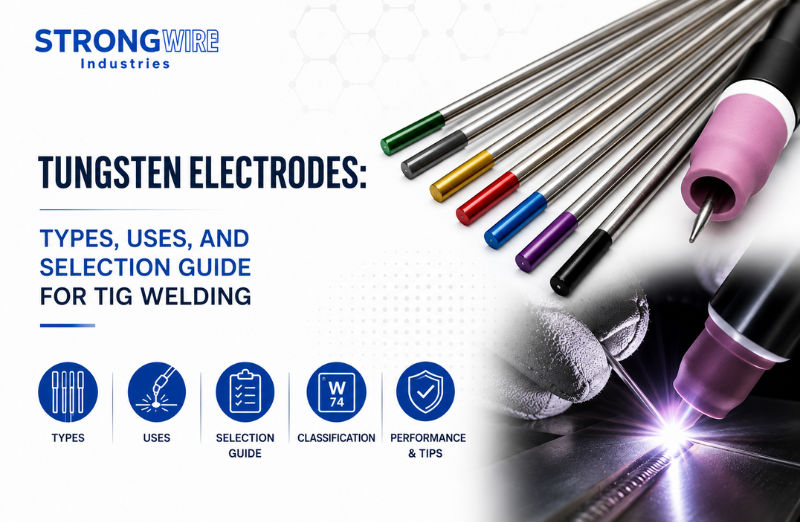
TIG (Tungsten Inert Gas) welding is widely recognized for producing precise, high-quality welds across a range of industrial applications. At the core of this welding process are Tungsten Electrodes, which play a critical role in creating and maintaining a stable welding arc.
Selecting the right Welding Tungsten Electrodes can significantly influence weld quality, arc stability, productivity, and overall operational efficiency. For manufacturers, fabrication companies, and industrial buyers, understanding the different types of tungsten electrodes and their applications is essential for achieving consistent welding performance.
This guide explains the types, uses, benefits, and selection criteria for tungsten electrodes for welding, helping engineers and procurement professionals make informed decisions.
What Are Tungsten Electrodes?
Tungsten Electrodes are non-consumable electrodes used in TIG welding processes. They conduct electrical current to generate the welding arc while maintaining their shape under extremely high temperatures.
Tungsten is selected because it has one of the highest melting points among metals, approximately 3,422°C (6,192°F), making it ideal for demanding welding applications.
Quick Answer
Tungsten Electrodes are non-consumable electrodes used in TIG welding to create a stable arc, enabling precise and high-quality welds on various metals.
How Do Tungsten Electrodes Work?
During TIG welding, the electrode is held within the welding torch while an electric arc forms between the tungsten tip and the workpiece.
The electrode’s primary function is to:
- Conduct welding current efficiently
- Maintain a stable arc
- Resist melting under high temperatures
- Support precise heat control
- Improve weld quality and consistency
Unlike consumable electrodes, tungsten electrodes do not become part of the weld metal, making them ideal for precision welding applications.
Types of Tungsten Electrodes
Different welding applications require different electrode compositions.
Pure Tungsten Electrodes
Pure tungsten electrodes contain approximately 99.5% tungsten.
Common Uses
- AC welding applications
- Aluminum welding
- Magnesium welding
Characteristics
- Good arc stability
- Forms a rounded tip during welding
- Suitable for lower current applications
Thoriated Tungsten Electrodes
These electrodes contain a small percentage of thorium oxide.
Characteristics
- Excellent arc starting
- High current-carrying capacity
- Longer service life
Applications
- Carbon steel welding
- Stainless steel welding
- Nickel alloy fabrication
Ceriated Tungsten Electrodes
Ceriated electrodes contain cerium oxide and are commonly used as an alternative to thoriated electrodes.
Benefits
- Easy arc starting
- Stable performance at low amperage
- Suitable for automated welding
Lanthanated Tungsten Electrodes
Lanthanated electrodes offer excellent versatility.
Advantages
- Reliable arc ignition
- Good longevity
- Suitable for AC and DC welding
These are among the most widely used Welding Tungsten Electrodes in modern fabrication environments.
Zirconiated Tungsten Electrodes
These electrodes contain zirconium oxide.
Applications
- High-quality aluminum welding
- AC welding operations
Benefits
- Excellent resistance to contamination
- Stable arc performance
Key Features and Benefits of Tungsten Electrodes
Quality Tungsten Electrodes provide several advantages that directly impact welding performance.
Key Features
- Excellent resistance to high temperatures
- Stable and concentrated welding arc
- Reliable electrical conductivity
- Long operational life
- Compatibility with various TIG welding applications
- Consistent welding performance
- Suitable for manual and automated welding processes
Key Benefits
- Improved weld quality
- Better heat control
- Reduced electrode consumption
- Increased welding precision
- Enhanced productivity
- Lower rework rates
- Consistent weld appearance
How Tungsten Electrodes Improve Industrial Performance
Industrial fabrication operations require accuracy, repeatability, and efficiency.
Improved Arc Stability
A stable arc helps produce uniform welds while reducing defects.
Enhanced Weld Quality
Proper electrode selection supports:
- Better penetration control
- Cleaner welds
- Reduced spatter
- Improved bead appearance
Increased Productivity
High-quality tungsten electrodes for welding help reduce downtime associated with electrode replacement and grinding.
Consistent Results
Manufacturers benefit from repeatable welding performance across large production runs.
Applications Across Industries
Aerospace Manufacturing
Precision welding requirements make TIG welding and tungsten electrodes essential for aerospace components.
Automotive Industry
Used for:
- Exhaust systems
- Chassis components
- Precision fabrication
Stainless Steel Fabrication
TIG welding provides the clean weld appearance often required in stainless steel applications.
Power Generation
Power plants and energy equipment manufacturers rely on tungsten electrodes for critical welding applications.
Food and Pharmaceutical Equipment
High-quality weld finishes are often required for hygienic processing systems.
Petrochemical Industry
Used in fabrication of piping systems, pressure vessels, and process equipment.
General Engineering
Widely used in maintenance, repair, and industrial manufacturing operations.
Factors to Consider Before Selection
Selecting the right Tungsten Electrodes requires evaluating several important factors.
Base Material
Different metals require different electrode types.
Examples include:
- Carbon steel
- Stainless steel
- Aluminum
- Copper alloys
- Nickel alloys
Wurrenelding Ct Type
Consider whether the application uses:
- AC current
- DC current
Electrode Diameter
The electrode diameter should match the welding current range and application requirements.
Welding Position
Certain electrode types perform better in specific welding conditions.
Production Requirements
Evaluate factors such as:
- Duty cycle
- Automation requirements
- Productivity goals
- Weld quality standards
Common Mistakes to Avoid
Avoiding these mistakes can improve welding performance and electrode life.
- Selecting an incorrect electrode type for the material being welded
- Using the wrong electrode diameter
- Improper electrode grinding techniques
- Contaminating the tungsten tip during welding
- Using excessive welding current
- Ignoring manufacturer recommendations
- Failing to maintain proper shielding gas coverage
Why Industries Prefer Tungsten Electrodes
Industrial manufacturers continue to choose Welding Tungsten Electrodes because they offer dependable performance in demanding environments.
Key Reasons
- Excellent arc control
- Superior weld quality
- Long service life
- Precision heat management
- Versatility across materials
- Compatibility with automation
- Consistent welding performance
These advantages make tungsten electrodes a preferred choice for industries requiring high-quality welds and strict quality standards.
Why Choose STRONGWIRE?
Selecting a reliable welding consumable supplier is important for achieving consistent production results.
Why Manufacturers Choose STRONGWIRE
- Strong industry knowledge and application expertise
- Consistent product quality standards
- Reliable manufacturing processes
- Technical support for welding applications
- Dependable supply chain management
- Customer-focused service approach
- Solutions designed for industrial performance requirements
STRONGWIRE supports manufacturers with welding consumables engineered for reliability, consistency, and operational efficiency.
Conclusion
Tungsten Electrodes are a critical component of TIG welding operations, directly influencing weld quality, arc stability, productivity, and operational performance. Understanding the different electrode types and their applications helps organizations select the most suitable solution for their welding requirements.
By choosing high-quality tungsten electrodes for welding and partnering with a trusted supplier such as STRONGWIRE, manufacturers can achieve consistent welding performance, improved efficiency, and dependable results across a wide range of industrial applications.