
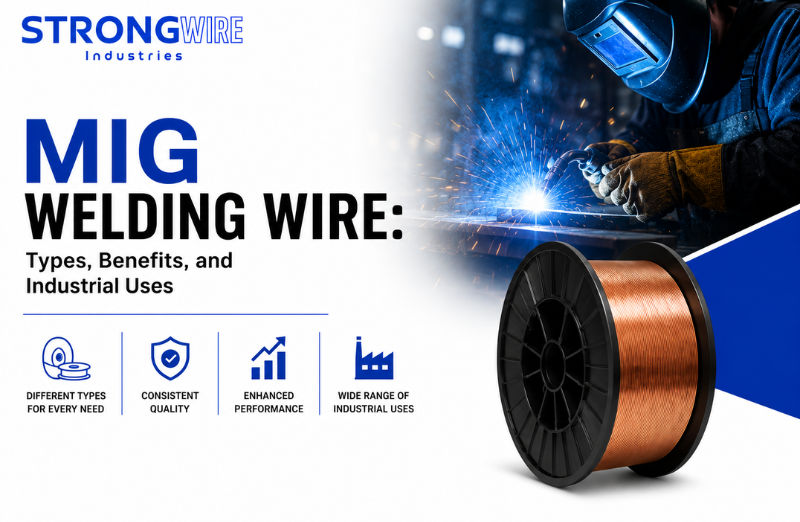
In today’s manufacturing and fabrication industries, welding quality directly influences product durability, structural integrity, and operational efficiency. Whether in automotive manufacturing, construction, heavy engineering, shipbuilding, or infrastructure development, selecting the right welding consumable is essential for achieving reliable results.
Among the most widely used welding consumables, MIG welding wire plays a critical role in modern fabrication processes. Known for its excellent arc stability, high deposition rates, and compatibility with automated welding systems, MIG wire supports both quality and productivity requirements across industries.
This guide explores the different types of MIG welding wire, their benefits, industrial applications, and key factors buyers should consider when selecting the right industrial welding wire for their operations.
What is MIG Welding Wire?
Definition Snippet
MIG welding wire is a continuous electrode wire used in Metal Inert Gas (MIG) welding processes. The wire acts as both the filler metal and the electrical conductor, creating a stable arc and forming strong weld joints.
MIG welding wire is available in multiple grades and compositions to suit different metals and applications.
Common applications include:
- Carbon steel welding
- Structural steel fabrication
- Automotive manufacturing
- Heavy equipment production
- Industrial fabrication
Specialized products such as high tensile steel welding wire and welding wire for high-strength steel are designed to meet demanding mechanical property requirements.
How Does MIG Welding Wire Work?
During MIG welding, the wire is continuously fed through a welding gun while shielding gas protects the molten weld pool from atmospheric contamination.
The process offers:
- Continuous welding operation
- Stable arc performance
- High welding speeds
- Consistent weld penetration
- Reduced downtime
Because the wire is continuously supplied, MIG wire is highly effective for both manual and automated welding operations.
Types of MIG Welding Wire
Carbon Steel MIG Welding Wire
Carbon steel MIG wire is commonly used in general fabrication and structural welding applications.
Applications include:
- Steel fabrication
- Construction projects
- Industrial equipment
- Manufacturing operations
High Tensile Steel Welding Wire
High tensile steel welding wire is specifically developed for welding high-strength steels requiring superior mechanical properties.
Benefits include:
- High tensile strength
- Excellent toughness
- Improved crack resistance
- Reliable structural performance
MIG TIG Solid Wire
MIG TIG solid wire is manufactured with consistent chemistry and dimensional accuracy for stable welding performance.
Advantages include:
- Smooth wire feeding
- Excellent arc stability
- Low spatter generation
- Superior weld appearance
Welding Wire for High-Strength Steel
For demanding structural applications, welding wire for high-strength steel helps maintain the mechanical integrity of engineered components.
Common industries include:
- Heavy engineering
- Infrastructure
- Transportation
- Energy projects
Key Features and Benefits of MIG Welding Wire
Excellent Arc Stability
High-quality MIG welding wire provides a smooth and stable arc throughout the welding process.
Benefits:
- Better weld consistency
- Reduced defects
- Improved operator control
High Deposition Rates
One of the major advantages of MIG welding is its ability to deposit filler metal quickly.
Benefits:
- Increased productivity
- Faster weld completion
- Lower labor costs
Consistent Wire Feedability
Premium solid MIG welding wire ensures uninterrupted feeding during welding operations.
Benefits:
- Reduced downtime
- Improved production efficiency
- Better automation performance
Low Spatter Generation
Quality MIG wire produces cleaner welds with minimal spatter.
Benefits:
- Less post-weld cleaning
- Improved appearance
- Reduced finishing costs
Automation Compatibility
Modern robotic welding systems rely heavily on consistent welding consumables.
Benefits:
- Repeatable quality
- Improved process control
- Support for high-volume manufacturing
How MIG Welding Wire Improves Industrial Performance
Benefit Snippet
MIG welding wire improves industrial performance by increasing welding speed, enhancing weld quality, reducing downtime, and supporting automated manufacturing systems.
Supports High-Speed Welding Production
Manufacturers increasingly adopt high-speed welding production methods to improve efficiency.
MIG welding wire supports this by offering:
- Continuous welding operation
- Faster travel speeds
- High deposition efficiency
- Reduced production cycle times
Improves Weld Consistency
Consistent wire chemistry helps maintain:
- Uniform weld quality
- Stable penetration
- Reliable mechanical properties
Reduces Rework
Quality industrial welding wire minimizes common welding defects such as:
- Porosity
- Incomplete fusion
- Excessive spatter
- Cracking
Reducing defects lowers repair costs and improves productivity.
Applications Across Industries
Construction Industry
Used for:
- Structural steel fabrication
- Building frameworks
- Infrastructure projects
Automotive Manufacturing
Applications include:
- Chassis production
- Structural components
- Vehicle assemblies
Heavy Engineering
Widely used in:
- Industrial machinery
- Equipment manufacturing
- Process plant fabrication
Shipbuilding
Supports welding of:
- Hull structures
- Marine equipment
- Offshore fabrication projects
Energy Sector
Used in:
- Power generation facilities
- Transmission structures
- Renewable energy projects
Factors to Consider Before Selection
Base Material Compatibility
Select MIG welding wire that matches the base material.
Common materials include:
- Carbon steel
- Alloy steel
- High-strength steel
- Structural steel
Mechanical Property Requirements
Evaluate:
- Tensile strength
- Yield strength
- Impact toughness
- Ductility
A suitable high tensile steel welding wire should meet project specifications.
Welding Environment
Consider:
- Indoor fabrication
- Outdoor welding
- Humidity levels
- Temperature conditions
Production Requirements
For automated manufacturing and high-speed welding production, select wire designed for consistent feedability and stable arc characteristics.
Wire Diameter Selection
Choose wire size based on:
- Material thickness
- Welding position
- Deposition requirements
- Equipment capability
- Selecting welding wire based only on cost, which can reduce performance and productivity
- Ignoring required mechanical properties, leading to weak or unreliable welds
- Using incorrect shielding gas, which affects arc stability, weld appearance, productivity, and mechanical properties
- Overlooking quality standards by not choosing wire from reputable manufacturers with proper quality control
- Choosing the wrong wire diameter, which impacts weld penetration, deposition rate, arc performance, and efficiency
Why Industries Prefer MIG Welding Wire
Industry Use-Case Snippet
Industries prefer MIG welding wire because it delivers reliable weld quality, supports high-speed production, and performs consistently in automated manufacturing environments.
Key Reasons
- High productivity
- Stable arc performance
- Excellent weld appearance
- Low spatter generation
- Reduced downtime
- Reliable mechanical properties
- Automation compatibility
- Consistent quality
- Cost-effective operation
- Improved workflow efficiency
These advantages make MIG welding one of the most widely adopted welding processes in industrial manufacturing.
Why Choose STRONGWIRE?
STRONGWIRE supports industrial welding applications with a commitment to quality, consistency, and technical reliability.
Industry Expertise
- Experience serving fabrication and manufacturing industries
- Understanding of industrial welding requirements
- Application-focused product development
Product Quality
- Strict quality control procedures
- Consistent wire chemistry
- Reliable welding performance
Custom Manufacturing Capabilities
- Solutions tailored to industry requirements
- Support for diverse welding applications
- Flexible production capabilities
Technical Support
- Guidance on wire selection
- Assistance with welding parameters
- Application-specific recommendations
Reliable Supply
- Consistent product availability
- Support for ongoing production schedules
- Dependable delivery performance
Consistent Performance
- Stable arc characteristics
- Reliable feedability
- Uniform weld quality
Customer-Focused Approach
- Practical technical assistance
- Long-term customer support
- Focus on operational efficiency
Conclusion
MIG welding continues to be one of the most efficient and versatile welding processes used in modern manufacturing. From general fabrication to demanding structural applications, MIG welding wire provides the performance, productivity, and reliability required by industrial operations.
Whether selecting MIG TIG solid wire, high tensile steel welding wire, or specialized welding wire for high-strength steel, choosing the right consumable is essential for achieving optimal weld quality and operational efficiency.
By partnering with experienced manufacturers such as STRONGWIRE, industries can benefit from reliable product quality, technical expertise, and dependable supply solutions that support long-term production success.