
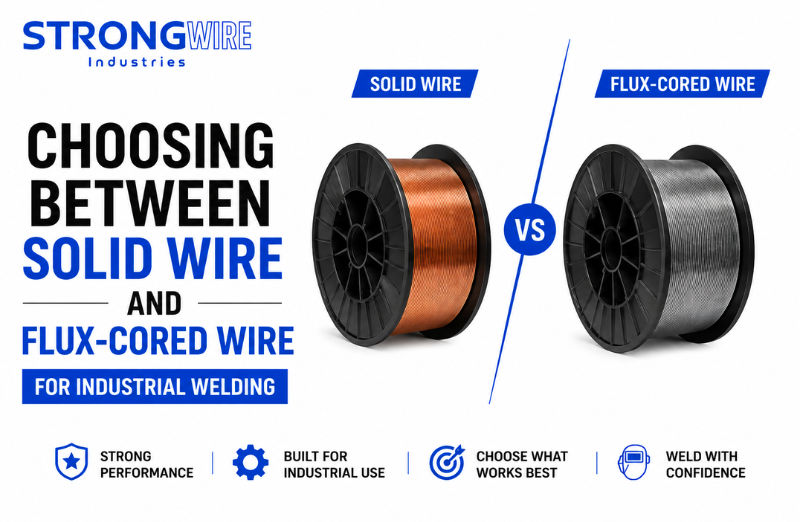
Selecting the right welding consumable is one of the most important decisions in industrial fabrication. The choice between Solid Wires For MIG & TIG and flux-cored wire directly impacts weld quality, productivity, operating costs, and project efficiency.
Industries such as construction, shipbuilding, heavy engineering, oil & gas, automotive, infrastructure, and manufacturing depend on reliable welding solutions to achieve strong and durable weld joints. Understanding the differences between Solid Wires, solid welding wire, and flux-cored wire can help engineers, procurement managers, and welding professionals make informed decisions.
This guide explains the characteristics, benefits, applications, and selection criteria of both welding wire types while also covering the importance of saw flux, saw welding flux, and welding saw flux in industrial welding operations.
What are Solid Wires For MIG & TIG?
Definition Snippet
Solid Wires For MIG & TIG are continuous metal wires used as filler material during welding. Unlike flux-cored wires, they have a solid metallic structure without a flux-filled core.
These wires are commonly used in:
- MIG (Metal Inert Gas) Welding
- TIG (Tungsten Inert Gas) Welding
- Automated welding systems
- Robotic welding applications
- Precision fabrication projects
A high-quality solid welding wire delivers consistent weld penetration, excellent bead appearance, and reduced spatter formation.
How Do Solid Wires Work?
During MIG welding, the wire is continuously fed through the welding gun while shielding gas protects the molten weld pool from atmospheric contamination.
In TIG welding applications, filler wire may be manually fed into the weld pool while the tungsten electrode generates the arc.
The result is:
- Stable arc performance
- Smooth metal transfer
- Clean weld deposits
- Improved welding efficiency
This makes Solid Wires For MIG & TIG a preferred solution for high-quality fabrication work.
What is Flux-Cored Wire?
Quick Answer
Flux-cored wire is a tubular welding wire filled with flux compounds that generate shielding gases and slag during welding.
Unlike solid wire, flux-cored wire can provide additional protection to the weld pool, making it suitable for outdoor environments and heavy-duty fabrication applications.
Flux-cored wires are generally categorized as:
- Gas-shielded flux-cored wire
- Self-shielded flux-cored wire
These wires are widely used where higher deposition rates and faster welding speeds are required.
Understanding SAW Flux and SAW Welding Flux
What is SAW Flux?
SAW Flux (Submerged Arc Welding Flux) is a granular material used during submerged arc welding to protect the weld pool from contamination and improve weld quality.
What Does SAW Welding Flux Do?
SAW welding flux performs several critical functions:
- Shields molten metal from atmospheric gases
- Improves weld bead appearance
- Controls weld chemistry
- Reduces weld defects
- Enhances mechanical properties
Industries often work with a trusted SAW Flux Manufacturer or SAW Flux Distributor to ensure consistent welding performance and quality standards.
Solid Wire vs Flux-Cored Wire: Key Differences
1. Shielding Method
Solid Wires
- Require external shielding gas
- Produce cleaner welds
- Ideal for controlled environments
Flux-Cored Wires
- Use internal flux for protection
- Better suited for outdoor welding
- More tolerant of wind and environmental conditions
2. Welding Speed
Flux-cored wire generally offers:
- Higher deposition rates
- Faster weld completion
- Increased productivity
Solid wires provide:
- Better control
- Higher weld precision
- Superior appearance
3. Weld Cleanliness
Solid welding wire typically produces:
- Less slag
- Minimal post-weld cleaning
- Cleaner finished surfaces
Flux-cored welding often requires slag removal after welding.
4. Cost Considerations
The total welding cost depends on:
- Material consumption
- Labor requirements
- Cleaning time
- Equipment setup
- Project specifications
For many precision fabrication projects, Solid Wires For MIG & TIG can provide excellent long-term value.
Key Features and Benefits of Solid Wires For MIG & TIG
Consistent Arc Stability
High-quality solid wires provide smooth arc performance and controlled metal transfer.
Excellent Weld Appearance
Solid welding wire creates clean and aesthetically pleasing weld beads.
Low Spatter Generation
Reduced spatter means:
- Less cleanup
- Better productivity
- Improved weld quality
Strong Mechanical Properties
Properly selected solid wires help achieve:
- High tensile strength
- Good ductility
- Reliable weld integrity
Suitable for Automation
Many manufacturers prefer Solid Wires For MIG & TIG for:
- Robotic welding systems
- CNC welding applications
- High-volume production lines
How It Improves Industrial Performance
Better Production Efficiency
Consistent wire feeding reduces interruptions and improves welding throughput.
Reduced Rework
Stable welding characteristics help minimize:
- Porosity
- Cracking
- Lack of fusion
- Weld defects
Improved Quality Control
Manufacturers can achieve repeatable welding results across production batches.
Enhanced Productivity
Reliable consumables reduce downtime and support continuous manufacturing operations.
Applications Across Industries
Automotive Manufacturing
Used for:
- Chassis fabrication
- Body panel welding
- Structural assemblies
Construction Industry
Supports:
- Steel structures
- Building frameworks
- Infrastructure projects
Heavy Engineering
Widely used in:
- Industrial machinery
- Equipment manufacturing
- Structural fabrication
Oil and Gas Industry
Applied in:
- Storage tanks
- Pipelines
- Pressure vessel fabrication
Shipbuilding
Provides reliable welding performance for marine structures and offshore equipment.
Factors to Consider Before Selection
Material Type
- Match wire composition with the base metal.
- Ensures weld strength and compatibility.
- Common materials:
- Carbon Steel
- Stainless Steel
- Alloy Steel
Welding Environment
- Consider the working conditions before selecting wire.
- Important factors:
- Indoor welding
- Outdoor welding
- Wind exposure
- Humidity levels
Productivity Requirements
- Flux-cored wire supports higher deposition rates.
- Suitable for high-speed production environments.
- Solid wires provide greater control and precision.
Weld Quality Requirements
- Solid Wires For MIG & TIG deliver cleaner welds.
- Better bead appearance and reduced spatter.
- Ideal for quality-sensitive fabrication projects.
Mechanical Property Requirements
- Evaluate required performance characteristics:
- Tensile Strength
- Impact Toughness
- Corrosion Resistance
- Service Temperature Capability
Common Mistakes to Avoid
Choosing Based Only on Price
- Lower-cost consumables may increase long-term operational costs.
- Consider quality, performance, and reliability.
Ignoring Welding Conditions
- Environmental factors directly affect weld quality.
- Always match consumables to application conditions.
Using Incorrect Wire Diameter
- Can lead to poor penetration and inconsistent weld quality.
- May reduce productivity and increase defects.
Overlooking Quality Standards
- Purchase from a trusted Solid Wires For MIG & TIG Manufacturer.
- Ensure compliance with industry quality requirements.
Neglecting Flux Selection in SAW Processes
- Incorrect SAW flux selection can impact weld integrity.
- Affects mechanical properties and overall performance.
Why Industries Prefer Solid Wires For MIG & TIG
Key Reasons
- Consistent weld quality
- Excellent arc stability
- Low spatter generation
- Smooth wire feeding
- Clean weld appearance
- Reduced post-weld cleaning
- Reliable mechanical properties
- Compatibility with automated welding systems
- Improved productivity
- Better process control
- Suitable for precision manufacturing
- Trusted for critical fabrication applications
Why Choose STRONGWIRE?
Industry Expertise
- Extensive experience in industrial welding solutions.
- Understanding of diverse fabrication requirements.
Product Quality
- Strict quality control processes.
- Consistent welding performance across applications.
Custom Manufacturing Capabilities
- Solutions tailored to specific industry needs.
- Supports various welding applications.
Technical Support
- Assistance with wire selection.
- Guidance on welding parameters and applications.
Reliable Supply
- Consistent product availability.
- Supports uninterrupted production schedules.
Consistent Performance
- Dependable welding results.
- Designed for industrial reliability.
Customer-Focused Approach
- Application-driven recommendations.
- Dedicated support for customer requirements.
Conclusion
Choosing between flux-cored wire and Solid Wires For MIG & TIG depends on project requirements, welding conditions, productivity goals, and desired weld quality.
For precision fabrication, cleaner welds, and automated manufacturing environments, solid welding wire remains a preferred choice. For high-deposition applications and challenging outdoor conditions, flux-cored wire can offer significant advantages.
Similarly, selecting the right SAW flux, SAW welding flux, and partnering with a reliable SAW Flux Manufacturer or SAW Flux Distributor plays an important role in achieving optimal welding performance.
By carefully evaluating operational requirements and sourcing high-quality consumables, industries can improve productivity, reduce defects, and achieve consistent welding results.