
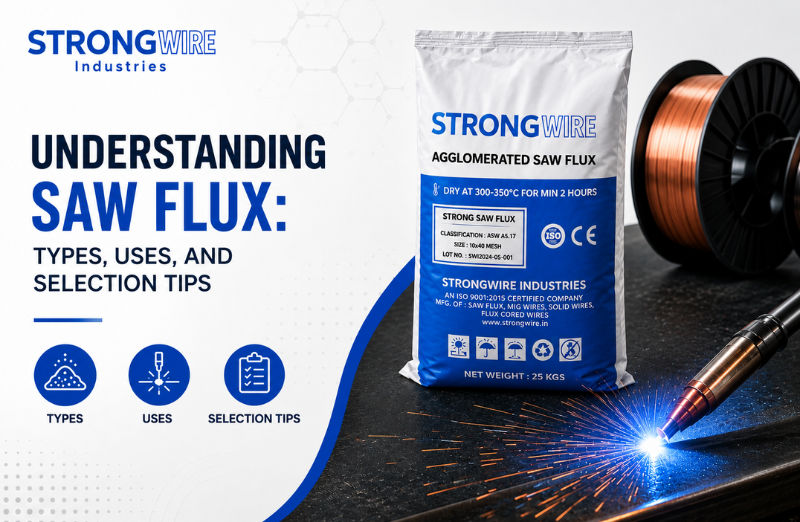
In modern heavy fabrication and manufacturing industries, welding quality directly impacts structural integrity, productivity, and long-term performance. Among the various welding processes used worldwide, Submerged Arc Welding (SAW) remains one of the most efficient methods for high-deposition welding applications.
A critical component of this process is SAW flux, which plays a major role in protecting the weld pool, controlling weld chemistry, and ensuring superior weld quality. Selecting the correct saw welding flux can significantly improve weld consistency, mechanical properties, and operational efficiency.
This guide explains everything industrial buyers, engineers, procurement teams, and fabrication professionals need to know about saw flux, including its types, applications, benefits, and selection criteria.
What is SAW Flux?
Definition
SAW flux is a granular material used in the Submerged Arc Welding process to shield the molten weld pool from atmospheric contamination. The flux covers the welding arc entirely, creating a protective environment that helps produce clean, strong, and defect-free welds.
In SAW operations, the welding arc remains submerged beneath a layer of flux. This layer melts during welding and forms slag that protects the weld as it cools.
Quick Answer
SAW flux is a specialized welding material used in submerged arc welding to protect the weld pool, improve weld quality, stabilize the arc, and enhance mechanical properties.
How Does SAW Flux Work?
The submerged arc welding process combines a continuously fed electrode wire with a layer of flux placed over the weld joint.
The flux for SAW performs several important functions:
- Shields the molten weld from oxygen and nitrogen contamination.
- Stabilizes the welding arc.
- Controls weld bead appearance.
- Influences weld metal chemistry.
- Reduces weld defects.
- Improves mechanical properties.
- Forms protective slag during cooling.
As welding progresses, part of the flux melts while unused flux can often be recovered and reused depending on operational practices.
Types of SAW Flux
Different welding applications require different types of welding SAW flux. Understanding these categories helps buyers choose the right solution.
Fused Flux
Fused flux is manufactured by melting raw materials together and then crushing them into granular particles.
Characteristics
- Uniform chemical composition
- Resistant to moisture absorption
- Suitable for demanding welding environments
- Consistent welding performance
Common Applications
- Pressure vessels
- Structural steel fabrication
- Shipbuilding
- Heavy engineering projects
Agglomerated Flux
Agglomerated flux is produced by mixing raw materials with binders before baking them.
Characteristics
- Flexible alloy additions
- Enhanced metallurgical control
- Improved mechanical properties
- Suitable for specialized welding applications
Common Applications
- High-strength steels
- Offshore structures
- Pipeline fabrication
- Critical industrial projects
Neutral Flux
Neutral flux contributes minimal alloying elements to the weld metal.
Advantages
- Predictable weld chemistry
- Consistent weld quality
- Suitable for multi-pass welding
Active Flux
Active flux influences weld chemistry by adding alloying elements during welding.
Advantages
- Enhanced mechanical properties
- Improved productivity
- Suitable for specific engineering requirements
Key Features and Benefits of SAW Flux
The correct saw flux offers numerous operational and quality advantages.
Excellent Weld Protection
The flux completely covers the arc and molten weld pool, minimizing contamination from atmospheric gases.
Stable Arc Performance
A consistent welding arc results in smoother welds and fewer interruptions.
Superior Weld Appearance
Proper flux selection helps achieve:
- Uniform bead profile
- Smooth weld surface
- Better penetration control
- Reduced post-weld finishing
Enhanced Mechanical Properties
Quality saw welding flux contributes to:
- Improved toughness
- Better impact strength
- Higher ductility
- Enhanced fatigue resistance
Increased Productivity
Submerged Arc Welding is known for high deposition rates, and suitable flux selection further improves production efficiency.
How SAW Flux Improves Industrial Performance
Industrial welding operations depend on repeatability, quality, and cost efficiency.
Reduced Rework
Consistent flux performance helps reduce:
- Porosity
- Slag inclusions
- Cracking
- Incomplete fusion
Higher Welding Efficiency
Proper flux for SAW allows:
- Faster travel speeds
- Increased deposition rates
- Improved throughput
Better Structural Reliability
Industries requiring critical welds benefit from the improved metallurgical characteristics provided by suitable welding flux systems.
Lower Overall Production Costs
Although flux selection is often overlooked, choosing the correct welding SAW flux can reduce:
- Downtime
- Inspection failures
- Repair costs
- Material waste
Applications Across Industries
Shipbuilding Industry
Large welded structures require reliable weld quality and high productivity.
SAW flux is commonly used for:
- Hull fabrication
- Deck structures
- Heavy steel assemblies
Pressure Vessel Manufacturing
Pressure vessels demand strong, defect-free welds with excellent mechanical properties.
Suitable saw flux helps achieve compliance with industry standards and quality requirements.
Pipeline Construction
Pipeline welding requires consistent weld integrity across long distances.
Applications include:
- Oil pipelines
- Gas pipelines
- Water transmission systems
Structural Steel Fabrication
Construction and infrastructure projects rely heavily on SAW processes.
Common applications include:
- Bridges
- Industrial buildings
- Steel frameworks
- Power plants
Heavy Equipment Manufacturing
Manufacturers of industrial machinery use saw flux india solutions for:
- Mining equipment
- Construction machinery
- Material handling systems
- Industrial fabrication
Factors to Consider Before Selection
Choosing the correct saw welding flux requires evaluating several technical factors.
Base Material Type
Consider:
- Mild steel
- Carbon steel
- High tensile steel
- Alloy steel
Different materials require different flux characteristics.
Mechanical Property Requirements
Evaluate:
- Tensile strength
- Yield strength
- Toughness
- Impact resistance
The selected flux should support the required weld properties.
Welding Parameters
Review:
- Current settings
- Voltage
- Travel speed
- Wire diameter
Flux performance can vary depending on welding conditions.
Flux-Wire Compatibility
Always ensure compatibility between:
- Welding wire
- Flux system
- Base material
Proper combinations improve weld consistency and quality.
Industry Standards
Verify compliance with applicable welding specifications and project requirements.
Examples may include:
- AWS standards
- ISO standards
- Customer specifications
- Industry-specific regulations
Common Mistakes to Avoid
- Choosing flux without considering the base material and application.
- Using incompatible combinations of SAW flux and welding wire.
- Storing flux in damp conditions that can introduce moisture contamination.
- Ignoring required mechanical properties and project specifications.
- Reusing contaminated flux without proper inspection.
- Operating outside recommended welding parameters.
- Failing to verify compliance with applicable welding standards and requirements.
Why Industries Prefer SAW Flux
Industrial manufacturers continue to rely on SAW technology because of its proven performance.
Key Reasons
- High deposition rates
- Excellent weld quality
- Reduced weld defects
- Improved productivity
- Superior mechanical properties
- Cost-effective large-scale welding
- Consistent performance in automated systems
For these reasons, demand for high-quality saw flux india products continues to grow across infrastructure, energy, fabrication, and manufacturing sectors.
Why Choose STRONGWIRE?
Selecting a reliable welding consumable partner is as important as selecting the correct flux itself.
STRONGWIRE focuses on delivering dependable welding solutions designed for demanding industrial applications.
What Makes STRONGWIRE a Trusted Choice?
- Extensive industry expertise
- Consistent product quality
- Reliable manufacturing processes
- Technical application support
- Customer-focused service approach
- Stable supply capabilities
- Solutions designed for industrial performance requirements
STRONGWIRE’s commitment to quality and consistency helps fabrication companies maintain productivity while achieving dependable weld performance.
Conclusion
SAW flux plays a vital role in achieving high-quality submerged arc welds across industries such as shipbuilding, pressure vessel manufacturing, structural fabrication, pipeline construction, and heavy engineering.
Understanding the different types of saw flux, their applications, and selection criteria helps organizations improve weld quality, increase productivity, and reduce operational costs. By choosing the right flux for SAW and partnering with a trusted supplier such as STRONGWIRE, manufacturers can achieve consistent welding performance and long-term operational reliability.