
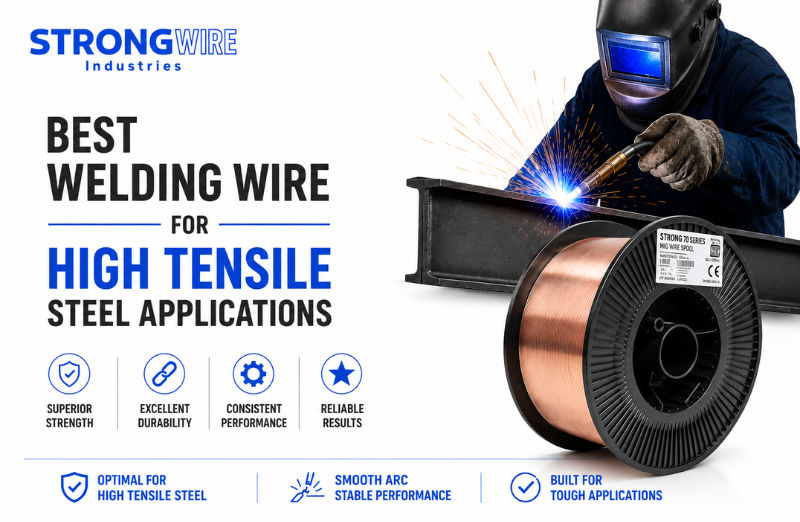
High tensile steels are widely used in industries where strength, durability, and structural reliability are critical. From heavy construction equipment and bridges to pressure vessels and offshore structures, these materials are designed to withstand demanding service conditions. However, achieving strong and reliable welds on high-strength steel requires more than advanced welding equipment it requires selecting the right high tensile steel wire.
The performance of a welding operation depends heavily on the compatibility between the base metal and welding consumable. Using the correct high tensile steel welding wire helps ensure weld integrity, mechanical strength, impact toughness, and long-term performance.
This guide explains how to select the best welding wire for high tensile steel applications, key performance considerations, industry uses, and why manufacturers trust quality welding consumables from STRONGWIRE.
What is High Tensile Steel Wire?
Definition
High tensile steel wire is a specialized welding consumable designed to weld high-strength steels while maintaining the required mechanical properties of the welded joint. These wires are engineered to provide appropriate tensile strength, toughness, ductility, and resistance to cracking.
Depending on the welding process, high tensile steel wires are available for MIG/MAG welding, submerged arc welding (SAW), and other industrial welding applications.
Quick Answer
High tensile steel wire is a welding consumable specifically developed to join high-strength steels while delivering reliable mechanical properties, weld quality, and structural performance.
How Does High Tensile Steel Wire Work?
During welding, the wire acts as filler material that melts and becomes part of the weld joint. The chemical composition of the wire is carefully controlled to ensure compatibility with high-strength base materials.
The wire contributes to:
- Weld metal strength
- Toughness and ductility
- Crack resistance
- Weld integrity
- Long-term structural performance
When paired with the correct welding parameters and flux system, a quality High tensile steel SAW wire helps produce defect-free welds suitable for critical applications.
Key Features and Benefits
Key Features
- Designed for high-strength steel applications
- Consistent chemical composition
- Excellent weldability
- Stable arc characteristics
- Good impact toughness
- Reliable mechanical properties
- Suitable for automated and semi-automated welding
Key Benefits
- Produces strong and durable weld joints
- Supports high productivity welding operations
- Reduces risk of weld defects
- Improves structural reliability
- Enhances weld consistency
- Suitable for demanding industrial environments
- Helps meet project quality requirements
Benefit Snippet
A high-quality high tensile steel welding wire helps achieve stronger welds, improved toughness, better productivity, and enhanced reliability in critical fabrication applications.
Types of Welding Wire Used for High Tensile Steel
Different projects may require different wire classifications depending on mechanical property requirements.
Solid Welding Wire
Solid wires are commonly used in automated and semi-automated welding systems.
Applications include:
- Structural fabrication
- Heavy engineering
- Manufacturing industries
High Tensile Steel SAW Wire
High tensile steel SAW wire is specifically designed for submerged arc welding applications requiring:
- Deep penetration
- High deposition rates
- Excellent mechanical properties
- Consistent weld quality
SAW wire is commonly paired with suitable welding flux to achieve the desired weld metal characteristics.
Low Alloy Welding Wire
Low alloy wires are often selected when enhanced tensile strength, toughness, or impact properties are required.
These wires are frequently used in:
- Offshore structures
- Pressure vessels
- Heavy equipment manufacturing
How High Tensile Steel Wire Improves Industrial Performance
Industrial projects often involve challenging service conditions where weld quality directly impacts safety and performance.
Improved Structural Strength
The right high tensile steel wire helps maintain the mechanical integrity of welded components under high loads and stresses.
Better Weld Toughness
High-quality welding wire supports impact resistance and toughness, particularly in demanding operating environments.
Increased Productivity
Consistent wire performance helps reduce:
- Rework
- Welding interruptions
- Consumable waste
- Inspection failures
Enhanced Weld Reliability
Properly selected welding consumables contribute to long-term durability and structural confidence.
Applications Across Industries
Structural Steel Fabrication
High-strength structural steels are widely used in infrastructure and construction projects.
Applications include:
- Bridges
- Industrial buildings
- Steel frameworks
- Infrastructure projects
Heavy Equipment Manufacturing
Manufacturers of mining, construction, and earthmoving equipment rely on high strength structural steel welding wire to ensure durability and performance.
Pressure Vessel Manufacturing
Pressure vessels often require welding consumables capable of delivering specific strength and toughness requirements.
Shipbuilding and Offshore Structures
Marine environments place significant demands on welded structures, making proper welding wire selection essential.
Oil and Gas Industry
Applications include:
- Storage tanks
- Pipelines
- Process equipment
- Offshore platforms
Railway and Transportation
High-strength steel components are commonly used in railcars, locomotives, and transportation infrastructure.
Factors to Consider Before Selection
Choosing the right high tensile steel welding wire requires careful evaluation of several factors.
Base Material Grade
Different grades of high-strength steel require compatible welding consumables.
Always verify:
- Tensile strength requirements
- Yield strength requirements
- Material specifications
Required Mechanical Properties
Evaluate:
- Tensile strength
- Impact toughness
- Ductility
- Crack resistance
The wire should support project-specific performance requirements.
Welding Process
Selection may depend on whether the application uses:
- SAW
- MIG/MAG
- Automated welding systems
- Mechanized welding systems
Joint Design and Thickness
Material thickness influences:
- Heat input requirements
- Wire selection
- Welding procedures
Industry Standards
Always verify compliance with:
- AWS specifications
- ISO standards
- Customer requirements
- Project specifications
Selection Snippet
The best high tensile steel wire is one that matches the base material, mechanical property requirements, welding process, and applicable industry standards.
Common Mistakes to Avoid
Avoiding common mistakes helps improve weld quality and operational efficiency.
- Selecting welding wire based solely on cost
- Ignoring material compatibility requirements
- Using incorrect welding parameters
- Overlooking toughness and impact requirements
- Choosing wire without reviewing project specifications
- Failing to verify compliance with industry standards
- Using unsuitable flux-wire combinations in SAW applications
These mistakes can increase the risk of weld defects, repairs, and project delays.
Why Industries Prefer High Tensile Steel Wire
Industrial manufacturers continue to use high tensile steel wire because it supports demanding performance requirements.
Key Reasons
- High weld strength
- Excellent toughness characteristics
- Reliable structural performance
- Compatibility with modern welding systems
- Consistent weld quality
- Improved productivity
- Reduced rework and maintenance requirements
These advantages make high tensile steel welding consumables essential for critical fabrication projects.
Why Choose STRONGWIRE?
Choosing a trusted welding consumable manufacturer is critical for maintaining quality and consistency across production operations.
Why Manufacturers Choose STRONGWIRE
- Extensive welding industry expertise
- Consistent product quality standards
- Reliable manufacturing processes
- Technical application support
- Custom manufacturing capabilities
- Dependable supply chain management
- Customer-focused service approach
STRONGWIRE provides welding consumables designed to support industrial fabrication requirements while helping manufacturers achieve reliable and repeatable welding performance
Conclusion
Selecting the best high tensile steel wire is essential for achieving strong, reliable, and durable welds in high-strength steel applications. Whether the project involves structural fabrication, heavy equipment manufacturing, pressure vessels, or offshore construction, the correct welding wire plays a significant role in overall weld quality and performance.
By understanding material requirements, welding processes, and mechanical property expectations, manufacturers can choose the most suitable high strength structural steel welding wire for their applications. Partnering with an experienced supplier such as STRONGWIRE further supports consistent welding performance and long-term project success.