
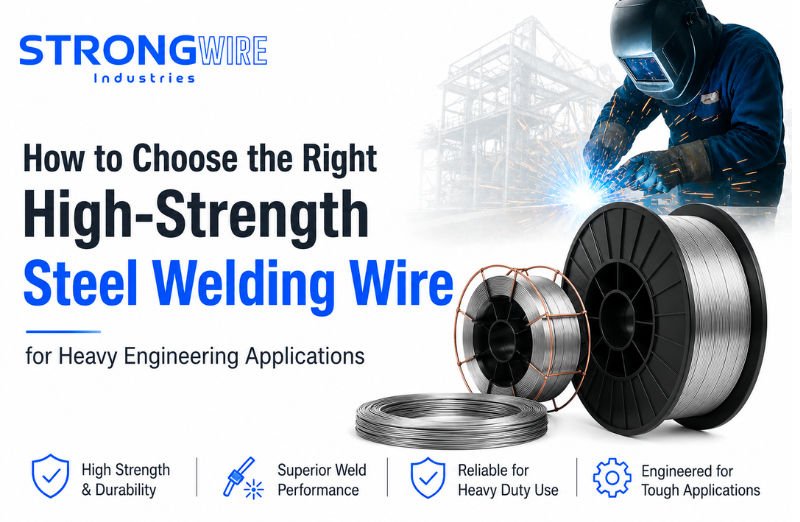
Heavy engineering industries demand welded joints that can withstand extreme mechanical loads, dynamic stress, harsh environments, and prolonged service life. Whether it’s structural fabrication, mining equipment, construction machinery, pressure vessels, bridges, offshore structures, or industrial plants, selecting the right high-strength steel welding wire plays a vital role in ensuring weld integrity and operational reliability.
Different grades of steel welding wire, MIG welding wire, and flux core welding wire are designed to meet varying mechanical strength, toughness, and productivity requirements. Choosing the wrong wire may lead to poor weld quality, increased repair costs, reduced equipment life, and project delays.
This guide explains how to choose the best industrial welding wire for heavy engineering applications, the factors that influence selection, common mistakes to avoid, and why partnering with a trusted industrial welding wire manufacturer can improve overall welding performance.
What is High-Strength Steel Welding Wire?
High-strength steel welding wire is a specially engineered filler material designed for welding high tensile strength steels used in demanding industrial applications. It provides excellent mechanical properties, strong fusion, impact resistance, and reliable weld quality under heavy service conditions.
These welding wires are available in several forms, including:
- Solid MIG welding wire
- Flux core welding wire
- Low-alloy steel welding wire
- Gas-shielded welding wire
- Specialized industrial welding consumables
The wire composition is carefully controlled to match the mechanical properties of high-strength base materials while minimizing defects such as cracking and porosity.
How Does High-Strength Steel Welding Wire Work?
During welding, the wire continuously feeds into the welding arc where it melts and combines with the parent metal. The molten weld pool solidifies to create a strong metallurgical bond between the workpieces.
Depending on the welding process:
MIG Welding Wire
MIG welding wire requires shielding gas that protects the weld pool from atmospheric contamination. It delivers:
- Stable arc performance
- Smooth weld appearance
- High deposition efficiency
- Low spatter generation
- Excellent productivity
Flux Core Welding Wire
Flux core welding wire contains flux inside the wire that produces shielding gases and slag during welding.
Advantages include:
- Better penetration
- Improved performance in outdoor environments
- Higher deposition rates
- Better tolerance to contaminated surfaces
- Suitable for thicker materials
Key Features and Benefits of High-Strength Steel Welding Wire
Selecting the right steel welding wire offers several performance advantages.
Superior Mechanical Strength
Designed to match high-strength structural steels, these wires provide excellent tensile strength and durable welded joints.
High Impact Toughness
Heavy engineering equipment often experiences vibration and cyclic loading. High-quality industrial welding wire maintains weld integrity even under severe operating conditions.
Excellent Weld Penetration
Proper penetration reduces the risk of weak joints and improves structural reliability.
Low Hydrogen Characteristics
Many premium welding wires reduce hydrogen-induced cracking, making them suitable for critical structural fabrication.
Improved Productivity
High deposition efficiency allows faster welding speeds and lower overall fabrication costs.
Consistent Weld Quality
Reliable wire chemistry ensures repeatable weld performance across large production batches.
How High-Strength Steel Welding Wire Improves Industrial Performance
Proper welding wire selection directly impacts manufacturing efficiency and long-term equipment performance.
Benefits include:
- Reduced repair and maintenance costs
- Longer service life of fabricated components
- Better fatigue resistance
- Improved dimensional stability
- Reduced weld defects
- Higher production efficiency
- Consistent welding quality across projects
For industries working with heavy fabricated structures, the right best welding wire for structural steel contributes significantly to project reliability.
Applications Across Heavy Engineering Industries
High-strength industrial welding wire is widely used in various sectors.
Structural Steel Fabrication
Heavy buildings, industrial sheds, bridges, and infrastructure projects require strong and durable welded joints.
Construction Equipment
Excavators, cranes, loaders, and earthmoving machinery depend on high-strength welds for safe operation.
Mining Equipment
Mining components experience continuous impact and abrasion, making reliable welding essential.
Pressure Vessels
Pressure vessels require welding wires with controlled chemistry and excellent toughness.
Shipbuilding
Marine structures demand corrosion-resistant welds capable of handling dynamic loading.
Oil & Gas
Pipelines, storage tanks, offshore platforms, and process equipment require dependable welding consumables.
Power Plants
Boilers, structural supports, and industrial piping rely on high-quality steel welding wire for long service life.
How to Choose the Right High-Strength Steel Welding Wire
Choosing the appropriate welding wire requires evaluating several technical factors.
Match the Base Metal
Always select a welding wire compatible with the chemical composition and mechanical properties of the parent steel.
Consider Tensile Strength Requirements
The weld metal should meet or slightly exceed the strength requirements of the base material without compromising toughness.
Evaluate the Welding Process
Choose:
- MIG welding wire for high-speed production and cleaner indoor welding.
- Flux core welding wire for thicker materials, outdoor applications, and higher deposition rates.
Check Welding Position
Some wires perform better in flat positions, while others are suitable for all-position welding.
Understand Service Conditions
Consider:
- Temperature
- Dynamic loading
- Corrosion exposure
- Abrasion
- Fatigue cycles
These factors influence wire selection.
Shielding Gas Compatibility
For MIG welding, confirm the recommended shielding gas mixture to achieve optimal arc stability and weld quality.
Verify Industry Standards
Select welding wires that comply with applicable AWS, ISO, or other recognized industry specifications relevant to your project.
Source from a Trusted Industrial Welding Wire Manufacturer
A reliable industrial welding wire manufacturer provides consistent product quality, technical support, documented specifications, and dependable supply for critical industrial applications.
Common Mistakes to Avoid
Avoid these common selection errors:
- Choosing wire based only on price
- Ignoring base metal compatibility
- Using incorrect shielding gas
- Selecting the wrong wire diameter
- Overlooking welding position requirements
- Ignoring environmental conditions
- Not reviewing mechanical property requirements
- Purchasing from suppliers without quality assurance
Preventing these mistakes helps reduce weld failures and improves long-term performance.
Why Industries Prefer High-Strength Steel Welding Wire
Heavy engineering companies increasingly prefer premium high-strength steel welding wire because it offers:
- Reliable weld consistency
- Excellent mechanical properties
- Improved productivity
- Lower rework rates
- Reduced downtime
- Better weld appearance
- Higher operational safety
- Long-term structural reliability
These advantages make it the preferred choice for demanding fabrication environments.
Why Choose StrongWire?
Selecting the right welding consumable supplier is just as important as choosing the right welding wire. StrongWire supports industrial customers with solutions designed for demanding fabrication and heavy engineering projects.
Key strengths include:
- Extensive expertise in industrial welding consumables
- High-quality MIG welding wire, flux core welding wire, and steel welding wire
- Consistent manufacturing and quality control
- Custom manufacturing capabilities for specific industrial requirements
- Technical guidance for product selection and welding applications
- Reliable supply for large-scale industrial projects
- Customer-focused service and dependable product performance
By working with an experienced industrial welding partner, manufacturers can improve welding efficiency, maintain consistent quality, and support long-term operational reliability.
Conclusion
Choosing the right high-strength steel welding wire is a critical decision that directly affects weld quality, equipment performance, fabrication efficiency, and overall project success. Factors such as base metal compatibility, welding process, mechanical properties, service environment, and applicable standards should all be evaluated before selecting a welding wire.
Whether your project requires MIG welding wire, flux core welding wire, or another type of industrial welding wire, partnering with an experienced industrial welding wire manufacturer like StrongWire helps ensure consistent quality, technical support, and dependable supply for heavy engineering applications.